
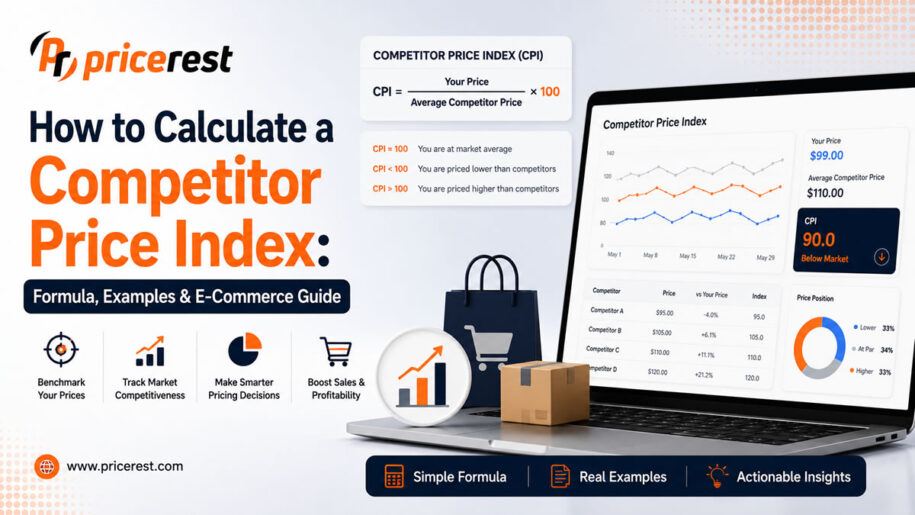
Understanding whether your products are expensive or competitive is difficult when you sell hundreds or thousands of products across a constantly changing market.
Table Of Content
- Price Index Formula
- Competitor Price Index Formula
- How to Interpret a Competitor Price Index
- Competitor Price Index Example
- How to Calculate Price Index Against Multiple Competitors
- Lowest Competitor Price Index
- Which Competitor Price Should You Use?
- Average Price vs Median Price
- How to Calculate Price Index Across Multiple Products
- What Is a Weighted Competitor Price Index?
- Weighted Price Index Example
- Why Weighted Price Index Can Be More Useful
- Category-Level Competitor Price Index
- Brand-Level Competitor Price Index
- Competitor-Level Price Index
- Price Index vs Price Difference: What's the Difference?
- What Is a Good Competitor Price Index?
- Why Competitor Stock Availability Matters
- Should Shipping Costs Be Included in Price Index?
- Why Real-Time Competitor Data Matters
- How Competitor Price Monitoring Improves Price Index Accuracy
- AI Product Matching and Price Index
- How to Use Competitor Price Index in Pricing Strategy
- Price Index and Dynamic Pricing
- Track Price Index Over Time
- Common Competitor Price Index Mistakes
- How PriceRest Helps Automate Competitor Price Analysis
- From Competitor Prices to Pricing Intelligence
- Start Monitoring Your Competitive Pricing Position
- Frequently Asked Questions About Competitor Price Index
Price Index Formula
A competitor may be cheaper on one product but significantly more expensive on another.
Looking at individual prices can therefore provide an incomplete picture.
A Competitor Price Index, also known as a Competitive Price Index, helps ecommerce businesses turn competitor pricing data into a simple metric that shows how their prices compare with the market.
In this guide, we’ll explain:
- What a Competitor Price Index is
- How to calculate a Price Index
- The Competitor Price Index formula
- Practical calculation examples
- How to calculate an index across multiple products
- Weighted vs unweighted Price Index
- How to interpret your Price Index
- How competitor price monitoring improves Price Index accuracy
- How PriceRest can automate competitive pricing analysis
What Is a Competitor Price Index?
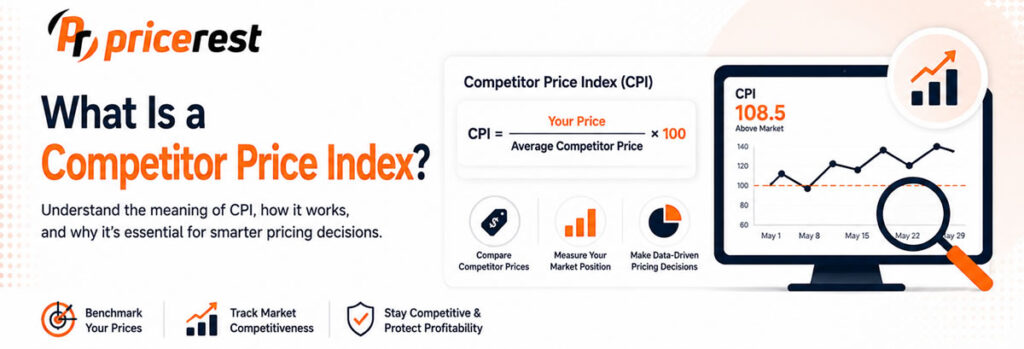
A Competitor Price Index is a pricing metric that compares your product prices with competitor or market prices using an index value.
Instead of simply asking:
“Is my product more expensive than my competitor?”
a Price Index helps answer:
“How expensive or inexpensive are my products compared with the market?”
The benchmark is typically represented by 100.
In a common competitor-index setup:
- 100 = Same price as the competitor
- Below 100 = Your price is lower
- Above 100 = Your price is higher
For example:
If your product costs $90 and your competitor sells the same product for $100, your Price Index would be:
90 ÷ 100 × 100 = 90
Your Price Index is therefore 90.
This means your price is 10% lower than the competitor’s price.

Competitor Price Index Formula
Competitor Price Index Formula
The basic Competitor Price Index formula is:
Example Calculation
This indicates that your price is 20% higher than the competitor’s price.
How to Interpret a Competitor Price Index
The number becomes useful when you understand what it represents.
| Price Index | Meaning |
|---|---|
| 80 | Your price is 20% lower |
| 90 | Your price is 10% lower |
| 95 | Your price is 5% lower |
| 100 | Your price matches the competitor |
| 105 | Your price is 5% higher |
| 110 | Your price is 10% higher |
| 120 | Your price is 20% higher |
This makes Price Index particularly useful for dashboards and large product catalogs.
Instead of reviewing thousands of individual price differences, pricing teams can quickly identify products or categories where their pricing position is changing.
Competitor Price Index Example
Competitor Price Index Example
Imagine you sell a wireless speaker.
Your Price Index is 95. This means your price is 5% lower than Competitor A.
Now suppose Competitor A changes the price from $100 to $90.
Your Price Index is now approximately 105.6.
Approximately 5% cheaper
Approximately 5.6% more expensive
You haven’t changed your price, but your competitive position has changed significantly.
You moved from being approximately 5% cheaper to approximately 5.6% more expensive.
Competitor price movements can change your market position instantly.
How to Calculate Price Index Against Multiple Competitors
How to Calculate Price Index with Multiple Competitors
Real ecommerce markets usually involve more than one competitor. One simple way to measure your competitive position is to calculate the average competitor price first and then compare your own price against it.
Calculate Average Competitor Price
Calculate Your Price Index
A Price Index below 100 means your price is lower than the selected benchmark. In this example, you are positioned slightly below the average market price.
Using the average competitor price gives pricing teams a simple way to understand how their product is positioned relative to the broader market.
Lowest Competitor Price Index
Why the Lowest Competitor Price Can Be a Better Benchmark
Average competitor price isn’t always the most useful benchmark. In highly price-sensitive ecommerce markets, businesses may care more about the lowest available competitor price.
Competitor A represents the lowest available competitor price in this example.
Your Lowest Competitor Price Index is approximately 111.1.
Your price appears cheaper than the average competitor price.
Your price is more expensive than the lowest available competitor.
Although you’re cheaper than the average market price, you’re approximately 11.1% more expensive than the lowest competitor.
The same product price can look highly competitive against the market average but expensive when compared with the lowest available competitor price.

Which Competitor Price Should You Use?
There is no universal benchmark that works for every ecommerce business.
You can compare against:
Lowest Competitor Price
Useful when customers are highly price-sensitive and merchants compete aggressively.
Average Competitor Price
Useful for understanding your general market position.
Median Competitor Price
Useful when extreme high or low prices could distort the average.
Selected Competitor
Useful when you have one major competitor whose pricing strategy matters more than other sellers.
Market Leader
Useful when you want to position your prices relative to a dominant retailer or brand.
Buy Box Price
Potentially useful for marketplace-specific pricing strategies where the current competitive offer matters.
The right benchmark depends on your pricing strategy.
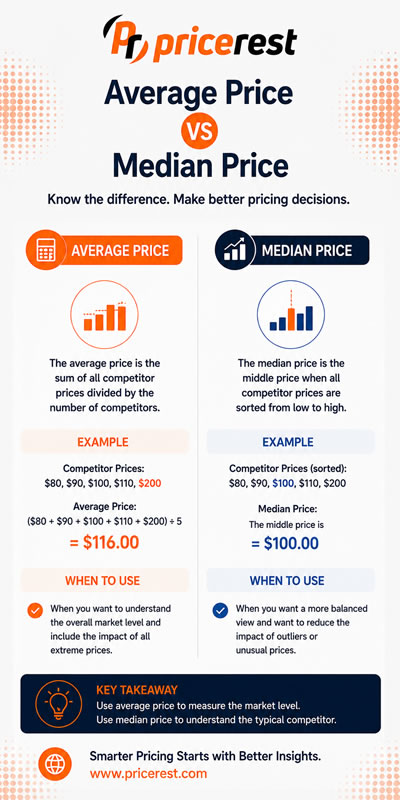
Average Price vs Median Price
Consider these competitor prices:
$90, $95, $100, $105, $300
The average is:
($90 + $95 + $100 + $105 + $300) ÷ 5 = $138
But $138 does not accurately represent where most competitors are positioned.
The median is:
$100
The $300 price is an outlier that significantly increases the average.
This is why median competitor pricing can sometimes provide a more representative benchmark.
How to Calculate Price Index Across Multiple Products
Calculating a Price Index for one product is easy.
The real challenge begins when you’re managing hundreds or thousands of SKUs.
Consider this example:
| Product | Your Price | Market Price | Price Index |
| Product A | $90 | $100 | 90 |
| Product B | $110 | $100 | 110 |
| Product C | $200 | $200 | 100 |
| Product D | $80 | $100 | 80 |
| Product E | $125 | $100 | 125 |
You could calculate a simple average of these indexes:
(90 + 110 + 100 + 80 + 125) ÷ 5 = 101
Overall Price Index:
101
At first glance, your overall pricing appears to be approximately 1% above the benchmark.
However, this calculation has an important limitation.
It treats every product as equally important.
In reality, they may not be.
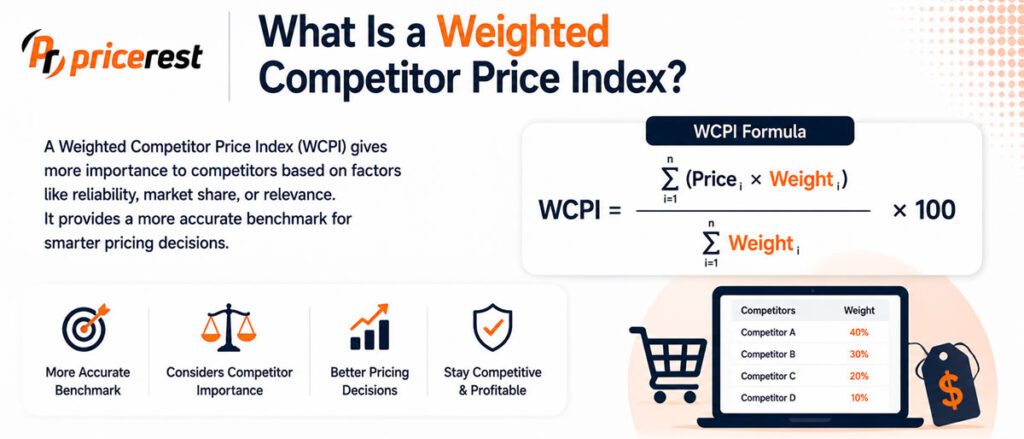
What Is a Weighted Competitor Price Index?
A Weighted Competitor Price Index assigns greater importance to products that matter more to your business.
For example, Product A might generate 40% of your sales while Product E generates only 2%.
Treating both products equally may distort the commercial significance of your pricing position.
Weights can be based on:
- Revenue
- Sales volume
- Units sold
- Product importance
- Traffic
- Strategic importance
- Category contribution
The general formula is:
Weighted Price Index = Σ (Product Price Index × Product Weight)
when the weights add up to 100%.
Weighted Price Index Example
Imagine you have four products:
| Product | Price Index | Revenue Weight |
| A | 90 | 40% |
| B | 105 | 30% |
| C | 110 | 20% |
| D | 120 | 10% |
Calculate:
Product A:
90 × 0.40 = 36
Product B:
105 × 0.30 = 31.5
Product C:
110 × 0.20 = 22
Product D:
120 × 0.10 = 12
Total:
36 + 31.5 + 22 + 12 = 101.5
Weighted Price Index:
101.5
Your strategically weighted product portfolio is therefore approximately 1.5% above the selected competitor benchmark.
Why Weighted Price Index Can Be More Useful
Imagine you sell 1,000 products.
Twenty products generate 60% of your revenue.
The remaining 980 products generate only 40%.
A simple average would treat all 1,000 products equally.
That means a low-volume accessory would have the same influence on your index as your best-selling product.
A weighted Price Index can provide a more commercially meaningful view.
For example, businesses could assign larger weights to:
- Best sellers
- High-revenue products
- High-traffic products
- Key Value Items
- Strategic product categories
This creates a Price Index that better reflects actual business performance.
Category-Level Competitor Price Index
Price Index can also be calculated at category level.
Suppose an electronics retailer has these results:
| Category | Price Index |
| Smartphones | 97 |
| Laptops | 108 |
| TVs | 101 |
| Accessories | 92 |
| Gaming | 104 |
The overall company Price Index may appear close to 100.
But category analysis reveals something much more useful.
The retailer is:
Aggressively priced in accessories
but
Relatively expensive in laptops.
Pricing teams can therefore identify exactly where pricing adjustments may be required.
Brand-Level Competitor Price Index
The same approach can be used for brands.
For example:
| Brand | Price Index |
| Brand A | 96 |
| Brand B | 103 |
| Brand C | 109 |
| Brand D | 99 |
This helps retailers understand whether their pricing position differs across brands.
Competitor-Level Price Index
You can also calculate separate indexes for individual competitors.
Imagine:
Price Index vs Competitor A:
97
Price Index vs Competitor B:
104
Price Index vs Competitor C:
112
This tells you that your products are generally cheaper than Competitor A but increasingly more expensive relative to Competitors B and C.
This level of analysis is useful because not every competitor should be treated equally.
Price Index vs Price Difference: What’s the Difference?
These two metrics answer different questions.
Price Difference
Shows the absolute difference.
Your price:
$120
Competitor:
$100
Price difference:
$20
Percentage Difference
Shows the relative difference.
($120 – $100) ÷ $100 × 100 = 20%
You are 20% more expensive.
Price Index
Normalizes the comparison around 100.
$120 ÷ $100 × 100 = 120
Price Index:
120
Price Index becomes especially useful when comparing large numbers of products, categories, competitors, or markets in dashboards.
What Is a Good Competitor Price Index?
There is no universal “perfect” Price Index.
A Price Index of 100 is not automatically the best strategy.
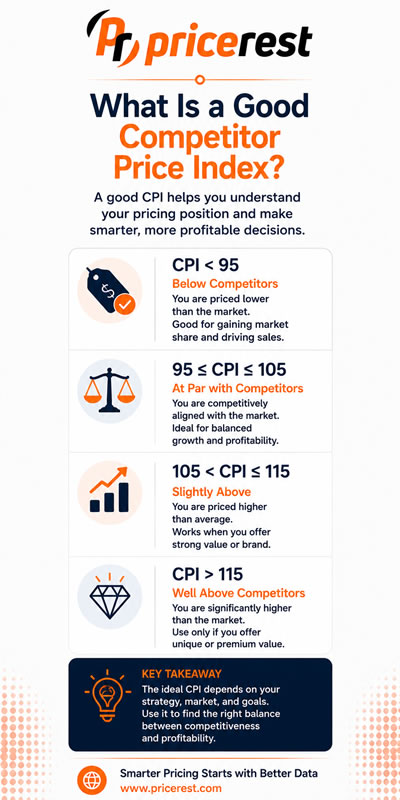
Your ideal target depends on factors such as:
- Brand positioning
- Profit margin
- Customer price sensitivity
- Product availability
- Competitor stock
- Shipping costs
- Demand
- Product lifecycle
- Marketplace competition
- Business objectives
A premium retailer may intentionally maintain an index above 100.
A discount retailer may target below 100.
For example:
Discount Strategy
Target Index: 95
The retailer aims to remain approximately 5% cheaper than the benchmark.
Market Matching Strategy
Target Index: 100
The retailer aims to match the market.
Premium Strategy
Target Index: 105–110
The retailer intentionally maintains higher prices because of service, brand strength, availability, delivery speed, or other advantages.
Price Index should therefore support your pricing strategy — not replace it.
Why Competitor Stock Availability Matters
Suppose:
Your Price: $100
Competitor A: $90 — Out of Stock
Competitor B: $105 — In Stock
If you blindly use the lowest competitor price, your benchmark becomes $90.
Your Price Index:
111.1
This makes you appear expensive.
But customers cannot actually purchase the $90 product.
If you compare only against in-stock competitors, your relevant benchmark may instead be $105.
New Price Index:
95.2
Suddenly your competitive position looks completely different.
This is why sophisticated competitor pricing analysis should consider stock availability alongside price.
Should Shipping Costs Be Included in Price Index?
It depends on how customers experience the final price.
Suppose:
Your Product Price: $100
Shipping: Free
Competitor Product Price: $95
Shipping: $10
Looking only at product prices suggests the competitor is cheaper.
But the effective customer cost is:
Your offer:
$100
Competitor offer:
$105
Using effective price:
$100 ÷ $105 × 100 = 95.2
You are actually approximately 4.8% cheaper.
For markets where shipping costs significantly affect purchase decisions, businesses may benefit from comparing effective prices rather than displayed product prices alone.
Why Real-Time Competitor Data Matters
A Price Index is only as accurate as the data behind it.
Imagine your dashboard says:
Price Index = 98
But your competitor changed its prices six hours ago.
Your real market position may already be completely different.
Competitor prices can change because of:
- Promotions
- Dynamic pricing
- Inventory changes
- Demand
- Marketplace competition
- Seasonal campaigns
- Competitor repricing
- Flash sales
This means manually calculated Price Index reports can quickly become outdated.
Automated competitor price monitoring helps keep the underlying pricing data current.
How Competitor Price Monitoring Improves Price Index Accuracy
Price Index calculation itself is simple.
Getting accurate competitor data at scale is the difficult part.
A reliable process requires businesses to:
1. Identify competitors
2. Find matching products
3. Collect competitor prices
4. Track stock availability
5. Update prices regularly
6. Detect price changes
7. Calculate indexes
8. Analyze trends
Doing this manually for thousands of products can become extremely time-consuming.
This is where competitor price monitoring software becomes valuable.
AI Product Matching and Price Index
Incorrect product matching can make Price Index calculations meaningless.
Imagine comparing:
128 GB smartphone
against
256 GB smartphone
or:
Single product
against
Three-pack bundle
The products may look similar but are not directly comparable.
Accurate product matching is therefore essential.
AI-powered matching systems can analyze signals such as:
- Product title
- Brand
- Model
- UPC
- EAN
- GTIN
- SKU
- Product attributes
- Image similarity
- Price similarity
This helps businesses create cleaner competitor datasets before calculating pricing metrics.
How to Use Competitor Price Index in Pricing Strategy
Price Index becomes much more valuable when it is connected to pricing decisions.
For example, a retailer could establish pricing rules such as:
Strategy 1: Match the Market
Target Price Index:
100
Strategy 2: Stay Slightly Below the Market
Target Price Index:
98
Strategy 3: Maintain Premium Positioning
Target Price Index:
105
Strategy 4: Follow the Lowest In-Stock Competitor
Target:
Lowest In-Stock Competitor × 0.99
Strategy 5: Protect Profit Margin
Stay competitive but never price below the minimum profitable price.
This final rule is particularly important.
Being the cheapest retailer is not always the most profitable strategy.

Price Index and Dynamic Pricing
Using Competitor Price Index for Dynamic Pricing
Competitor Price Index can also become an input for dynamic pricing. Instead of using Price Index only as a reporting metric, businesses can use it to calculate target prices automatically.
This means your target price should stay approximately 2% below the market benchmark.
Market Benchmark Increases
Market Benchmark Decreases
Price Changes Can Be Automated
Dynamic pricing software can potentially automate these adjustments while respecting additional pricing constraints.
By combining competitor benchmarks, target Price Index values and pricing rules, businesses can create more responsive and automated pricing strategies.
Track Price Index Over Time
Track How Your Competitive Position Changes Over Time
One Price Index snapshot tells you where you are today. Historical Price Index tells you how your competitive position is changing.
Becoming More Price Competitive
The trend indicates that your pricing is becoming increasingly aggressive relative to the benchmark.
Becoming More Expensive Relative to the Market
This could indicate that the retailer is gradually becoming more expensive relative to the market.
Price position is moving below the benchmark.
Price position is moving above the benchmark.
Historical Price Index analysis helps pricing teams identify gradual shifts in competitive positioning that may not be visible from a single point-in-time comparison.
Common Competitor Price Index Mistakes
Comparing the Wrong Products
Product matching errors create inaccurate benchmarks.
Using Out-of-Stock Competitors
An unavailable offer may not represent meaningful competition.
Using Only the Lowest Price
The cheapest seller may be an outlier or strategically irrelevant competitor.
Ignoring Shipping Costs
Displayed product prices may not represent the customer’s final cost.
Treating Every Product Equally
High-value and high-volume products may deserve greater weighting.
Using Outdated Competitor Data
A perfect formula cannot compensate for stale pricing data.
Trying to Maintain an Index of 100 Everywhere
Different products and categories may require different pricing strategies.
How PriceRest Helps Automate Competitor Price Analysis
PriceRest helps ecommerce businesses automate the data collection required for competitive pricing analysis.
Instead of manually checking competitor websites and updating spreadsheets, businesses can continuously monitor competitor pricing and availability across online sales channels.
PriceRest can support competitive pricing workflows with:
- Automated competitor price monitoring
- AI-powered product matching
- Image similarity matching
- Product-code matching
- Automatic competitor discovery
- Google Shopping monitoring
- Marketplace monitoring
- Stock availability monitoring
- Historical price tracking
- Price change alerts
- Dynamic pricing
- API integrations
This allows pricing teams to spend less time collecting data and more time understanding what that data means.
From Competitor Prices to Pricing Intelligence
Competitor Price Index is ultimately more than a formula.
The formula:
(Your Price ÷ Competitor Price) × 100
takes only seconds to calculate.
The real challenge is maintaining accurate competitive data across thousands of products, sellers, marketplaces, and websites.
When competitor price monitoring, product matching, stock information, historical data, and pricing automation work together, Price Index becomes part of a broader pricing intelligence strategy.
Instead of asking:
“What does my competitor charge?”
businesses can start asking better questions:
“Where are we positioned in the market?”
“Which categories are becoming less competitive?”
“Which competitors are changing prices most aggressively?”
“Which products should we reprice?”
“Can we increase prices without losing competitiveness?”
Those are the questions that turn competitor pricing data into actionable business intelligence.
Start Monitoring Your Competitive Pricing Position
Calculating a Competitor Price Index is easy.
Maintaining accurate competitor pricing data across thousands of products is the difficult part.
PriceRest helps ecommerce businesses automate competitor price monitoring, product matching, stock tracking, historical pricing analysis, and dynamic pricing.
Instead of manually checking competitor prices, you can continuously understand how your products are positioned across the market.
Better competitor data leads to better pricing decisions.
Start your free trial with PriceRest and turn competitor prices into actionable pricing intelligence.
Frequently Asked Questions About Competitor Price Index
What is a Competitor Price Index?
A Competitor Price Index is a metric used to compare your product prices with competitor or market prices. A benchmark value of 100 commonly represents equal pricing, while values above or below 100 indicate relative price differences.
How do you calculate Competitor Price Index?
A common formula is:
Competitor Price Index = (Your Price ÷ Competitor Price) × 100
For example, if your product costs $90 and your competitor charges $100:
90 ÷ 100 × 100 = 90
Your Price Index is 90.
What does a Price Index of 100 mean?
A Price Index of 100 means your price equals the competitor or benchmark price used in the calculation.
What does a Price Index below 100 mean?
Using the formula in this guide, a Price Index below 100 means your price is lower than the benchmark.
For example, an index of 95 means your price is approximately 5% lower.
What does a Price Index above 100 mean?
A Price Index above 100 means your price is higher than the selected benchmark.
An index of 110 means your price is approximately 10% higher.
Should I compare my price with the lowest or average competitor price?
It depends on your pricing strategy. Lowest-price benchmarks can be useful in highly competitive markets, while average or median prices may provide a better representation of the overall market.
What is a weighted Price Index?
A weighted Price Index gives more importance to selected products based on factors such as revenue, sales volume, traffic, or strategic importance.
Is a Price Index of 100 always good?
No. The ideal Price Index depends on your positioning and pricing strategy. Discount retailers may intentionally operate below 100, while premium retailers may operate above 100.
Can Price Index be used for dynamic pricing?
Yes. Businesses can use competitive benchmarks and target Price Index values as inputs for dynamic pricing rules, while also considering minimum margins, stock availability, and other pricing constraints.
Why is competitor monitoring important for Price Index?
Price Index calculations depend on accurate competitor prices. Automated competitor monitoring helps keep pricing, availability, and historical data updated, making competitive pricing analysis more reliable.
Request a personalized demo of PriceRest
We look forward to showing you how our platform allows you to optimize the pricing, execution, and measurement initiatives that matter most to your brand and products.
It is Free!
What can I expect?
- A brief conversation to assess what PriceRest can do to help your pricing strategy
- Live product demo with insight into how to get the most benefit from PriceRest
- Discuss your prices KPIs to determine the best path forward for your business
- No commitment required