
Table Of Content
- Introduction
- Why Pricing Strategy Matters
- What Is a Pricing Strategy?
- Factors That Determine the Ideal Product Price
- The Most Common Pricing Strategies
- How Competitor Price Monitoring Improves Pricing Strategy
- Why AI Is Changing Pricing Strategy
- Dynamic Pricing vs Static Pricing
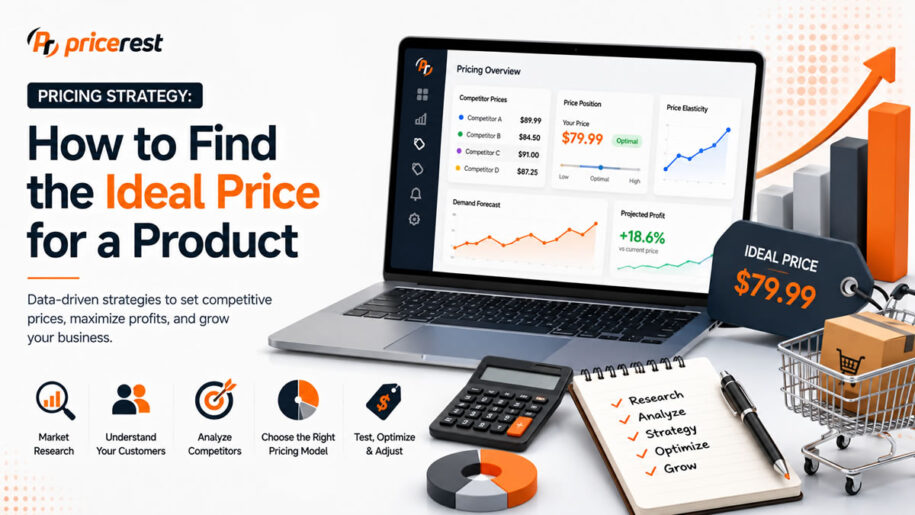
- How to Find the Ideal Price for a Product
- Common Pricing Mistakes
- Pricing Strategy for Ecommerce Businesses
- How PriceRest Helps Businesses Optimize Pricing
- Best Practices for Long-Term Pricing Success
- Final Verdict
- Frequently Asked Questions
Introduction
Pricing is one of the most important decisions any business makes. Set your prices too high, and you may lose customers to competitors. Price your products too low, and you risk shrinking your profit margins or damaging your brand’s perceived value.
The ideal product price is rarely determined by cost alone. Successful businesses consider production costs, competitor pricing, customer demand, market conditions, brand positioning, and long-term business goals before deciding how much to charge.
Modern pricing strategies are increasingly supported by AI-powered pricing intelligence tools that analyze competitors, monitor market changes, and recommend optimal prices in real time.
In this guide, you’ll learn how to develop an effective pricing strategy, understand the most common pricing models, and discover how ecommerce businesses use competitor price monitoring and dynamic pricing to maximize both sales and profitability.
Why Pricing Strategy Matters
A well-designed pricing strategy influences much more than revenue. It affects customer perception, competitive positioning, profit margins, inventory turnover, and long-term business growth.
An effective pricing strategy helps businesses:
- Maximize profit margins
- Increase conversion rates
- Stay competitive
- Improve customer trust
- Protect brand positioning
- Respond quickly to market changes
- Reduce unnecessary discounting
- Increase long-term profitability
What Is a Pricing Strategy?
A pricing strategy is a structured approach used to determine how much a company charges for its products or services. Rather than selecting a price arbitrarily, businesses evaluate internal costs, customer demand, market conditions, competitor pricing, and business objectives to identify the most effective price point.
The right pricing strategy should balance competitiveness with profitability while supporting long-term growth.
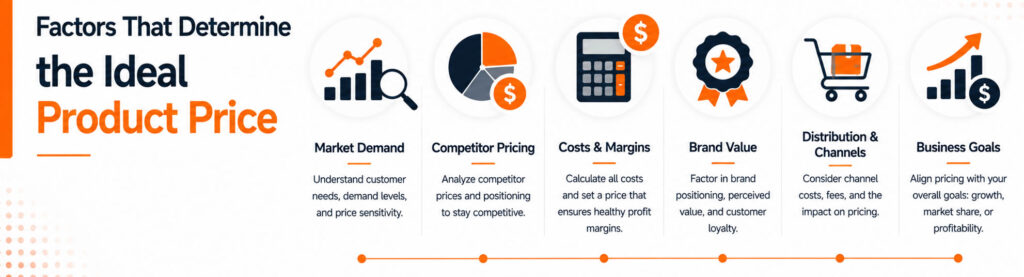
Factors That Determine the Ideal Product Price
Cost of Goods Sold (COGS)
Every pricing strategy starts with understanding product costs. This includes manufacturing costs, shipping, packaging, marketing, marketplace fees, payment processing, and operational expenses. Your selling price must cover these costs while generating sustainable profit.
Competitor Pricing
Customers compare prices across multiple websites before purchasing. Monitoring competitor prices helps businesses understand current market positioning and avoid pricing products significantly above or below the market average.
AI-powered competitor monitoring software automates this process by tracking prices across ecommerce websites, marketplaces, and Google Shopping.
Customer Perceived Value
Customers don’t buy products based solely on price—they buy based on perceived value. Strong branding, superior customer service, faster shipping, warranties, and unique product features can justify higher prices than competitors.
Supply and Demand
Demand fluctuations should influence pricing decisions. Products experiencing high demand and limited supply often support premium pricing, while excess inventory may require more competitive pricing strategies.
Brand Positioning
Luxury brands intentionally maintain premium pricing to reinforce exclusivity, while discount retailers compete primarily on affordability. Your pricing strategy should align with your brand identity and target audience.
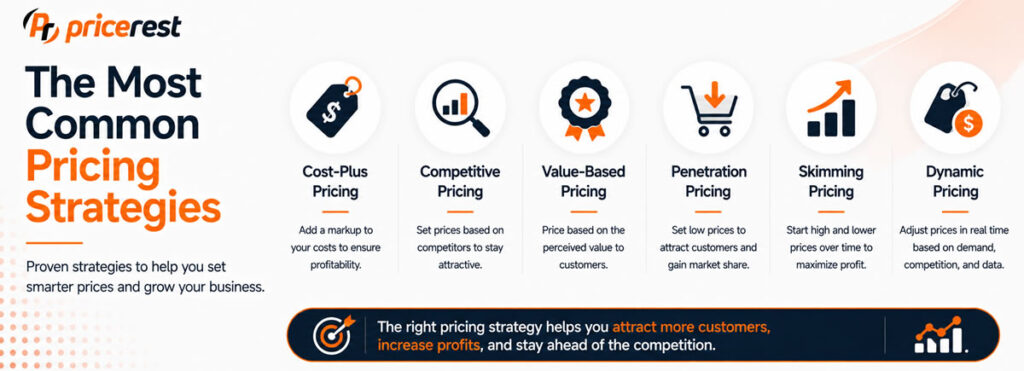
The Most Common Pricing Strategies
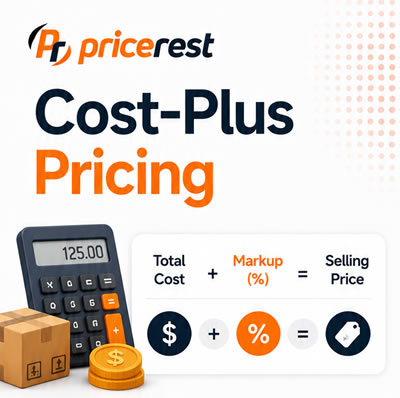
Cost-Plus Pricing
Cost-plus pricing calculates the selling price by adding a fixed markup percentage to the product’s total cost.
Advantages
- Simple to calculate
- Predictable profit margins
- Easy implementation
Disadvantages
- Ignores competitor pricing
- Doesn’t consider customer demand
- May reduce competitiveness
Competitive Pricing
Competitive pricing sets prices based on competitor prices rather than internal costs alone.
Businesses may choose to:
- Match competitor prices
- Price slightly below competitors
- Maintain premium pricing
- Differentiate through added value
Competitive pricing is particularly effective in ecommerce, where customers can compare prices instantly.
Value-Based Pricing
Value-based pricing focuses on the perceived value customers receive rather than production costs. Premium brands frequently use this strategy to maximize profitability while strengthening brand positioning.
Penetration Pricing
Businesses entering competitive markets often launch products at lower prices to gain market share quickly. Prices may increase later as brand awareness and customer loyalty grow.
Premium Pricing
Premium pricing intentionally positions products above competitors to communicate quality, exclusivity, or innovation.
Dynamic Pricing
Dynamic pricing automatically adjusts prices based on competitor activity, demand, inventory levels, customer behavior, and market conditions. Ecommerce businesses increasingly rely on AI-powered dynamic pricing software to automate these decisions.
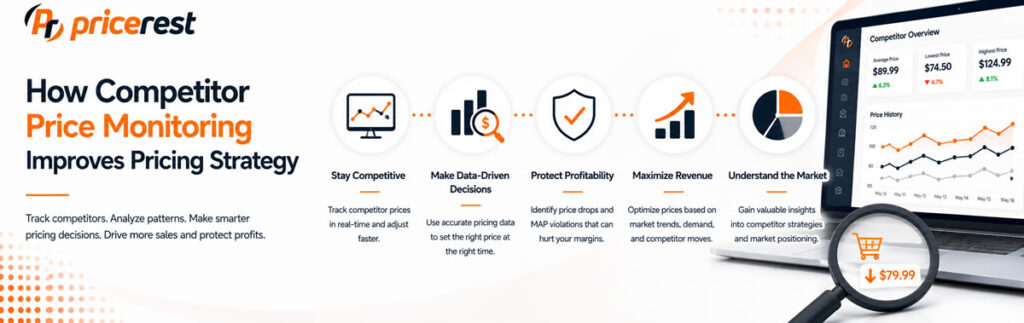
How Competitor Price Monitoring Improves Pricing Strategy
Monitoring competitor prices is one of the most effective ways to improve pricing decisions.
Businesses gain insights into:
- Competitor pricing trends
- Discount frequency
- Promotional campaigns
- Product availability
- Stock shortages
- Market positioning
- Seasonal pricing behavior
Instead of relying on assumptions, pricing teams make decisions using real market data.
Why AI Is Changing Pricing Strategy
Artificial intelligence enables businesses to process millions of pricing data points automatically.
Modern AI pricing platforms can:
- Match competitor products
- Detect price changes
- Recommend pricing adjustments
- Forecast pricing trends
- Monitor marketplaces
- Analyze customer demand
- Automate repricing
AI allows businesses to react faster while reducing manual pricing work.
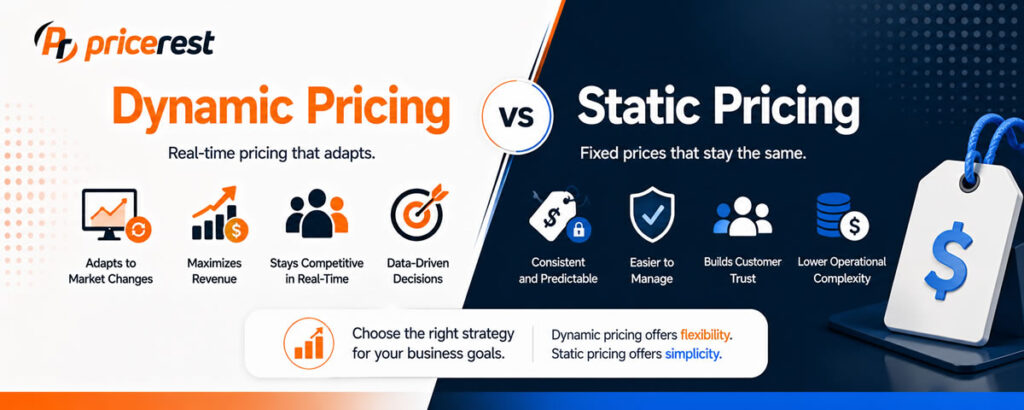
Dynamic Pricing vs Static Pricing
| Dynamic Pricing | Static Pricing |
|---|---|
| Automatically updates prices | Fixed prices |
| Responds to market changes | Manual updates |
| Competitor-aware | Limited flexibility |
| Improves competitiveness | Slower reactions |
| Supports automation | Requires manual work |
How to Find the Ideal Price for a Product
Finding the optimal price requires balancing profitability with competitiveness.
A practical pricing process includes:
Step 1
Calculate your total costs.
Step 2
Determine your target profit margin.
Step 3
Research competitor prices.
Step 4
Understand customer willingness to pay.
Step 5
Monitor market demand.
Step 6
Test different pricing strategies.
Step 7
Continuously optimize pricing using real-time market data.
Pricing should be treated as an ongoing process rather than a one-time decision.
Common Pricing Mistakes
Many businesses unintentionally reduce profitability through ineffective pricing practices.
Common mistakes include:
- Pricing based only on costs
- Ignoring competitors
- Excessive discounting
- Never reviewing prices
- Manual competitor research
- Ignoring customer perception
- Failing to monitor marketplaces
- Not using pricing automation
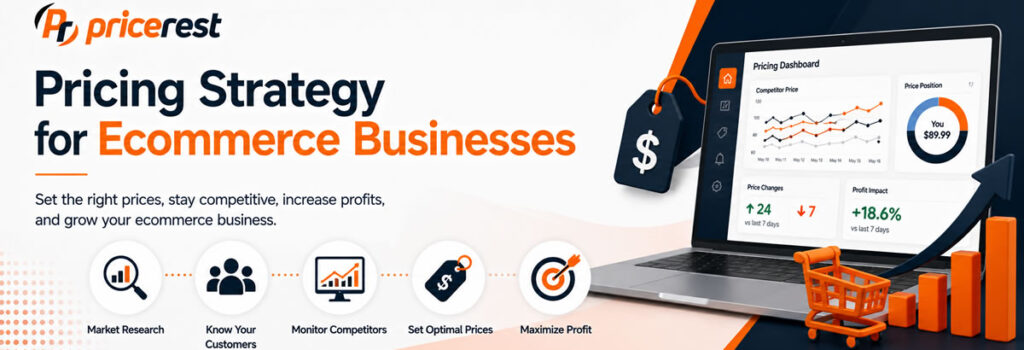
Pricing Strategy for Ecommerce Businesses
Ecommerce businesses operate in highly competitive environments where prices change constantly.
Successful ecommerce pricing strategies typically include:
- Competitor price monitoring
- Dynamic pricing
- Marketplace monitoring
- Google Shopping monitoring
- Stock availability analysis
- Historical pricing analytics
- AI-powered product matching
These technologies help businesses maintain competitive pricing without sacrificing profitability.
How PriceRest Helps Businesses Optimize Pricing

PriceRest combines competitor price monitoring, AI-powered product matching, dynamic pricing, marketplace monitoring, Google Shopping monitoring, historical analytics, and competitor discovery into one pricing intelligence platform.
Businesses can:
- Monitor competitor prices automatically.
- Analyze pricing trends.
- Discover new competitors.
- Track marketplace pricing.
- Receive instant price alerts.
- Protect profit margins.
- Automate pricing decisions.
By replacing manual pricing research with real-time market intelligence, PriceRest enables businesses to make faster and more profitable pricing decisions.
Best Practices for Long-Term Pricing Success
An effective pricing strategy should evolve alongside your business and the market. Consider these best practices:
- Monitor competitors continuously.
- Review pricing performance regularly.
- Use AI-powered pricing intelligence.
- Track historical pricing trends.
- Test different pricing models.
- Protect minimum profit margins.
- Automate repetitive pricing tasks.
- Combine pricing data with inventory analysis.

Final Verdict
There is no universal “perfect price” for every product. The ideal price is one that balances customer value, competitive positioning, profitability, and long-term business goals.
Businesses that rely on real-time pricing intelligence rather than intuition are better positioned to respond to market changes, protect margins, and increase revenue. By combining competitor price monitoring, dynamic pricing, AI-powered product matching, and historical analytics, companies can continuously refine their pricing strategy instead of treating pricing as a one-time decision.
In today’s competitive ecommerce environment, the most successful pricing strategies are built on accurate market data—and platforms like PriceRest provide the insights and automation needed to make those decisions with confidence.

Frequently Asked Questions
What is the best pricing strategy?
The best pricing strategy depends on your business goals, industry, and customers. Many ecommerce businesses combine competitive pricing, value-based pricing, and dynamic pricing to remain competitive while maximizing profitability.
How do I determine the ideal price for a product?
Calculate your costs, analyze competitor prices, understand customer demand, evaluate perceived value, and continuously optimize pricing using real-time market intelligence.
Why is competitor price monitoring important?
Competitor monitoring helps businesses understand market pricing, respond to competitor price changes, identify pricing opportunities, and improve profitability through better pricing decisions.
What is dynamic pricing?
Dynamic pricing automatically adjusts product prices based on market conditions, competitor activity, inventory levels, demand, and predefined pricing rules.
How can AI improve pricing strategy?
AI automates competitor monitoring, product matching, pricing analysis, demand forecasting, and pricing recommendations. This allows businesses to react faster to market changes while reducing manual work.
Request a personalized demo of PriceRest
We look forward to showing you how our platform allows you to optimize the pricing, execution, and measurement initiatives that matter most to your brand and products.
It is Free!
What can I expect?
- A brief conversation to assess what PriceRest can do to help your pricing strategy
- Live product demo with insight into how to get the most benefit from PriceRest
- Discuss your prices KPIs to determine the best path forward for your business
- No commitment required