
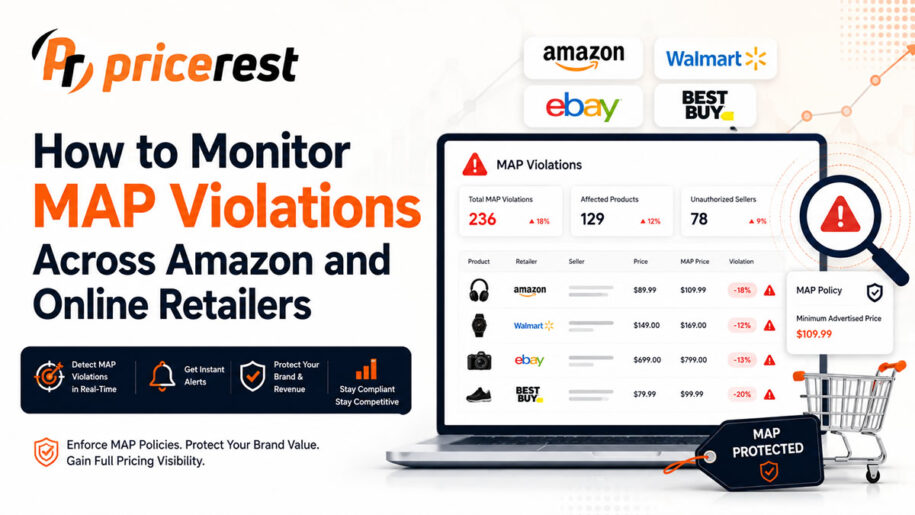
Minimum Advertised Price (MAP) violations can quickly become a serious problem for brands, manufacturers, and distributors selling through multiple online channels.
A single unauthorized price drop on Amazon can trigger a chain reaction. Other sellers may respond by lowering their prices, retailers can begin competing aggressively, profit margins can shrink, and the perceived value of the brand may suffer.
The challenge becomes even greater when your products are sold across Amazon, marketplaces, Google Shopping, and hundreds of independent online retailers.
Manually checking every product and seller is simply not scalable.
This is where automated MAP monitoring software becomes essential.
In this guide, we explain what MAP violations are, how to monitor MAP violations across Amazon and online retailers, how automated MAP monitoring works, and how brands can build a more effective MAP compliance strategy.
Table Of Content
- What Is a MAP Violation?
- What Is MAP Monitoring?
- Why MAP Violations Are Difficult to Monitor Manually
- How to Monitor MAP Violations Across Amazon and Online Retailers
- How to Monitor MAP Violations on Amazon
- Monitor MAP Violations Across Independent Online Retailers
- Use Google Shopping to Discover MAP Violations
- Detect Unauthorized Sellers Alongside MAP Violations
- How Automated MAP Monitoring Software Works
- Why AI Product Matching Matters for MAP Monitoring
- Set Automatic MAP Violation Alerts
- Track Historical MAP Violations
- Identify Repeat MAP Violators
- Monitor Stock Availability Alongside Price
- MAP Monitoring vs Price Monitoring
- MAP Monitoring vs MSRP Monitoring
- How Often Should You Monitor MAP Prices?
- What Features Should MAP Monitoring Software Have?
- Common MAP Monitoring Mistakes
- How PriceRest Helps Monitor MAP Violations
- Build a Scalable MAP Monitoring Strategy
- Start Monitoring MAP Violations Automatically
- Frequently Asked Questions About MAP Monitoring
What Is a MAP Violation?
A MAP violation occurs when a retailer or seller publicly advertises a product below the Minimum Advertised Price established by a brand or manufacturer.
For example, imagine a manufacturer establishes a MAP price of $199 for a product.
If an online retailer advertises that product for $179, the advertised price is below the established MAP threshold.
This may be identified as a MAP violation depending on the brand’s MAP policy and applicable laws.
MAP policies are commonly used by brands and manufacturers to help maintain consistent advertised pricing across their reseller networks.
They can also help businesses:
- Maintain consistent advertised prices
- Protect brand positioning
- Reduce destructive price competition
- Support authorized retailers
- Identify problematic reseller behavior
- Monitor marketplace pricing
- Maintain visibility across distribution networks
However, having a MAP policy is only the first step.
Brands must also continuously monitor the market to identify potential violations.
What Is MAP Monitoring?
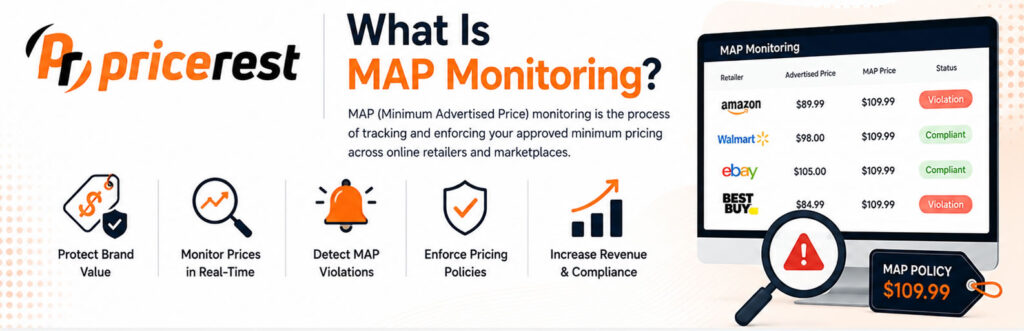
MAP monitoring is the process of tracking advertised product prices across marketplaces and online retailers to identify prices that fall below predefined Minimum Advertised Price thresholds.
Instead of manually visiting hundreds of product pages, businesses can use automated MAP monitoring software to continuously collect and analyze pricing information.
A MAP monitoring system can typically track:
- Product prices
- MAP thresholds
- Retailer names
- Marketplace sellers
- Price changes
- Violation timestamps
- Stock availability
- Historical pricing
- Repeated violations
When the monitored price falls below the MAP threshold, the system can flag the product and generate an alert.
This allows brands to discover pricing problems much faster.
Why MAP Violations Are Difficult to Monitor Manually
Monitoring MAP compliance may sound simple when a company works with five retailers and sells ten products.
The situation changes dramatically when a brand has hundreds or thousands of SKUs distributed across multiple sales channels.
A brand may need to monitor:
- Amazon
- Walmart
- eBay
- Google Shopping
- Marketplace sellers
- Authorized retailers
- Independent ecommerce stores
- Regional marketplaces
- Distributor websites
A single product could appear on dozens or even hundreds of different pages.
For example:
1,000 products × 30 sellers = 30,000 potential product listings
Checking these listings manually every day would require an enormous amount of time.
More importantly, prices can change multiple times during the day.
A seller could violate MAP for only several hours and return to the correct price before your team manually checks the page.
Automated monitoring solves this visibility problem.
How to Monitor MAP Violations Across Amazon and Online Retailers
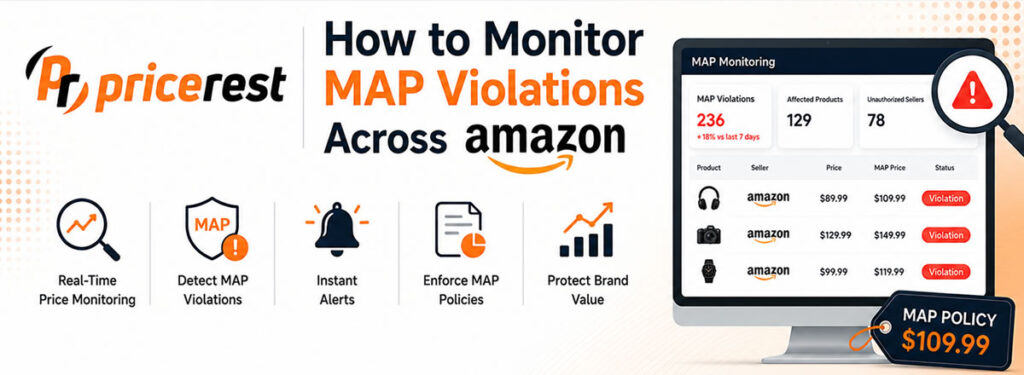
An effective MAP monitoring strategy can be divided into several steps.
Step 1: Define Your MAP Prices
The first step is establishing the MAP threshold for every product you want to monitor.
Your monitoring database should ideally include:
- Product name
- SKU
- UPC
- EAN
- GTIN
- Manufacturer Part Number
- MAP price
- MSRP
- Product URL
Maintaining accurate product identifiers becomes especially important when monitoring large catalogs.
They help monitoring systems identify the same product across different retailers.
Step 2: Identify Your Authorized Retailers
Create a list of sellers and retailers that are authorized to sell your products.
This can include:
- Direct retail partners
- Distributors
- Marketplace sellers
- Ecommerce stores
- Regional retailers
Maintaining an authorized seller database makes it easier to understand who is selling your products and whether unexpected sellers have entered the market.
This information can also support unauthorized seller detection.
Step 3: Discover Where Your Products Are Being Sold
Knowing your existing retailers is not always enough.
Products can appear on websites or marketplaces that your team has never manually identified.
Brands therefore need mechanisms for discovering additional product listings.
Modern price monitoring systems can use several discovery methods.
Google Search Monitoring
Product identifiers, names, and other attributes can be searched through Google to discover retailer pages selling the product.
Google Shopping Monitoring
Google Shopping can reveal additional merchants advertising the same products.
This can help brands expand their monitoring coverage beyond a predefined retailer list.
Marketplace Monitoring
Products can also be discovered across marketplaces such as Amazon and other ecommerce platforms.
Retailer Website Scanning
Individual retailer websites can be scanned to locate products matching your catalog.
These discovery methods allow brands to continuously expand their visibility across the market.
How to Monitor MAP Violations on Amazon
Amazon presents a particularly challenging environment for MAP monitoring because multiple sellers may compete on the same product listing.
Brands therefore need to monitor more than the visible product price.
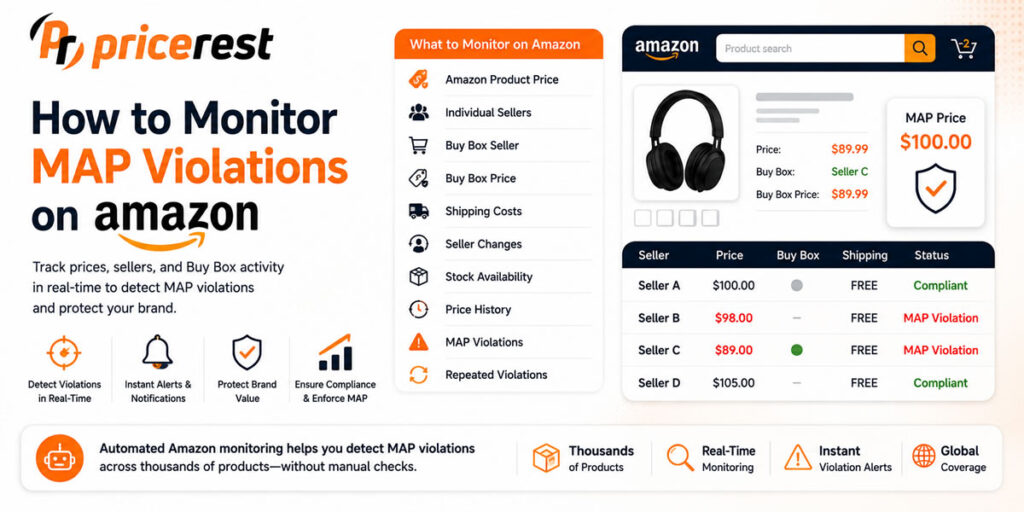
Effective Amazon MAP monitoring may include tracking:
- Amazon product price
- Individual sellers
- Buy Box seller
- Buy Box price
- Shipping costs
- Seller changes
- Stock availability
- Price history
- MAP violations
- Repeated violations
For example, suppose your MAP price is $100.
Seller A: $100
Seller B: $98
Seller C: $89
Seller D: $105
Seller B and Seller C may require investigation because their advertised prices fall below the established threshold.
Automated Amazon monitoring makes it possible to detect these situations across thousands of products without manually checking individual Amazon pages.
Monitor MAP Violations Across Independent Online Retailers
MAP violations do not only happen on marketplaces.
Independent ecommerce websites can also advertise products below MAP.
Brands may need to monitor:
- Large ecommerce retailers
- Specialty retailers
- Distributor websites
- Regional ecommerce stores
- Niche online shops
- Dealer websites
This is why website-level price monitoring is important.
A monitoring platform can regularly visit relevant product pages, collect the advertised price, and compare it against your MAP threshold.
If:
Advertised Price < MAP Price
the system can flag the listing as a potential violation.
Use Google Shopping to Discover MAP Violations
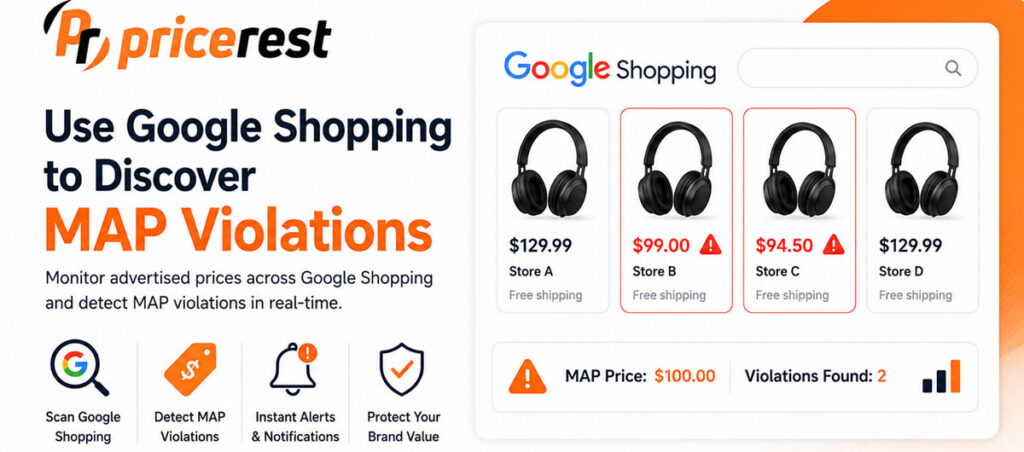
Google Shopping can be particularly valuable for MAP monitoring because it aggregates product offers from many merchants.
Searching for a product may reveal dozens of stores advertising the same item.
This creates another opportunity for brands to discover:
- Unknown retailers
- Unexpected price discounts
- New product listings
- Potential unauthorized sellers
- MAP violations
Combining Google Shopping monitoring with direct website monitoring can significantly expand market coverage.
Detect Unauthorized Sellers Alongside MAP Violations
MAP violations and unauthorized sellers are often closely related problems.
A brand may discover a seller advertising below MAP and realize that the seller is not part of its authorized distribution network.
This creates two important questions:
Is this seller violating our MAP policy?
and
Is this seller authorized to sell our products at all?
Combining MAP monitoring with unauthorized seller detection provides brands with a broader view of their online distribution network.
Instead of simply identifying low prices, businesses can investigate who is responsible for them.
How Automated MAP Monitoring Software Works
Modern MAP monitoring software automates much of the process.
A typical workflow looks like this:
1. Upload Products
Import your product catalog, including product identifiers and MAP prices.
↓
2. Add Known Competitors and Retailers
Define websites, marketplaces, sellers, or product URLs that should be monitored.
↓
3. Discover Additional Product Listings
Use product searching and matching technology to identify additional sellers and retailer pages.
↓
4. Collect Pricing Data
The system scans monitored sources according to the configured frequency.
↓
5. Compare Prices Against MAP
Collected prices are automatically compared with your MAP thresholds.
↓
6. Detect Violations
Listings below MAP are identified.
↓
7. Generate Alerts
Relevant teams can receive notifications when violations occur.
↓
8. Store Historical Data
Historical records allow brands to analyze recurring violations and pricing behavior.
The result is a continuous MAP monitoring process that requires significantly less manual work.
Why AI Product Matching Matters for MAP Monitoring
One of the biggest challenges in large-scale MAP monitoring is determining whether two listings actually represent the same product.
Retailers frequently use different:
- Product titles
- Descriptions
- Images
- Categories
- Product codes
- Naming structures
For example, the same product could appear under several slightly different titles.
Traditional matching methods may struggle with these variations.
AI-powered product matching can analyze multiple signals such as:
- Product title similarity
- Product code
- UPC/EAN/GTIN
- Brand
- Model
- Product attributes
- Image similarity
- Price differences
These signals can be combined to generate a product matching confidence score.
This helps automate product discovery and reduces the amount of manual matching required.

Set Automatic MAP Violation Alerts
Finding a violation several weeks later provides much less value than detecting it shortly after it occurs.
This is why alerts are an important part of MAP monitoring.
Businesses can configure alerts when:
- A product drops below MAP
- A new seller violates MAP
- A specific retailer changes its price
- A previously compliant seller violates MAP again
- A new seller appears
- A major price decrease occurs
These notifications allow teams to investigate violations much faster.
Track Historical MAP Violations
Current prices only show what is happening now.
Historical data shows how seller behavior changes over time.
A historical MAP monitoring system can help answer questions such as:
- When did the violation start?
- How long did the violation continue?
- How often has this seller violated MAP?
- What was the lowest advertised price?
- Which products are violated most frequently?
- Which sellers repeatedly advertise below MAP?
- How quickly did prices return to MAP?
This information can help brands distinguish isolated incidents from recurring pricing patterns.
Identify Repeat MAP Violators
Not every violation has the same significance.
One retailer may briefly advertise a product below MAP because of an incorrect promotion.
Another seller may repeatedly advertise dozens of products below MAP.
Historical monitoring makes these patterns easier to identify.
Brands can analyze:
Violation Frequency
How many times has the seller violated MAP?
Violation Duration
How long did each violation continue?
Violation Depth
How far below MAP was the advertised price?
Products Affected
How many products were involved?
This allows teams to prioritize the most significant cases instead of treating every violation equally.
Monitor Stock Availability Alongside Price
Price alone does not always provide enough context.
Suppose several retailers sell the same product:
Retailer A — $99 — In Stock
Retailer B — $110 — In Stock
Retailer C — $85 — Out of Stock
If your MAP price is $100, Retailer A represents a potential violation.
Retailer C also displays a low price, but the product is currently unavailable.
Tracking price and stock availability together gives brands more context when reviewing pricing activity.
MAP Monitoring vs Price Monitoring
MAP monitoring and competitor price monitoring use similar data but serve different purposes.
| Feature | MAP Monitoring | Competitor Price Monitoring |
|---|---|---|
| Track retailer prices | Yes | Yes |
| Compare against MAP | Yes | Not necessarily |
| Identify MAP violations | Yes | No |
| Analyze competitors | Sometimes | Yes |
| Historical pricing | Yes | Yes |
| Dynamic pricing | Usually separate | Often integrated |
| Seller monitoring | Important | Optional |
| Brand protection focus | High | Lower |
MAP monitoring focuses primarily on advertised-price compliance, while competitor price monitoring focuses on understanding market pricing and competitive positioning.
Many businesses benefit from combining both.
MAP Monitoring vs MSRP Monitoring
MAP and MSRP are sometimes confused, but they serve different purposes.
MAP (Minimum Advertised Price) represents a minimum advertised-price threshold established under a brand’s policy.
MSRP (Manufacturer’s Suggested Retail Price) represents the price a manufacturer recommends retailers charge.
MSRP is therefore a suggested retail price, while MAP policies focus on advertised pricing.
Monitoring platforms may track both values to help brands understand how market prices compare with their pricing strategy.
How Often Should You Monitor MAP Prices?
The ideal monitoring frequency depends on factors such as:
- Number of products
- Number of sellers
- Marketplace activity
- Price volatility
- Industry
- Distribution network size
Some businesses may only require daily monitoring.
Others operating in highly competitive marketplaces may need more frequent checks.
The important point is consistency.
Manual checks performed occasionally can easily miss temporary violations.
Automated monitoring allows businesses to establish a repeatable schedule.
What Features Should MAP Monitoring Software Have?
When evaluating MAP monitoring software, brands should consider more than basic price scraping.
Important capabilities include:
Automated Price Monitoring
The platform should automatically collect advertised prices from relevant retailers.
Amazon Monitoring
Brands selling through Amazon should be able to monitor marketplace prices and seller activity.
Multi-Retailer Monitoring
The software should support independent ecommerce websites as well as marketplaces.
Product Matching
Automated product matching reduces the amount of manual mapping required.
Google Shopping Monitoring
Google Shopping can help discover additional retailers and pricing activity.
Unauthorized Seller Detection
Identifying unknown sellers can provide additional distribution intelligence.
MAP Violation Alerts
Teams should be notified when potential violations are detected.
Historical Price Tracking
Historical data helps identify recurring patterns.
Stock Monitoring
Availability data adds important context to pricing information.
Reporting
Businesses should be able to analyze violations by product, seller, retailer, and date.
API Access
Larger businesses may need to integrate monitoring data into internal systems.

Common MAP Monitoring Mistakes
Even businesses using monitoring tools can make mistakes.
Monitoring Only Amazon
Amazon may be important, but violations can occur across independent retailers and other marketplaces.
Broader coverage provides better visibility.
Monitoring Only Known Sellers
New retailers and unauthorized sellers may appear over time.
Product discovery should therefore be an ongoing process.
Checking Prices Too Infrequently
Temporary violations may disappear before the next scan.
Choose a monitoring frequency appropriate for your market.
Ignoring Historical Data
A single violation provides limited context.
Historical records reveal recurring behavior.
Ignoring Product Matching
Incorrect product matches can create inaccurate monitoring results.
Reliable matching technology is essential when working with large catalogs.
Treating Every Violation Equally
A $1 difference and a 30% price reduction may represent very different situations.
Frequency, duration, and severity should also be considered.
How PriceRest Helps Monitor MAP Violations
PriceRest provides automated MAP monitoring capabilities for brands, manufacturers, distributors, and ecommerce businesses that need visibility into advertised prices across online sales channels.
Instead of manually checking retailer websites and marketplace listings, PriceRest helps businesses automate price collection, product matching, violation detection, and historical analysis.
PriceRest can support businesses with:
- Automated MAP price monitoring
- Amazon price monitoring
- Marketplace monitoring
- Independent retailer monitoring
- Google Shopping monitoring
- AI-powered product matching
- Image similarity matching
- Product-code matching
- Automatic competitor discovery
- Unauthorized seller detection
- Stock monitoring
- Historical price analytics
- MAP violation alerts
- API integrations
- Scheduled monitoring
PriceRest’s product searching and matching technology can also help discover additional product listings through Google Search, Google Shopping, and retailer website scanning.
This allows brands to move beyond monitoring only the sellers they already know.
Instead, they can build a continuously expanding view of where their products are being sold and how they are being advertised.
Build a Scalable MAP Monitoring Strategy
A strong MAP monitoring strategy combines several processes.
Define accurate MAP thresholds → Monitor known sellers → Discover new retailers → Automatically match products → Track advertised prices → Detect violations → Generate alerts → Analyze historical behavior → Identify recurring violators
Automation becomes increasingly important as the number of products and retailers grows.
For a company monitoring thousands of SKUs across dozens of sellers, manual MAP monitoring is rarely practical.
Automated MAP monitoring provides the visibility required to identify potential violations quickly and understand pricing behavior across the broader market.
Start Monitoring MAP Violations Automatically
MAP monitoring becomes increasingly difficult as your product catalog, reseller network, and marketplace presence grow.
Manual monitoring may work for a handful of products, but it becomes inefficient when hundreds or thousands of products are distributed across Amazon, marketplaces, Google Shopping, and independent retailers.
Automated MAP monitoring allows brands to continuously track advertised prices, discover potential violations, identify recurring pricing patterns, and gain greater visibility into their reseller networks.
PriceRest helps automate this process by combining MAP monitoring, marketplace monitoring, retailer price tracking, AI-powered product matching, seller discovery, historical analytics, and automated alerts in a single platform.
Stop spending hours manually checking retailer prices.
Start your free PriceRest trial and discover MAP violations across Amazon and online retailers automatically.

Frequently Asked Questions About MAP Monitoring
What is MAP monitoring?
MAP monitoring is the process of tracking advertised product prices across retailers and marketplaces and comparing them against established Minimum Advertised Price thresholds. Automated MAP monitoring software can identify listings that fall below these thresholds.
How do you monitor MAP violations?
Businesses can monitor MAP violations by defining MAP prices, tracking retailer and marketplace listings, collecting advertised prices automatically, comparing those prices against MAP thresholds, and generating alerts when potential violations are detected.
Can you monitor MAP violations on Amazon?
Yes. Amazon MAP monitoring tools can track product prices, marketplace sellers, seller changes, price history, and potential MAP violations across Amazon listings.
Can MAP monitoring software find unauthorized sellers?
Some MAP monitoring platforms can combine price monitoring with seller discovery and unauthorized seller detection. This allows brands to identify both low advertised prices and previously unknown sellers.
Can Google Shopping be used for MAP monitoring?
Yes. Google Shopping can help brands discover merchants advertising their products and identify potential pricing discrepancies. It can be particularly useful when combined with direct retailer website monitoring.
How often should MAP prices be monitored?
Monitoring frequency depends on product count, seller activity, price volatility, and industry. Businesses operating in fast-moving marketplaces may benefit from more frequent monitoring than companies with relatively stable pricing.
What is the difference between MAP monitoring and price monitoring?
MAP monitoring compares advertised prices against predefined MAP thresholds to identify potential violations. Competitor price monitoring focuses more broadly on tracking market prices for competitive analysis and pricing decisions.
Why is historical MAP monitoring important?
Historical MAP data allows brands to see when violations started, how long they lasted, how frequently they occurred, and which sellers repeatedly advertised products below MAP.
Can MAP monitoring work across multiple countries?
Yes. Businesses operating internationally can monitor retailer websites and marketplaces across multiple countries, depending on the coverage supported by their monitoring platform.
What should I look for in MAP monitoring software?
Look for automated monitoring, marketplace coverage, retailer website monitoring, product matching, seller tracking, Google Shopping monitoring, historical data, violation alerts, reporting, stock tracking, and API capabilities.
Request a personalized demo of PriceRest
We look forward to showing you how our platform allows you to optimize the pricing, execution, and measurement initiatives that matter most to your brand and products.
It is Free!
What can I expect?
- A brief conversation to assess what PriceRest can do to help your pricing strategy
- Live product demo with insight into how to get the most benefit from PriceRest
- Discuss your prices KPIs to determine the best path forward for your business
- No commitment required