
Table Of Content
- What Is Competitor Price Monitoring?
- What Are AI Agents in Competitor Price Monitoring?
- How AI Agents Could Transform Competitor Price Monitoring
- 1. Autonomous Competitor Price Monitoring
- 2. AI-Powered Product Matching
- 3. AI Agents Could Prioritize Important Price Changes
- Low Priority
- Medium Priority
- High Priority
- 4. From Price Alerts to Pricing Recommendations
- 5. AI Agents and Dynamic Pricing
- 6. AI Agents Could Understand Competitor Pricing Behavior
- 7. AI Agents for MAP Monitoring
- 8. AI Agents Could Detect New Competitors Automatically
- 9. Multi-Agent Systems Could Manage Different Pricing Tasks
- Monitoring Agent
- Matching Agent
- Market Intelligence Agent
- MAP Compliance Agent
- Pricing Agent
- Repricing Agent
- Reporting Agent
- 10. Human-in-the-Loop Pricing Will Remain Important
- 11. Natural Language Could Become the New Pricing Interface
- 12. AI Agents Need High-Quality Pricing Data
- Price Monitoring Software vs AI Pricing Agents
- The Future: From Pricing Dashboards to Pricing Intelligence Agents
- How PriceRest Is Preparing for AI-Powered Competitor Monitoring
- Conclusion: AI Agents Are the Next Step in Competitor Price Monitoring
- Frequently Asked Questions About AI Agents and Price Monitoring
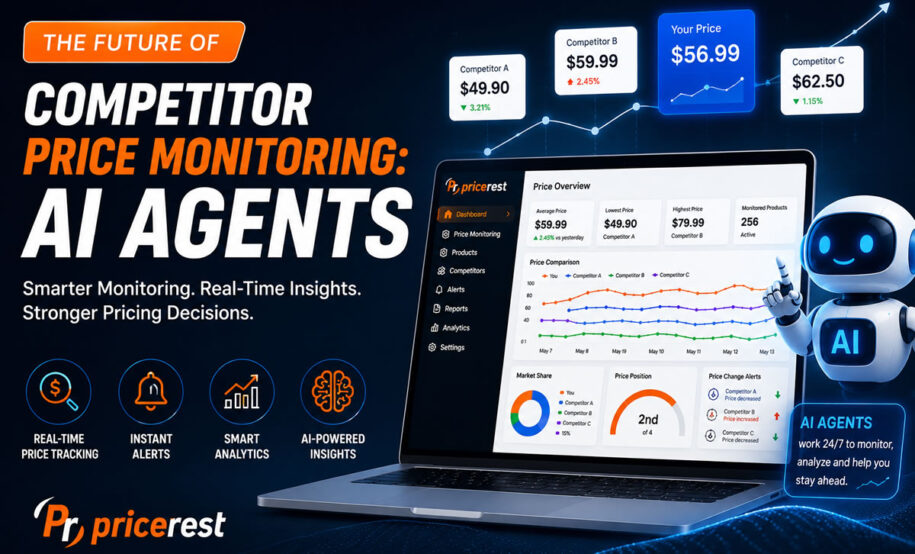
Competitor price monitoring is entering a new era.
For years, ecommerce businesses have used price monitoring software to automatically collect competitor prices, track stock availability, analyze historical pricing data, and receive alerts when the market changes.
But the next generation of pricing technology will go much further.
Instead of simply telling you:
“Competitor A lowered its price.”
an AI pricing agent could understand the event, analyze its importance, evaluate your pricing position, check your margin rules, determine whether action is necessary, and recommend—or eventually execute—the appropriate response.
This represents an important transition:
Price Monitoring → Price Intelligence → AI Pricing Agents
Agentic AI is particularly relevant to retail because pricing involves large amounts of constantly changing data and repetitive decisions. McKinsey estimates that retail merchants could reclaim significant time by shifting repetitive analytical work to AI agents.
For ecommerce businesses, this could fundamentally change how competitor price monitoring works.
What Is Competitor Price Monitoring?
Competitor price monitoring is the process of automatically tracking competitor prices, stock availability, promotions, sellers, and other pricing-related information across ecommerce websites and marketplaces.
Traditional competitor price monitoring software typically follows a straightforward workflow:
Collect → Match → Compare → Alert → Analyze
For example, imagine you sell a product for $99.
Your competitors currently sell the same product at:
| Seller | Price | Stock |
|---|---|---|
| Your Store | $99 | In Stock |
| Competitor A | $95 | In Stock |
| Competitor B | $102 | In Stock |
| Competitor C | $89 | Out of Stock |
A traditional monitoring system collects this information and shows that Competitor A is cheaper.
That is already much more efficient than manually checking competitor websites.
But it still leaves an important question:
What should you do with the data?
This is where AI agents become interesting.
What Are AI Agents in Competitor Price Monitoring?
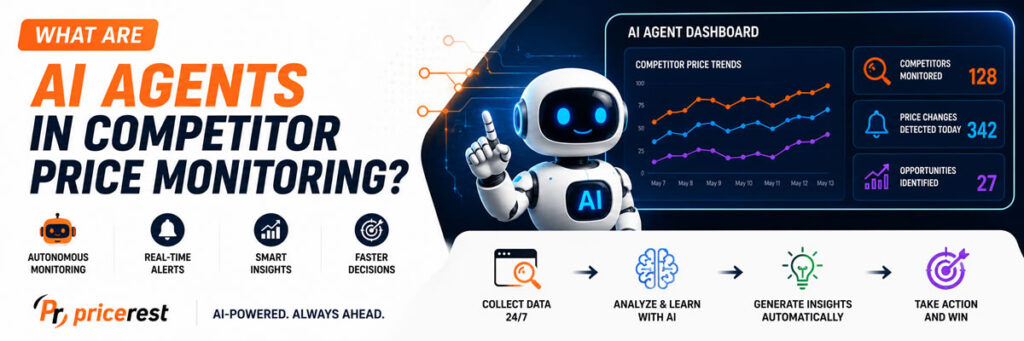
An AI agent for competitor price monitoring is an intelligent software system designed to continuously observe market data, analyze pricing events, evaluate them against business objectives and potentially initiate actions.
Instead of waiting for a pricing manager to inspect every alert, an agent could continuously evaluate thousands of products.
For example:
Competitor A reduced Product X from $105 to $94.
A normal monitoring system might send:
Price Drop Alert: Competitor A — $94
An AI agent could provide much more context:
Competitor A reduced the product price by 10.5% approximately two hours ago.
Competitors B and C have not followed the price reduction.
Competitor A appears to be running a temporary promotion.
Your current price is $99 and remains within your target market position.
Matching $94 would reduce your estimated margin below your preferred threshold.
Recommended action: Maintain the current price and continue monitoring.
The difference is significant.
Traditional software reports the event.
AI agents attempt to understand the event.
How AI Agents Could Transform Competitor Price Monitoring
The future competitor monitoring workflow could look more like:
Monitor → Understand → Evaluate → Recommend → Act → Measure → Learn
Rather than simply producing dashboards, pricing platforms could increasingly become active decision-support systems.
This direction is already visible across retail technology. McKinsey describes agentic systems as proactive tools capable of analyzing large amounts of performance data, identifying issues and producing actionable recommendations without waiting for a user to ask.
Autonomous Competitor Price Monitoring
The first responsibility of an AI pricing agent is observation.
Agents could continuously monitor:
- Competitor prices
- Product availability
- Promotions
- Shipping costs
- Marketplace sellers
- MAP violations
- Price changes
- New competitors
- Product assortment changes
- Historical pricing behavior
Instead of manually configuring every possible alert, businesses could define objectives.
For example:
“Monitor our most important competitors and tell me when a price change could materially affect our competitiveness.”
The agent determines which events deserve attention.
AI-Powered Product Matching
Accurate competitor monitoring depends on accurate product matching.
This becomes difficult when retailers use different:
- Product titles
- SKUs
- Product descriptions
- Images
- Categories
- Product codes
- Variants
AI can combine multiple signals to determine whether two listings represent the same product.
Apple AirPods Pro 2nd Gen USB-C
Apple AirPods Pro (2nd Generation) with MagSafe Case
An intelligent matching engine can evaluate product names, identifiers, images and other attributes rather than relying entirely on exact text matching.
This allows AI agents to discover competitors instead of requiring teams to manually provide every competitor URL.
AI Agents Could Prioritize Important Price Changes
One of the biggest problems with large-scale monitoring is alert fatigue.
Imagine monitoring:
20,000 products × 10 competitors
That potentially means hundreds of thousands of competitor listings.
Thousands of prices could change every day. But not every change deserves human attention.
An AI agent could classify events based on business impact.
Low Priority
A competitor changes:
$49.99 → $49.79No meaningful impact.
Medium Priority
A major competitor changes:
$49.99 → $46.99Market position changes.
High Priority
Three major competitors simultaneously reduce prices by approximately 10%.
Potential market-wide pricing movement.
The agent could therefore prioritize the third event instead of sending dozens of individual alerts.
From Price Alerts to Pricing Recommendations
This may be one of the biggest changes.
Traditional price monitoring asks:
“What changed?”
AI-powered price intelligence asks:
“Why does it matter?”
AI pricing agents add another question:
“What should we do?”
Suppose your product sells for $120.
The agent might determine that immediately matching $109 is unnecessary and violates your margin constraint.
The goal is not necessarily to become the cheapest seller.
The goal is to find the most appropriate competitive position while protecting profitability.
AI Agents and Dynamic Pricing
This is where competitor monitoring and dynamic pricing increasingly converge.
The agent observes the market. Then it evaluates pricing rules. Then it determines whether the product price should change.
Modern dynamic pricing already uses competitor prices, demand, inventory and business rules as inputs. The agentic layer potentially makes the process more autonomous and context-aware.
AI Agents Could Understand Competitor Pricing Behavior
A single price observation has limited value.
A sequence of observations tells a story.
Consider a competitor that repeatedly:
- Lowers prices every Friday
- Restores them Monday morning
- Discounts when inventory increases
- Raises prices when other sellers go out of stock
A traditional dashboard can display this history.
An AI agent could attempt to recognize the pattern.
Competitor A has reduced this product category between 5% and 8% during four of the last five weekends. Prices typically return to normal on Monday. The current reduction therefore appears consistent with a temporary promotional strategy.
That context can prevent unnecessary price reactions.
AI Agents for MAP Monitoring
AI agents could also transform Minimum Advertised Price (MAP) monitoring.
Traditional MAP monitoring identifies products advertised below the permitted price.
Future AI agents could potentially monitor the entire compliance workflow:
Detect → Verify → Classify → Prioritize → Document → Alert
The system could then determine:
- Which seller violated MAP?
- When did the violation begin?
- Is the seller still violating MAP?
- Is it a repeated violation?
- Which products are affected?
- Are other sellers following the price decrease?
- How severe is the violation?
This would transform MAP monitoring from a simple violation list into a more intelligent compliance workflow.
AI Agents Could Detect New Competitors Automatically
Traditional monitoring often starts with a predefined competitor list.
But ecommerce markets constantly change.
- New sellers appear
- New marketplace listings emerge
- Retailers add products
- Competitors enter new categories
An AI agent could continuously search marketplaces, Google Shopping, search engines and retailer websites to discover relevant competing offers.
Instead of asking:
“Which websites should we monitor?”
The system could increasingly answer:
“Here are the competitors that matter for this product.”
Multi-Agent Systems Could Manage Different Pricing Tasks
An especially interesting future architecture involves multiple specialized agents.
Instead of one AI model doing everything, different agents could handle different parts of pricing intelligence.
Monitoring Agent
Collects competitor prices, stock and seller information.
Matching Agent
Identifies equivalent products across websites.
Market Intelligence Agent
Analyzes competitor behavior and market positioning.
MAP Compliance Agent
Detects and prioritizes pricing violations.
Pricing Agent
Determines potential price adjustments.
Repricing Agent
Applies approved changes to ecommerce platforms.
Reporting Agent
Explains what happened and summarizes performance.
These agents could collaborate around a common pricing objective.
Multi-agent commerce architectures are already emerging in the broader retail ecosystem. NVIDIA, for example, describes specialized agents working together for promotion pricing, recommendations, search and commerce workflows while remaining constrained by merchant-defined business logic.
Human-in-the-Loop Pricing Will Remain Important
AI agents do not necessarily mean removing humans from pricing decisions.
A more realistic near-term model is:
AI monitors → AI analyzes → AI recommends → Human approves
Businesses can determine different autonomy levels.
High-risk decisions could require approval while repetitive, low-risk adjustments could become automated.
This governance layer is important because pricing affects margins, brand positioning, channel relationships and regulatory or contractual obligations.
Natural Language Could Become the New Pricing Interface
Pricing dashboards today often require users to configure filters, reports and rules manually.
AI agents could make pricing software much more conversational.
A pricing manager could ask:
The agent could query the underlying competitor pricing database and return the relevant analysis.
This could significantly reduce the amount of time teams spend navigating dashboards and exporting spreadsheets.
AI Agents Need High-Quality Pricing Data
There is one important limitation.
An AI pricing agent is only as useful as the data behind it.
If competitor data is incorrect, delayed or mismatched, even a sophisticated AI model can reach the wrong conclusion.
AI agents therefore increase—not decrease—the importance of reliable price intelligence.
Future pricing systems will require:
This is why competitor price monitoring remains the foundation of agentic pricing.
Price Monitoring Software vs AI Pricing Agents
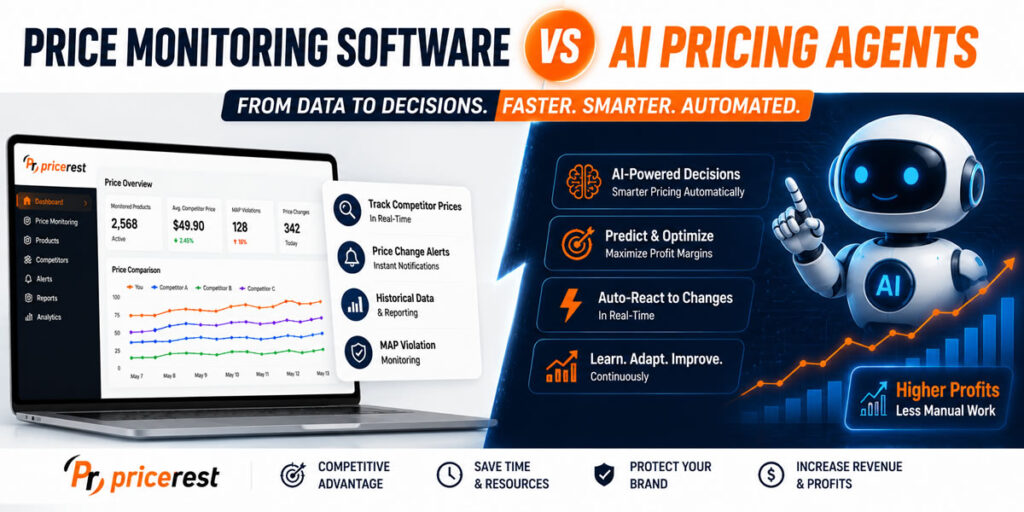
| Capability | Traditional Monitoring | AI Pricing Agent |
|---|---|---|
| Track competitor prices | ✓ | ✓ |
| Monitor stock | ✓ | ✓ |
| Historical pricing | ✓ | ✓ |
| Price alerts | ✓ | ✓ |
| Product matching | ✓ | ✓ AI-assisted |
| Understand market events | Limited | ✓ |
| Prioritize important changes | Limited | ✓ |
| Recommend actions | Limited | ✓ |
| Natural-language analysis | Limited | ✓ |
| Coordinate pricing workflows | Limited | ✓ |
| Autonomous actions | Rule-based | Potentially agentic |
The key evolution is therefore not simply better data collection.
It is moving from data collection to decision automation.
The Future: From Pricing Dashboards to Pricing Intelligence Agents
The pricing dashboard is unlikely to disappear.
But its role may change.
Instead of requiring a pricing manager to open a dashboard every morning and search for problems, AI agents could continuously monitor the business and surface only the decisions that require attention.
The workflow moves from:
Human → Dashboard → Data → Analysis → Decision
toward:
AI Agent → Data → Analysis → Recommendation → Human Approval
and, eventually for suitable workflows:
AI Agent → Data → Decision → Action → Measurement
McKinsey’s 2026 pricing research points in this direction: agentic AI adoption in pricing is currently relatively low, but respondents expect substantial adoption growth over the next one to three years, particularly in market intelligence, cost tracking, list-price setting and promotional pricing.
How PriceRest Is Preparing for AI-Powered Competitor Monitoring
The foundation of an effective pricing agent is a reliable competitive data infrastructure.
PriceRest already helps ecommerce businesses, brands, manufacturers, retailers and distributors automate important parts of this foundation through:
- Competitor price monitoring
- Stock availability monitoring
- MAP violation detection
- Historical price analysis
- Dynamic pricing and repricing
- AI-powered product matching
- Google Search and Google Shopping scanning
- Competitor website scanning
- Scheduled competitor suggestions
- Pricing alerts and reporting
The next evolution is connecting these capabilities through increasingly intelligent workflows.
Instead of only answering:
“What is my competitor’s price?”
pricing intelligence systems should increasingly help businesses answer:
“What changed, why does it matter, and what should I do next?”
That is the real opportunity behind AI agents in competitor price monitoring.
Conclusion: AI Agents Are the Next Step in Competitor Price Monitoring
Competitor price monitoring started by replacing manual website checks.
Then it evolved into automated price intelligence.
The next stage is agentic pricing intelligence.
AI agents will increasingly help businesses move from simply seeing competitor price changes to understanding and responding to them intelligently.
The future workflow can be summarized simply:
Monitor → Understand → Decide → Act → Learn
Businesses that build strong competitive pricing data today will be better positioned for this transition because every intelligent pricing agent ultimately depends on one thing:
accurate, timely and actionable market data.
With PriceRest, businesses can already automate competitor price monitoring, MAP violation tracking, product matching and dynamic pricing—creating the data foundation required for the next generation of AI-powered pricing workflows.
Better pricing decisions start with better competitor data.

Frequently Asked Questions About AI Agents and Price Monitoring
What is an AI agent for competitor price monitoring?
An AI agent is a software system that continuously monitors competitor pricing data, analyzes market changes and helps determine what actions should be taken based on predefined business objectives and constraints.
Can AI automatically monitor competitor prices?
Yes. Competitor monitoring platforms can already automate price collection, stock monitoring and product matching. AI agents add an additional intelligence layer that can interpret these changes and prioritize important events.
Can AI agents automatically change product prices?
Potentially yes. When connected to dynamic pricing systems and ecommerce platforms, agents can recommend or execute price changes within predefined rules such as minimum margin, maximum discount and pricing-position constraints.
Will AI replace pricing managers?
More likely, AI agents will automate repetitive monitoring and analysis while pricing professionals retain control over strategy, exceptions and high-impact decisions. Retail research currently frames agentic AI largely as a way to shift merchant time from repetitive analytical work toward strategic activities.
Can AI agents detect MAP violations?
Yes. AI-assisted systems can monitor reseller prices, compare them with MAP thresholds, identify violations and help prioritize repeated or high-impact violations.
Why is competitor price data important for AI agents?
AI agents require accurate market information to make reliable recommendations. Incorrect product matches or outdated prices can result in incorrect pricing decisions.
What is agentic AI pricing?
Agentic AI pricing refers to pricing systems where AI agents monitor market signals, reason about business constraints, recommend actions and potentially execute pricing decisions with varying levels of autonomy.
What is the difference between dynamic pricing and AI pricing agents?
Dynamic pricing automatically adjusts prices according to predefined rules or models. AI pricing agents can potentially manage a broader workflow by monitoring competitors, interpreting events, selecting appropriate strategies, executing changes and evaluating their results.

Do you want to be a successful player in e-commerce?
- You must keep a close monitor on what your competitors are doing
- Know the product’s pricing points.
- Use Price Monitoring Tools
- Use Dynamic Pricing Strategies
- Automatically Update Your Products According To Your Competitors.
Join PriceRest for better dynamic pricing strategies for your short- and long-term sales processes.

To have a better understanding of e-commerce for success, join today!
And see what PriceRest can do for you.
Request a personalized demo of PriceRest
We look forward to showing you how our platform allows you to optimize the pricing, execution, and measurement initiatives that matter most to your brand and products.
It is Free!
What can I expect?
- A brief conversation to assess what PriceRest can do to help your pricing strategy
- Live product demo with insight into how to get the most benefit from PriceRest
- Discuss your prices KPIs to determine the best path forward for your business
- No commitment required