
AI Product Matching Engine
Introduction
One of the biggest challenges in competitor price monitoring is not collecting prices—it’s finding the correct competitor products in the first place.
The same product can appear on hundreds of ecommerce websites with different titles, descriptions, images, categories, and pricing. Some retailers use manufacturer part numbers (MPNs), while others rely only on product titles. In many cases, identical products have completely different naming conventions.
Manually searching and matching products across multiple websites is slow, expensive, and prone to errors.
That’s why PriceRest developed an AI-powered Product Matching Engine that automates the entire process.
Instead of requiring users to manually search competitor websites one by one, PriceRest continuously discovers, analyzes, scores, and matches products using multiple AI technologies.
Why Product Matching Is So Difficult
At first glance, product matching seems straightforward.
In reality, it’s one of the most technically challenging problems in ecommerce.
Consider the following examples:
Product A
Apple iPhone 16 Pro 256GB Black Titanium
Another retailer lists:
Apple iPhone 16 Pro Black 256 GB
Another lists:
iPhone 16 Pro 256GB Titan Black
Another:
Apple Smartphone A3293 256GB
Although all four listings refer to the same product, their titles are completely different.
Now imagine matching millions of products like this every day.
Simple keyword matching quickly becomes unreliable.
This is where artificial intelligence becomes essential.
How PriceRest’s AI Matching Engine Works
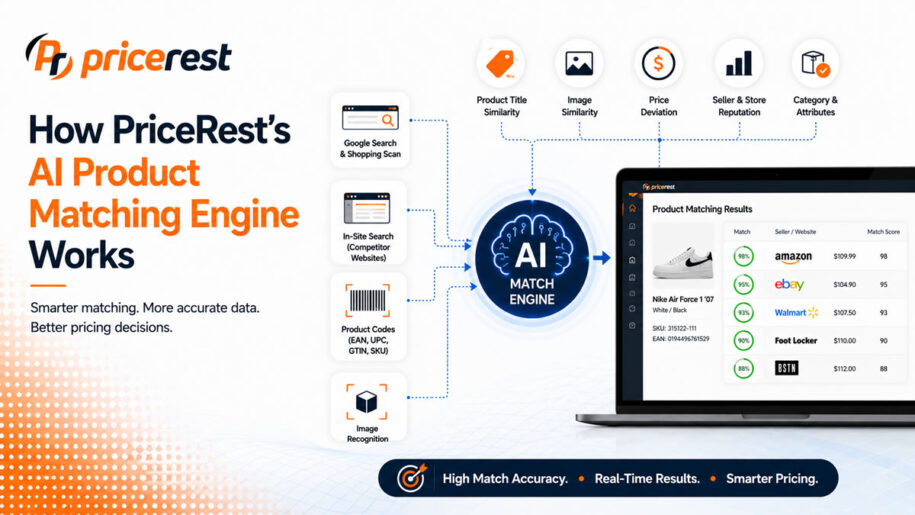
Instead of relying on a single matching method, PriceRest combines multiple data sources and AI algorithms to calculate the probability that two products are identical.
Every potential competitor product receives an AI Match Score, allowing users to immediately understand the confidence level of each match.
Step 1 — Google Search Discovery
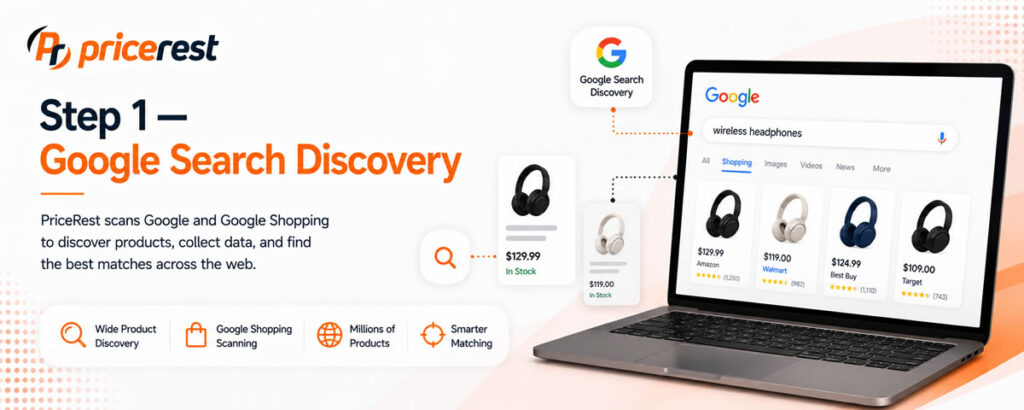
The process begins by searching the public web.
PriceRest automatically performs intelligent Google searches using the customer’s product information.
Searches may include:
- Product name
- Brand
- Manufacturer
- SKU
- MPN
- GTIN / EAN / UPC
- Product attributes
Google often discovers competitor pages much faster than manually adding websites.
Instead of searching competitor domains individually, PriceRest lets Google’s index work as the first discovery engine.
Benefits include:
- Faster competitor discovery
- New competitor identification
- Global website coverage
- Automatic product page detection
Step 2 — Google Shopping Scanning
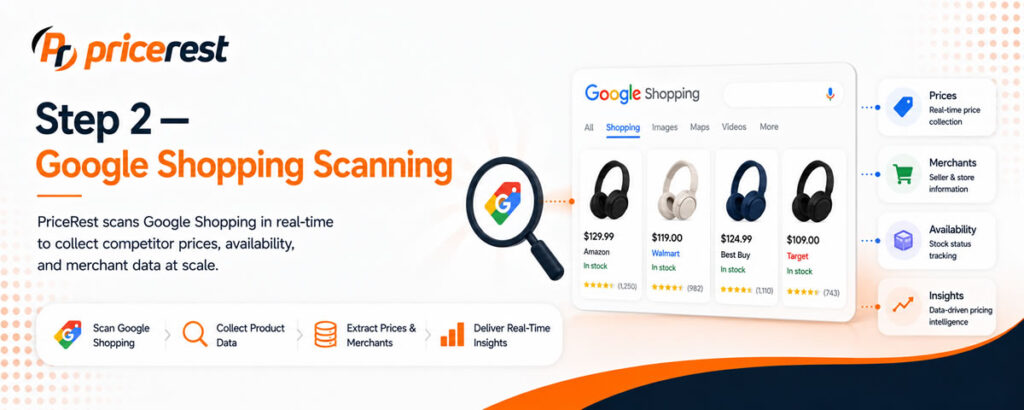
Many ecommerce stores submit product feeds directly to Google Shopping.
PriceRest scans Google Shopping results to identify additional sellers offering the same product.
This provides valuable information including:
- Advertised prices
- Available sellers
- Shopping listings
- Product availability
- Additional competitor discovery
Google Shopping significantly expands product coverage beyond manually configured competitors.
Step 3 — Competitor Website Search
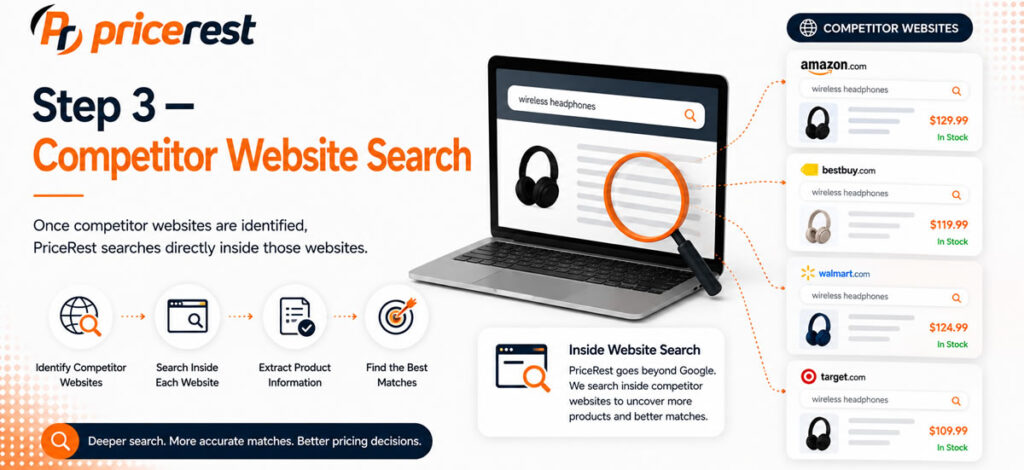
Once competitor websites are identified, PriceRest searches directly inside those websites.
Instead of crawling every page blindly, the platform intelligently searches internal site search engines using:
- Product name
- SKU
- Product codes
- Brand
- Model
This dramatically increases matching speed while reducing unnecessary crawling.
Benefits include:
- Faster crawling
- Better product accuracy
- Lower crawling costs
- Higher matching precision
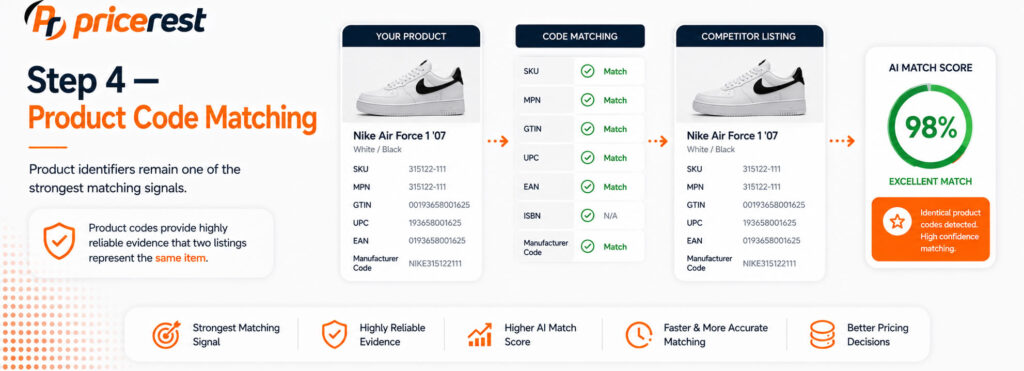
Step 4 — Product Code Matching
Product identifiers remain one of the strongest matching signals.
PriceRest automatically compares:
- SKU
- MPN
- GTIN
- UPC
- EAN
- ISBN (when applicable)
- Manufacturer codes
When identical product identifiers are found, the AI Match Score increases significantly because product codes provide highly reliable evidence that two listings represent the same item.
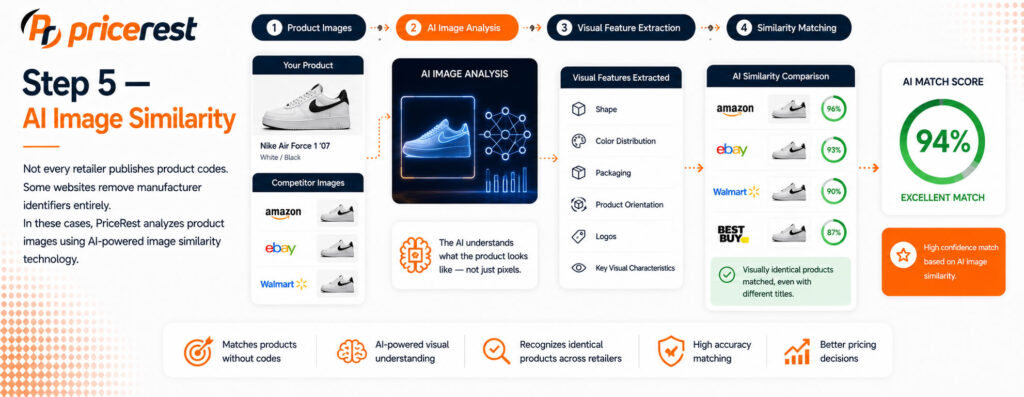
Step 5 — AI Image Similarity
Not every retailer publishes product codes.
Some websites remove manufacturer identifiers entirely.
In these cases, PriceRest analyzes product images using AI-powered image similarity technology.
Rather than comparing images pixel by pixel, the AI extracts visual features such as:
- Shape
- Color distribution
- Packaging
- Product orientation
- Logos
- Key visual characteristics
This allows visually identical products to be recognized even when product titles differ.
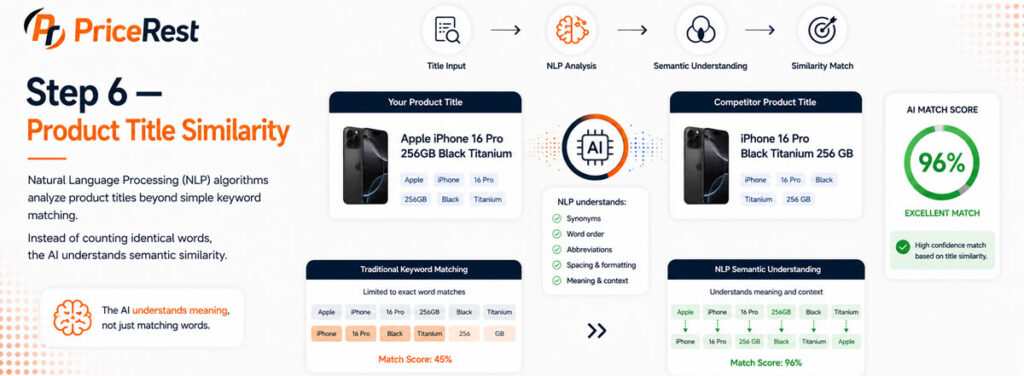
Step 6 — Product Title Similarity
Natural Language Processing (NLP) algorithms analyze product titles beyond simple keyword matching.
Instead of counting identical words, the AI understands semantic similarity.
For example:
Apple iPhone 16 Pro 256GB Black Titanium
can be matched with
iPhone 16 Pro Black Titanium 256 GB
even though the wording differs considerably.
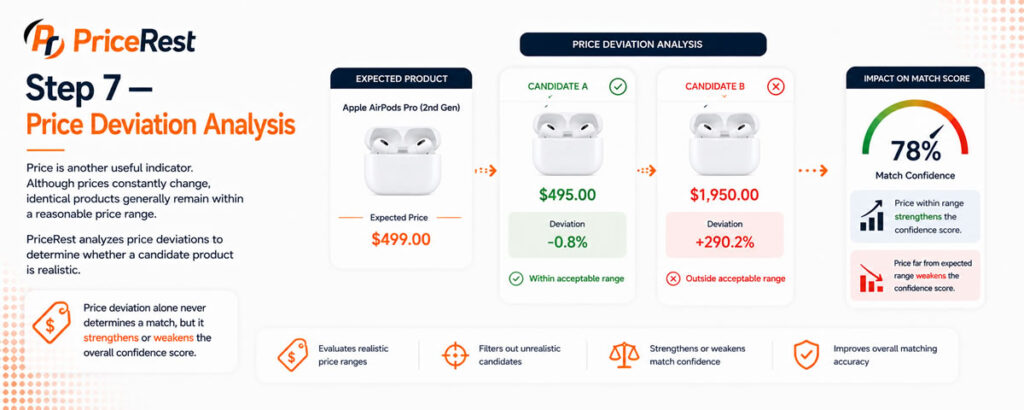
Step 7 — Price Deviation Analysis
Price is another useful indicator.
Although prices constantly change, identical products generally remain within a reasonable price range.
PriceRest analyzes price deviations to determine whether a candidate product is realistic.
For example:
Expected price: $499
Candidate A: $495 ✅
Candidate B: $1,950 ❌
Price deviation alone never determines a match, but it strengthens or weakens the overall confidence score.
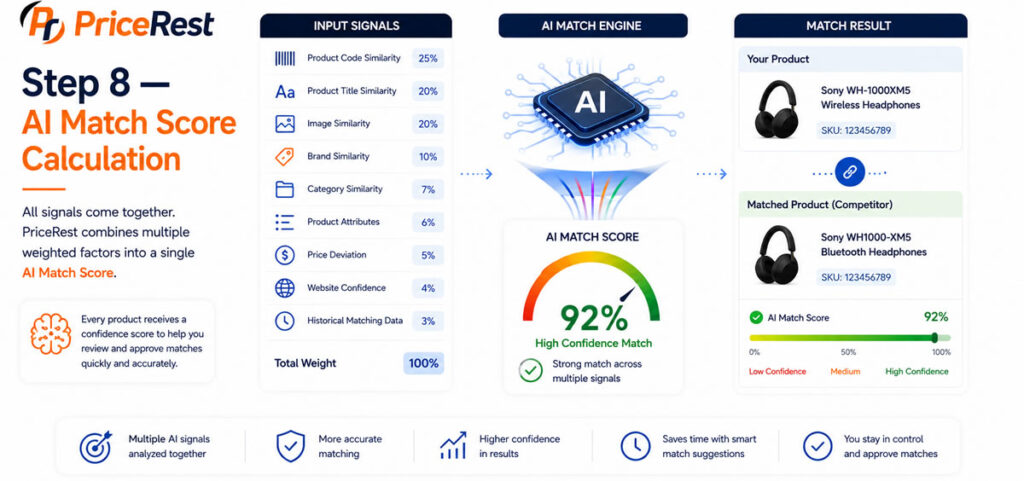
Step 8 — AI Match Score Calculation
This is where all collected signals come together.
PriceRest combines multiple weighted factors into a single AI Match Score, including:
- Product code similarity
- Product title similarity
- Image similarity
- Brand similarity
- Category similarity
- Product attributes
- Price deviation
- Website confidence
- Historical matching data
Instead of making a simple yes/no decision, every product receives a confidence score that helps users quickly review and approve matches when needed.
Scheduled Competitor Suggestions
Competitor landscapes constantly evolve.
New sellers appear.
Existing competitors add products.
Marketplaces expand.
Because of this, product matching cannot be a one-time process.
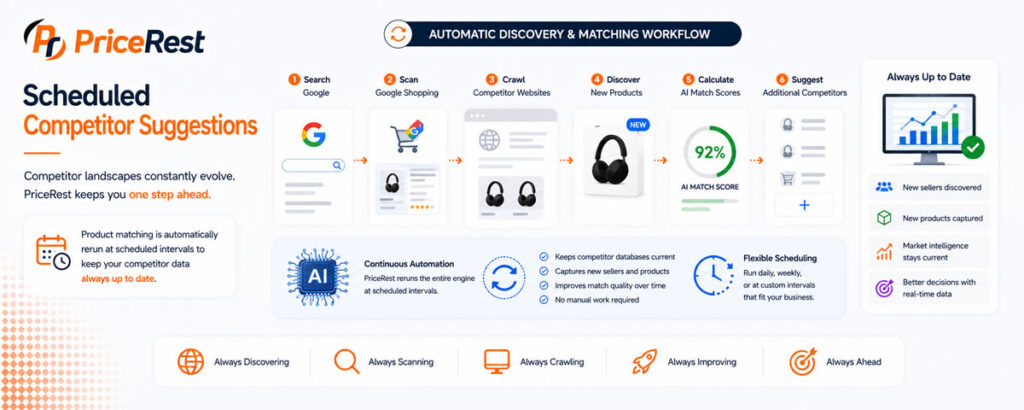
PriceRest automatically reruns the discovery and matching engine at scheduled intervals.
The platform continuously:
- Searches Google
- Scans Google Shopping
- Crawls competitor websites
- Discovers new products
- Calculates new AI Match Scores
- Suggests additional competitors
This automation ensures that competitor databases remain current without requiring manual intervention.
Benefits of AI-Powered Product Matching
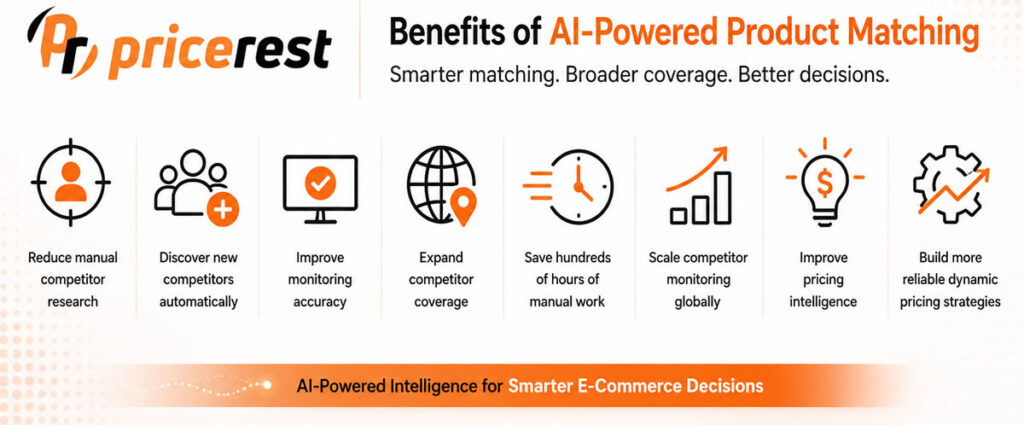
Businesses using AI-powered product matching can:
- Reduce manual competitor research
- Discover new competitors automatically
- Improve monitoring accuracy
- Expand competitor coverage
- Save hundreds of hours of manual work
- Scale competitor monitoring globally
- Improve pricing intelligence
- Build more reliable dynamic pricing strategies
Why PriceRest Uses Multiple Matching Technologies
Many product matching systems rely on only one or two signals, such as product titles or SKUs.
This approach often struggles with incomplete product data, inconsistent naming conventions, or missing identifiers.
PriceRest takes a multi-layered approach by combining Google Search discovery, Google Shopping scanning, competitor website search, product code comparison, AI image recognition, natural language processing, and price deviation analysis into a single matching engine.
By evaluating all these signals together, the platform delivers significantly higher matching accuracy and reduces the need for manual product verification.
Frequently Asked Questions
How does PriceRest automatically find competitor products?
PriceRest automatically discovers competitor products by combining Google Search, Google Shopping scanning, competitor website search, AI-powered product matching, and intelligent web crawling.
What is an AI Match Score?
An AI Match Score is a confidence score that estimates how likely two product listings represent the same product. The score is calculated using multiple signals, including product codes, title similarity, image similarity, price deviation, brand, and product attributes.
Can PriceRest match products without product codes?
Yes. Even when SKUs, GTINs, or MPNs are unavailable, PriceRest can use AI image recognition, title similarity, brand information, and pricing analysis to identify highly probable product matches.
Does PriceRest automatically discover new competitors?
Yes. The platform continuously searches Google, Google Shopping, and competitor websites to identify new sellers and products. Scheduled Competitor Suggestions ensure that newly discovered opportunities are automatically presented for review.
Why is AI product matching important for competitor price monitoring?
Accurate product matching is the foundation of reliable competitor price monitoring. Without correctly identifying identical products, pricing comparisons become inaccurate, leading to poor pricing decisions. AI-powered matching improves accuracy, reduces manual work, and enables businesses to monitor competitors at scale.
Request a personalized demo of PriceRest
We look forward to showing you how our platform allows you to optimize the pricing, execution, and measurement initiatives that matter most to your brand and products.
It is Free!
What can I expect?
- A brief conversation to assess what PriceRest can do to help your pricing strategy
- Live product demo with insight into how to get the most benefit from PriceRest
- Discuss your prices KPIs to determine the best path forward for your business
- No commitment required