
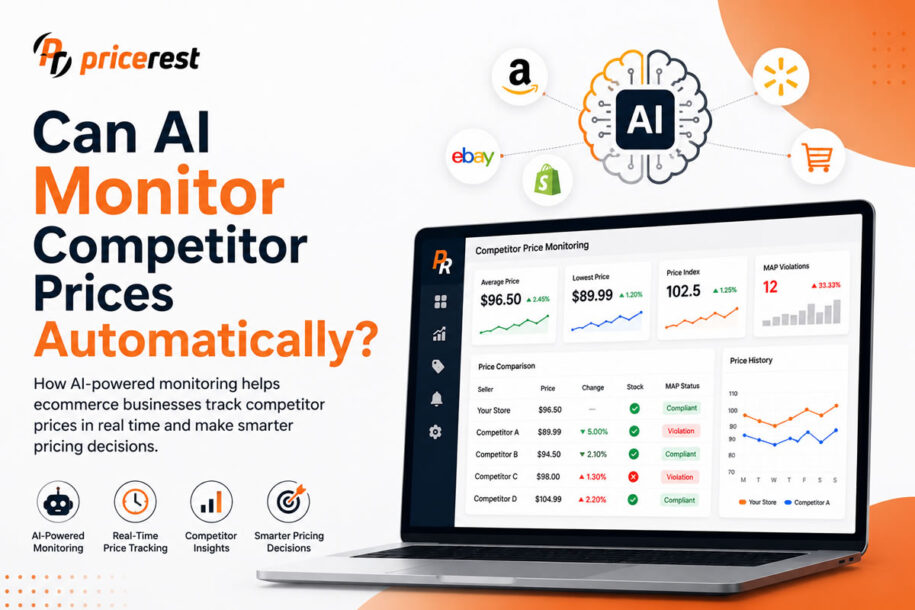
Yes. AI can monitor competitor prices automatically across ecommerce websites, online retailers, marketplaces, and shopping platforms.
Table Of Content
- What Is AI Competitor Price Monitoring?
- 1. Automatic Competitor Price Collection
- 2. AI-Powered Product Matching
- 3. AI Can Discover Competitor Products Automatically
- 4. AI Can Detect Competitor Price Changes Automatically
- 5. AI Can Monitor Stock Availability Together With Price
- 6. AI Can Prioritize Important Competitor Price Changes
- 7. AI Can Analyze Historical Competitor Pricing Behavior
- 8. Can AI Monitor Competitor Prices on Google Shopping?
- 9. Can AI Monitor Competitor Websites Automatically?
- 10. Can AI Monitor MAP Violations Automatically?
- 11. Can AI Recommend Price Changes?
- 12. Can AI Automatically Change Product Prices?
- 13. AI Agents Can Go Beyond Traditional Price Monitoring
- 14. Price Monitoring Software vs AI Pricing Agents
- 15. What Are the Benefits of AI Competitor Price Monitoring?
- 16. What Are the Limitations of AI Competitor Price Monitoring?
- 17. AI Competitor Price Monitoring vs Manual Price Monitoring
- 18. How PriceRest Automates Competitor Price Monitoring
- 19. From Competitor Monitoring to AI Pricing Intelligence
- Frequently Asked Questions About AI Competitor Price Monitoring
Instead of manually visiting competitor websites and checking prices product by product, businesses can use AI-powered competitor price monitoring software to automatically collect pricing data, detect price changes, monitor stock availability, discover competing products, and analyze market movements.
But AI can go much further than simply collecting prices.
Traditional competitor monitoring answers:
“What changed?”
AI-powered price monitoring can increasingly help answer:
“Why does this change matter?”
And the next generation of AI pricing agents could answer:
“What should we do next?”
This represents an important evolution:
Manual Monitoring → Automated Price Monitoring → Pricing Intelligence → AI Pricing Agents
For ecommerce businesses, brands, retailers, and manufacturers, AI has the potential to make competitor monitoring faster, more scalable, and much more actionable.
What Is AI Competitor Price Monitoring?
AI competitor price monitoring is the use of automation and artificial intelligence to collect, match, analyze, and interpret competitor pricing information.
Traditional competitor price monitoring software typically follows a straightforward process:
Collect → Match → Compare → Alert → Analyze
AI adds an additional intelligence layer:
Monitor → Understand → Evaluate → Recommend → Act
For example, imagine one of your competitors changes a product price from $120 to $105.
A traditional monitoring system might send:
Price Drop Alert: Competitor A reduced the product price from $120 to $105.
An AI-powered system could potentially provide additional context:
Competitor A reduced the product price by 12.5%. The product remains in stock. Other major competitors have not changed their prices. Historical data suggests this competitor frequently runs short-term promotions. An immediate price adjustment may not be necessary.
The difference is significant.
Traditional software reports the event.
AI-powered systems can help interpret the event.
How Does AI Monitor Competitor Prices Automatically?
AI-powered competitor price monitoring combines several technologies and processes.
The system first needs to understand your products.
Then it needs to find equivalent products across competitor websites.
Once products are matched, the system can continuously collect and compare prices.
A typical workflow looks like this:
1. Automatic Competitor Price Collection
The first responsibility of competitor price monitoring software is data collection.
Instead of employees manually visiting competitor websites, monitoring software can automatically scan product pages at scheduled intervals.
The system can collect information such as:
- Current product price
- Previous price
- Discounted price
- Stock availability
- Seller information
- Promotions
- Shipping costs
- Product URL
- Historical prices
Consider an ecommerce company selling 5,000 products.
If the company wants to monitor five competitors for every product, that potentially represents:
5,000 products × 5 competitors = 25,000 competitor listings
Checking 25,000 product pages manually every day would be extremely difficult.
Automated competitor monitoring makes this process scalable.
2. AI-Powered Product Matching
Collecting competitor prices is only useful when you are comparing the correct products.
This is one of the biggest challenges in competitor price monitoring.
Different ecommerce websites often describe the same product differently.
For example:
Your Product
Apple AirPods Pro 2nd Generation USB-C
Competitor Product
Apple AirPods Pro (2nd Gen) with MagSafe Charging Case USB-C
A basic exact-text matching system may struggle to determine whether these listings represent the same product.
AI-powered product matching can analyze multiple signals.
These may include:
- Product title
- Brand
- SKU
- MPN
- GTIN
- EAN
- UPC
- Product description
- Product image
- Category
- Model
- Variant
- Price difference
Instead of relying on one attribute, AI can combine these signals to generate a product matching confidence score.
For example:
| Matching Signal | Similarity |
|---|---|
| Product Title | 94% |
| Brand | 100% |
| Product Code | 100% |
| Image Similarity | 97% |
| Category | 100% |
| Overall AI Match Score | 98% |
This can significantly reduce the amount of manual work required to create competitor product relationships.
3. AI Can Discover Competitor Products Automatically
Traditional competitor monitoring often requires users to provide competitor product URLs manually.
For small catalogs, this may be manageable.
For thousands of products, it becomes a major operational challenge.
AI-powered competitor discovery can automate much of this process.
The system can search sources such as:
- Google Search
- Google Shopping
- Competitor websites
- Online marketplaces
- Internal retailer search engines
Suppose your product is:
Sony WH-1000XM5 Wireless Headphones
The system can search different sources for matching products.
AI can then compare the discovered listings against your product information.
Instead of manually adding every competitor URL, the system might report:
14 potential competitor listings discovered.
The user can then review the suggestions, or highly confident matches can potentially be processed automatically.
This turns competitor monitoring from a static system into a continuously evolving process.
4. AI Can Detect Competitor Price Changes Automatically
Once competitor products have been identified and matched, prices can be monitored continuously.
Consider this example:
| Seller | Yesterday | Today | Change |
|---|---|---|---|
| Your Store | $99 | $99 | 0% |
| Competitor A | $105 | $94 | -10.5% |
| Competitor B | $102 | $102 | 0% |
| Competitor C | $109 | $104 | -4.6% |
The monitoring system immediately identifies that Competitor A made the largest price reduction.
Instead of discovering this manually several hours or days later, the business could receive an automatic notification:
Competitor Price Drop Detected
Competitor A reduced Product X from $105 to $94.
Price change: -10.5%
Businesses can therefore react to significant market movements much faster.
5. AI Can Monitor Stock Availability Together With Price
The cheapest competitor is not necessarily the most important competitor.
Stock availability matters.
Consider this market:
| Seller | Price | Stock Status |
|---|---|---|
| Your Store | $100 | In Stock |
| Competitor A | $96 | In Stock |
| Competitor B | $89 | Out of Stock |
| Competitor C | $103 | In Stock |
If you only look at price, Competitor B appears to be the biggest pricing threat.
Its price is $11 below yours.
But the product is out of stock.
Automatically reducing your price to compete with an unavailable product could unnecessarily reduce your profit margin.
This is why intelligent competitor monitoring should evaluate:
Price + Stock + Seller + Promotion + Historical Behavior
instead of analyzing price alone.
6. AI Can Prioritize Important Competitor Price Changes
One of the biggest challenges with large-scale competitor monitoring is alert fatigue.
Imagine monitoring:
20,000 products × 10 competitors
That potentially means:
200,000 competitor product relationships.
Thousands of prices could change every day.
But not every price change deserves attention.
Low-Priority Event
Competitor price:
$49.99 → $49.79
Probably insignificant.
Medium-Priority Event
Major competitor:
$49.99 → $44.99
Potentially important.
High-Priority Event
Four major competitors reduce their prices by approximately 10% within several hours.
Potentially a market-wide pricing movement.
An AI pricing agent could analyze these events and prioritize the third event.
Instead of telling pricing teams everything that happened, AI can help identify what actually matters.
7. AI Can Analyze Historical Competitor Pricing Behavior
A single competitor price tells you what is happening now.
Historical pricing data can help explain why it may be happening.
Imagine Competitor A reduces a product from:
$100 → $90
At first glance, this looks like an aggressive price reduction.
However, historical data shows that the same competitor reduced the product to approximately $90 during four of the previous five weekends.
Prices normally returned to approximately $100 on Monday.
An AI-powered system could potentially report:
Competitor A reduced the product price by 10%. Similar reductions occurred during four of the previous five weekends and typically lasted two to three days. The current price change may represent a temporary promotional strategy rather than a permanent pricing adjustment.
That information can prevent an unnecessary price war.
Instead of automatically matching every competitor price drop, businesses can make decisions using historical context.
8. Can AI Monitor Competitor Prices on Google Shopping?
Yes.
Google Shopping can be particularly useful for competitor discovery and product matching.
A business may know its main competitors but still be unaware of smaller retailers selling the same products.
Automated product searching can help identify these sellers.
The system can potentially collect:
- Retailer name
- Product title
- Product price
- Product URL
- Availability
- Product image
AI can then determine whether the discovered listing matches your own product.
For example:
| Google Shopping Result | Price | AI Match Score |
|---|---|---|
| Retailer A | $129 | 99% |
| Retailer B | $124 | 97% |
| Retailer C | $139 | 95% |
| Retailer D | $89 | 42% |
The first three listings may be strong potential matches.
Retailer D could represent another model, variant, bundle, or unrelated product.
AI therefore helps automate both competitor discovery and product validation.
9. Can AI Monitor Competitor Websites Automatically?
Yes.
Businesses can provide specific competitor websites they want to monitor.
The system can then search those websites for equivalent products.
For example, suppose you sell:
Samsung Galaxy Buds3 Pro
Instead of manually visiting each competitor website and searching for the product, automated systems can perform the search.
AI can evaluate:
- Product title similarity
- Product codes
- Product images
- Product descriptions
- Product attributes
- Price differences
The system can then calculate whether the discovered listing is likely to represent the same product.
Once matched, the competitor product can become a permanent monitoring target.
10. Can AI Monitor MAP Violations Automatically?
Yes.
AI-powered monitoring can also support Minimum Advertised Price (MAP) monitoring.
Brands and manufacturers can define MAP prices for their products and automatically monitor reseller prices.
Consider this example:
| Seller | Advertised Price | MAP Price | Status |
|---|---|---|---|
| Seller A | $109 | $100 | ✓ Compliant |
| Seller B | $99 | $100 | MAP Violation |
| Seller C | $84 | $100 | MAP Violation |
| Seller D | $104 | $100 | ✓ Compliant |
The monitoring system can automatically detect that Seller B and Seller C are advertising below the defined MAP price.
But intelligent MAP monitoring can go further.
Businesses can analyze:
- Which sellers violate MAP
- Which products are affected
- When violations started
- How long violations continue
- Violation frequency
- Historical seller prices
- Repeated violations
- Violation severity
For example:
| Seller | Violation | Below MAP | Duration | Previous Violations |
|---|---|---|---|---|
| Seller B | $1 | 1% | 3 hours | 0 |
| Seller C | $16 | 16% | 4 days | 12 |
oth sellers violate MAP.
But Seller C clearly represents a more significant compliance issue.
An AI agent could help prioritize Seller C rather than treating every violation equally.
11. Can AI Recommend Price Changes?
Yes.
This is where competitor price monitoring begins evolving into AI-powered pricing intelligence.
Consider the following market:
| Seller | Price |
|---|---|
| Your Store | $120 |
| Competitor A | $109 |
| Competitor B | $121 |
| Competitor C | $125 |
Your minimum profitable selling price is:
$110
Simply matching Competitor A would mean selling below your preferred minimum price.
Instead, an intelligent pricing system could evaluate:
- Competitor prices
- Minimum selling price
- Target margin
- Desired market position
- Competitor importance
- Stock availability
- Pricing rules
It could potentially recommend:
Recommended Price: $115
Competitor A is currently the lowest-priced seller. However, matching its $109 price would violate your minimum profitable price rule. A price of $115 improves your competitive position while protecting your target margin.
This is the difference between price data and pricing intelligence.
12. Can AI Automatically Change Product Prices?
Yes.
When competitor monitoring is connected with a dynamic pricing or repricing system, prices can potentially be updated automatically.
For example, imagine your pricing rule is:
Keep our price 2% below Competitor A, but never sell below $50.
Competitor A reduces its price to:
$60
The pricing system calculates:
$60 × 0.98 = $58.80
Your minimum allowed price is:
$50
Because $58.80 remains above your minimum price, the system can update the product price automatically.
| Pricing Rule | Value |
|---|---|
| Competitor A Price | $60.00 |
| Target Position | 2% Below |
| Calculated Price | $58.80 |
| Minimum Allowed Price | $50.00 |
| Final Price | $58.80 |
| Action | Update Price |
13. AI Agents Can Go Beyond Traditional Price Monitoring
The next evolution of automated competitor monitoring is the AI pricing agent.
Traditional price monitoring software primarily reports market changes.
An AI pricing agent could potentially analyze those changes and determine whether action is necessary.
For example:
Competitor A changes:
$105 → $94
Traditional monitoring might say:
Competitor A reduced its price to $94.
An AI pricing agent could potentially say:
Competitor A reduced its price by 10.5%. The product remains in stock, but Competitors B and C have not followed the reduction. Historical pricing data suggests Competitor A frequently runs short-term promotions. Matching $94 would reduce your margin below your preferred threshold.
Recommended action: Maintain the current price and continue monitoring.
The evolution can therefore be summarized as:
Price Monitoring → Price Intelligence → AI Pricing Agents
14. Price Monitoring Software vs AI Pricing Agents
| Capability | Traditional Monitoring | AI Pricing Agent |
|---|---|---|
| Track competitor prices | ✓ | ✓ |
| Monitor stock | ✓ | ✓ |
| Historical pricing | ✓ | ✓ |
| Price alerts | ✓ | ✓ |
| Product matching | ✓ | ✓ AI-assisted |
| Competitor discovery | Limited | ✓ |
| Understand market events | Limited | ✓ |
| Prioritize important changes | Limited | ✓ |
| Analyze historical patterns | Limited | ✓ |
| Recommend actions | Limited | ✓ |
| Natural-language analysis | Limited | ✓ |
| Coordinate pricing workflows | Limited | ✓ |
| Autonomous actions | Rule-based | Potentially agentic |
The biggest change is therefore not simply collecting more competitor data.
It is moving from:
15. What Are the Benefits of AI Competitor Price Monitoring?
AI-powered competitor monitoring can provide several important advantages.
Less Manual Work
Teams no longer need to manually visit competitor websites and update spreadsheets.
Faster Price Change Detection
Important competitor price movements can be identified automatically.
Better Product Matching
AI can compare titles, identifiers, images, and other product attributes.
Scalable Monitoring
Businesses can monitor thousands of products and competitor listings simultaneously.
Better Market Visibility
Price, stock, seller, and historical data provide a more complete picture of the competitive environment.
Smarter Alerts
AI can potentially prioritize important events instead of sending alerts for every small change.
Better Pricing Decisions
Competitor information can be combined with margins and pricing rules to generate more useful recommendations.
Dynamic Pricing Automation
Pricing decisions can potentially be executed automatically within predefined business constraints.
16. What Are the Limitations of AI Competitor Price Monitoring?
AI does not eliminate every challenge.
The quality of AI analysis depends heavily on the quality of the underlying competitor data.
Incorrect Product Matching
If two different products are incorrectly matched, the resulting price comparison may be misleading.
Product Variations
Size, color, storage capacity, model year, bundle quantity, and other variations can complicate product matching.
Temporary Promotions
Not every competitor discount represents a permanent pricing strategy.
Out-of-Stock Products
A very low competitor price may not be relevant if customers cannot actually purchase the product.
Website Changes
Competitor websites frequently change layouts, product structures, and technical implementations.
Business Constraints
AI needs clearly defined rules.
These may include:
- Minimum price
- Maximum price
- Target margin
- Competitor priority
- MAP policies
- Inventory objectives
- Brand positioning
- Pricing strategy
This leads to one of the most important principles of AI-powered pricing:
AI agents increase—not decrease—the importance of reliable price intelligence.
Future pricing systems will increasingly require:
Accurate Data + Product Matching + Historical Data + Business Rules + AI Reasoning + Automation
This is why competitor price monitoring remains the foundation of AI-powered pricing.
17. AI Competitor Price Monitoring vs Manual Price Monitoring
| Capability | Manual Monitoring | Automated AI Monitoring |
|---|---|---|
| Check competitor prices | Manual | Automatic |
| Monitor thousands of products | Difficult | ✓ |
| Detect price changes | Manual | Automatic |
| Monitor stock | Manual | Automatic |
| Historical price analysis | Difficult | ✓ |
| Product matching | Manual | AI-assisted |
| Discover new competitors | Manual | AI-assisted |
| Monitor MAP violations | Manual | Automatic |
| Identify pricing patterns | Difficult | AI-assisted |
| Prioritize important events | Manual | AI-assisted |
| Pricing recommendations | Manual | Potentially automated |
| Dynamic repricing | Manual | Automatic |
For small catalogs, manual monitoring may still be possible.
But as the number of products, competitors, marketplaces, and sellers increases, automation becomes increasingly important.
18. How PriceRest Automates Competitor Price Monitoring
PriceRest helps ecommerce businesses, brands, manufacturers, retailers, and distributors automate competitor price monitoring and turn competitive data into actionable pricing intelligence.
Instead of manually searching for competitors and checking their prices, businesses can automate important parts of the process with PriceRest.
PriceRest supports capabilities such as:
- Automated competitor price monitoring
- Competitor stock monitoring
- Historical price tracking
- MAP violation monitoring
- Dynamic pricing and repricing
- Google Search scanning
- Google Shopping scanning
- Competitor website scanning
- Product-code-based matching
- AI image similarity matching
- Product title similarity analysis
- AI match scoring
- Scheduled competitor suggestions
For example, after products are uploaded to PriceRest, businesses can use different methods to discover matching competitor products.
The system can search Google, scan Google Shopping results, search selected competitor websites, and compare discovered listings using multiple product signals.
AI-assisted matching can then evaluate factors such as:
Product Codes + Product Titles + Images + Product Attributes + Price Differences
This can significantly reduce the manual work involved in building and maintaining competitor monitoring.
19. From Competitor Monitoring to AI Pricing Intelligence
The most important development is not that AI can collect competitor prices.
Automated price collection has existed for years.
The more significant change is what happens after the price is collected.
Traditional monitoring asks:
What is my competitor’s price?
Modern price intelligence asks:
How does my price compare with the market?
AI-powered monitoring can ask:
Why did the market change?
AI pricing agents could eventually ask:
What should we do next?
The complete evolution looks like this:
| Stage | Primary Question |
|---|---|
| Manual Monitoring | What are my competitors charging? |
| Automated Monitoring | What changed? |
| Price Intelligence | What does the change mean? |
| AI-Powered Analysis | Why does it matter? |
| AI Pricing Agent | What should we do? |
| Autonomous Pricing | Can the action be executed automatically? |
This is why AI competitor monitoring should not simply be viewed as another way to scrape prices.
It represents a broader transition from price tracking to pricing decision intelligence.
Conclusion: Can AI Really Monitor Competitor Prices Automatically?
But the real opportunity is much bigger than automatically checking competitor websites.
Competitor monitoring is evolving through several stages:
The next generation of competitor monitoring software will increasingly move beyond telling businesses:
Instead, pricing systems will help answer:
PriceRest helps businesses build this foundation by automating competitor price monitoring, product searching and matching, MAP monitoring, historical price analysis, and dynamic pricing.
Frequently Asked Questions About AI Competitor Price Monitoring
Can AI monitor competitor prices automatically?
Yes. AI-powered competitor price monitoring software can automatically collect competitor prices, monitor stock availability, detect price changes, and analyze competitive market movements across ecommerce websites and marketplaces.
How does AI competitor price monitoring work?
Competitor monitoring software collects product information from competitor websites, matches those products against your catalog, monitors prices and stock, records historical changes, and generates alerts. AI can improve product matching, competitor discovery, anomaly detection, and pricing analysis.
Can AI find competitor products automatically?
Yes. AI can compare product titles, product codes, brands, descriptions, images, categories, variants, and other attributes to identify potential competitor product matches.
Can AI monitor thousands of competitor products?
Yes. Automated monitoring systems can monitor large product catalogs and competitor networks that would be extremely difficult to manage manually.
Can AI detect competitor price drops?
Yes. Competitor monitoring software can compare current observations against previous and historical prices to automatically identify price increases and decreases.
Can AI monitor competitor stock availability?
Yes. Competitor monitoring systems can track both price and stock availability. This is important because an out-of-stock competitor may have less pricing relevance than an in-stock competitor.
Can AI discover new competitors automatically?
Yes. AI-assisted competitor discovery can search Google, Google Shopping, marketplaces, and competitor websites to identify new sellers and potential competing listings.
Can AI monitor MAP violations?
Yes. MAP monitoring software can compare reseller prices against predefined MAP thresholds and automatically detect potential violations. Businesses can also track violation history, frequency, duration, and seller behavior.
Can AI recommend product prices?
Yes. AI-powered pricing systems can combine competitor prices with minimum prices, margins, stock information, market position, and pricing rules to recommend potential price adjustments.
Can AI automatically change ecommerce prices?
Yes. When competitor monitoring is connected with dynamic pricing or repricing software, product prices can be automatically adjusted according to predefined business rules and limits.
Is AI competitor monitoring better than manual monitoring?
For businesses with large product catalogs or many competitors, automated monitoring is significantly more scalable. It reduces repetitive work and helps businesses detect market changes faster.
What is an AI pricing agent?
An AI pricing agent is a software system that can monitor market data, interpret pricing events, evaluate business rules, recommend actions, and potentially execute pricing decisions within predefined limits.
What is the difference between price monitoring software and an AI pricing agent?
Price monitoring software primarily collects and reports competitor pricing information. An AI pricing agent goes further by analyzing the information, determining its importance, recommending actions, and potentially coordinating or executing pricing workflows.

Do you want to be a successful player in e-commerce?
- You must keep a close monitor on what your competitors are doing
- Know the product’s pricing points.
- Use Price Monitoring Tools
- Use Dynamic Pricing Strategies
- Automatically Update Your Products According To Your Competitors.
Join PriceRest for better dynamic pricing strategies for your short- and long-term sales processes.

To have a better understanding of e-commerce for success, join today!
And see what PriceRest can do for you.
Request a personalized demo of PriceRest
We look forward to showing you how our platform allows you to optimize the pricing, execution, and measurement initiatives that matter most to your brand and products.
It is Free!
What can I expect?
- A brief conversation to assess what PriceRest can do to help your pricing strategy
- Live product demo with insight into how to get the most benefit from PriceRest
- Discuss your prices KPIs to determine the best path forward for your business
- No commitment required