
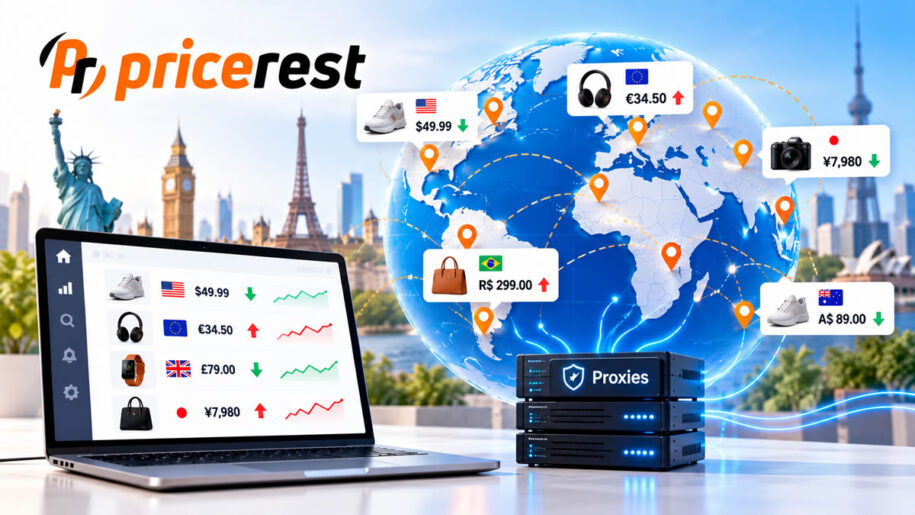
Proxies let a price monitoring system load a product page from an IP address in the country it is monitoring, so it sees the same price, currency, tax display, stock and delivery options as a local shopper. Without a local IP, many online stores redirect to another country’s site, show prices in the wrong currency or hide local promotions, and the competitor prices you collect are simply not the ones your customers see.
The problem
Why online prices depend on location
Online stores decide what to show based on where a visitor appears to be. The country, and sometimes the region or ZIP code, of the visitor’s IP address can change the price, the currency, whether VAT is included, which promotions appear, whether the product is in stock and whether the store ships there at all.
When a business monitors competitors in several countries from one office, every request comes from the same location. The result is often wrong data:
- Geo-redirects. A visitor from abroad is sent to the international or home-country version of the store, with different prices.
- Wrong currency. The store converts prices into the visitor’s currency, so the collected price is no longer the local one.
- Different tax display. European stores show prices including VAT, and some adjust the display for visitors from outside the EU.
- Local promotions. Country-specific campaigns, coupons and marketplace offers are only visible to local visitors.
- Region and ZIP pricing. Some large retailers change prices or stock by store, region or delivery address within the same country.
- Availability. A product can show as unavailable simply because the store does not ship to the visitor’s country.
Location affects prices even inside one country. Research by Alberto Cavallo found that Amazon charged identical prices across US ZIP codes 91% of the time, compared with 78% for three large traditional retailers, which means the other retailers varied their prices by location much more often. See more figures in our price monitoring statistics.
What a proxy does in price monitoring
A proxy is an intermediary server that sends a request on your behalf, so the website sees the proxy’s IP address instead of yours. In price monitoring, a proxy located in the target country makes the product page load as it would for a shopper in that country, which is what you need to collect the local price.
For global price monitoring, proxies solve three practical problems:
- Local accuracy. Each country’s prices are collected from that country.
- Coverage. One team can monitor many countries without local offices or devices.
- Reliability. Requests are spread across several IP addresses instead of coming from a single server, which keeps the load on each website low and predictable.
The tools
Types of proxies for price monitoring
| Proxy type | IP comes from | Typical use in price monitoring |
|---|---|---|
| Datacenter | Servers in data centers | Fast and affordable; works for many stores that do not localise by visitor type |
| Residential | Home internet connections | Stores that show different content to data center traffic; local prices in many countries |
| ISP (static residential) | Internet providers, hosted on servers | A stable local IP for longer sessions |
| Mobile | Mobile carrier networks | Mobile-first markets and app-based prices |
Rotating vs sticky sessions
A rotating proxy uses a new IP address for each request, which suits collecting many independent product pages. A sticky session keeps the same IP for several minutes, which is needed when a price only appears after several steps on the same site, for example after choosing a delivery region.
HTTP vs SOCKS5
Most price collection uses HTTP or HTTPS proxies, which every scraping tool and headless browser supports. SOCKS5 works at a lower level and can carry any kind of traffic, which is useful for tools that do not speak HTTP proxies natively.
The method
How country-level price collection works
- Choose the market. Decide which country, and if needed which region or ZIP code, each competitor should be monitored from.
- Route requests through that country. Send each request through a proxy located there. Many providers let you choose the country in the proxy username or with a parameter.
- Set the local context. Match the browser language, currency and, for location-based retailers, the store or delivery ZIP code, so the page shows the local offer.
- Read the right price. Extract the current selling price, the crossed-out list price, stock status and seller, not just the first number on the page.
- Normalise and compare. Store the price in its original currency, handle VAT consistently and convert only for comparison, so exchange rate movements are not mistaken for price changes.
From running crawlers in 64 countries. PriceRest collects prices from more than 2,500 online stores and routes requests through country-specific exit points for more than 20 markets, including the US, the UK, Germany, France, Spain, Canada, Mexico, Australia and Saudi Arabia. The problems we see most often when location is wrong are:
- a store silently redirecting to its international site, with different prices;
- prices shown in the visitor’s currency instead of the local one;
- a country-specific cookie consent page loading instead of the product;
- a product marked unavailable only because the store does not ship to the visitor’s country;
- location-based retailers showing the price of a default store rather than the one that matters.
How to check that you collected the local price
Before trusting a new country setup, check a sample of products by hand and keep these checks running automatically:
- The currency on the page matches the local currency.
- The domain after redirects is the local site, not an international version.
- The number format is parsed correctly, since 1.299,00 in Germany equals 1,299.00 in the US.
- The VAT display is what local shoppers see.
- The stock status reflects local availability, not shipping restrictions.
- The price is within a plausible range of its previous value, so sudden jumps are reviewed before they trigger decisions.
Using proxies responsibly
Proxies should be used to see the same public page a local shopper sees, not to get around a website’s restrictions. Responsible price monitoring collects only publicly displayed product data, keeps request rates low for every website, avoids personal data, and uses proxy providers whose IP addresses are sourced with the owners’ consent.
- Collect only public product pages, never data behind other people’s accounts.
- Keep request rates per website low and spread over time; monitoring once or a few times a day is enough for most products.
- Do not use proxies to bypass blocks, CAPTCHAs or explicit access restrictions.
- Choose providers that explain how their residential IPs are sourced.
- Follow the laws of the countries you operate in, and ask legal counsel if you are unsure.
Choosing
How to choose a proxy provider
| Criterion | What to look for |
|---|---|
| Country coverage | Every market you monitor, ideally with region or city targeting |
| Targeting method | Simple country selection, for example in the username |
| Session control | Both rotating and sticky sessions |
| Protocols | HTTP and SOCKS5 support for different tools |
| Success rate and speed | Consistent results on the stores you monitor, tested on a sample first |
| IP sourcing | A clear, consent-based sourcing policy for residential IPs |
| Pricing model | Per GB or per IP, matched to how many pages you collect |
Example: SocksNode. SocksNode is a proxy provider that lets you choose the country by adding it to the proxy username, and offers rotating ports for a new IP on every request as well as session ports that keep one IP, over both HTTP and SOCKS5. Its guide to collecting local prices country by country shows the setup in four steps.
Next steps
Proxies are one part of global price monitoring
Proxies solve the location problem, but accurate global price monitoring also needs product matching across languages, a crawler for each store, correct reading of sale prices and variants, currency and VAT normalisation, and constant maintenance as websites change. Teams that monitor a few stores can build this themselves with a proxy provider and a scraping tool. Teams that monitor many countries usually prefer software that handles location, matching and maintenance for them.
PriceRest monitors more than 2,500 online stores in 64 countries and 20 Amazon marketplaces, with location handled for you. Read how PriceRest monitors prices across countries or start with what price monitoring is.
FAQ
Frequently asked questions
Why do you need proxies for global price monitoring?
Online stores change prices, currency, tax display, promotions and availability based on the visitor location. A proxy in the target country lets a price monitoring system see the page as a local shopper does, so the collected competitor price is the one customers in that market actually see.
Do online prices really differ by country and location?
Yes. Stores redirect foreign visitors, show converted currencies and run local promotions, and some retailers vary prices even within one country. Research by Alberto Cavallo found that Amazon charged identical prices across US ZIP codes 91% of the time, compared with 78% for three large traditional retailers.
What type of proxy is best for price monitoring?
It depends on the stores. Datacenter proxies are fast and affordable and work for many stores. Residential proxies are better for stores that show different content to data center traffic and for local prices in many countries. Mobile proxies suit mobile-first markets.
What is the difference between rotating and sticky proxies?
A rotating proxy uses a new IP address for every request, which suits collecting many independent product pages. A sticky session keeps the same IP for several minutes, which is needed when a price only appears after several steps on the same website, such as choosing a delivery region.
Is it legal to use proxies for price monitoring?
Using proxies to view publicly displayed prices as a local shopper is a common business practice. Responsible use means collecting only public product data, keeping request rates low, not bypassing access restrictions and using ethically sourced IPs. Rules differ by country, so check with legal counsel for your situation.
Do I need my own proxies if I use price monitoring software?
Usually not. Price monitoring software such as PriceRest handles location for you and collects each country price from that country. Your own proxies are mainly needed if you build your own scrapers or tools.
Monitor local competitor prices in 64 countries
PriceRest collects each market’s prices from that market. 14-day free trial, no credit card required.
Start Free TrialRequest a personalized demo of PriceRest
We look forward to showing you how our platform allows you to optimize the pricing, execution, and measurement initiatives that matter most to your brand and products.
It is Free!
What can I expect?
- A brief conversation to assess what PriceRest can do to help your pricing strategy
- Live product demo with insight into how to get the most benefit from PriceRest
- Discuss your prices KPIs to determine the best path forward for your business
- No commitment required