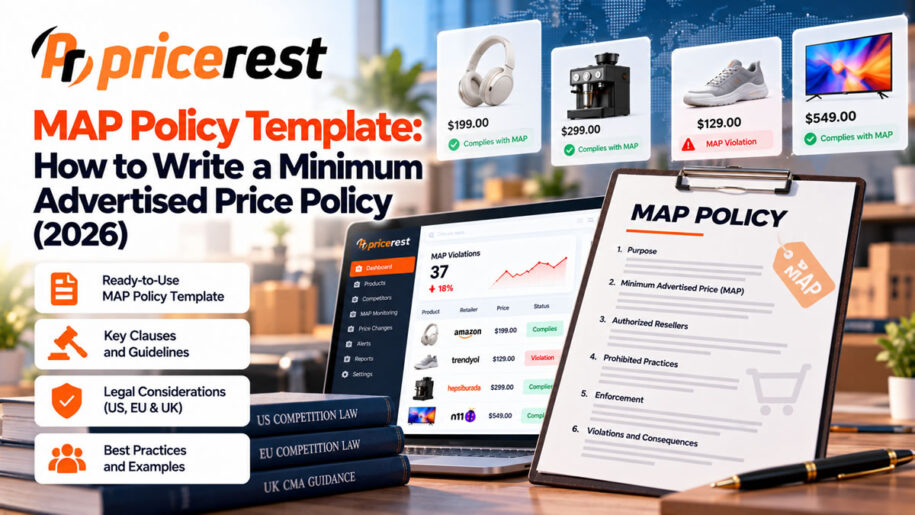
A MAP policy is a one-way announcement in which a brand states the minimum price at which its products may be advertised and what it may do if that price is not respected. A good US MAP policy covers advertised prices only, leaves resellers free to set their actual selling prices, applies to all resellers in the same way, does not ask anyone to sign or promise compliance and lets the brand decide responses alone. A free template you can copy is below. It is written for the United States; in the EU and UK a minimum advertised price is treated as resale price maintenance.
Important: This template is a starting point for general information, not legal advice. Competition law depends on the facts, the state and the country. Have a qualified antitrust lawyer review your policy and how you enforce it before you publish it. Read first: Is MAP pricing legal?
Basics
What is a MAP policy?
A MAP policy, or minimum advertised price policy, is a document in which a manufacturer or brand announces the lowest price at which its products may be advertised and how it may respond if a reseller advertises below that price. It restricts advertised prices, not the prices resellers actually charge. In the US it is usually written as a unilateral policy, not a contract.
Brands use MAP policies to protect brand value, reduce online price wars and support resellers that invest in service and presentation. Definitions of MAP policy, minimum advertised price and MAP violation are in our glossary.
Where you can use a MAP policy
| Market | Can you use this template? |
|---|---|
| United States | Generally yes, if the policy is truly unilateral. Check state law, especially in stricter states such as Maryland and California. |
| European Union | No. The 2022 Vertical Guidelines list minimum advertised prices as a form of resale price maintenance. Use recommended or maximum prices instead. |
| United Kingdom | No. The Competition and Markets Authority treats MAP as resale price maintenance and has fined brands for it. |
| Other countries | Check local competition law before you publish anything. |
The full comparison, with cases and fines, is in our guide: Is MAP pricing legal? MAP policy rules in the US, EU and UK.
Template
Free MAP policy template
Copy the template below and replace everything in square brackets. Have your lawyer review the result before you publish it.
[BRAND NAME] Minimum Advertised Price (MAP) Policy
Effective date: [DATE]
1. Purpose. [BRAND NAME] has adopted this policy on its own initiative to protect the value of its brand and to support resellers that invest in product knowledge, service and presentation.
2. Scope. This policy applies to the advertising of the products listed in Schedule A (the MAP Products) by all resellers, in any medium. This includes websites, online marketplaces, shopping feeds, social media, email campaigns, catalogs, flyers and paid advertising. It applies in the same way to all resellers.
3. Minimum advertised price. The minimum advertised price (MAP) of each MAP Product is shown in Schedule A. MAP Products should not be advertised below their MAP, including through advertised coupons, rebates or other offers that reduce the advertised price below MAP.
4. What this policy does not cover. This policy applies only to advertising. Resellers remain free to set their own selling prices. This policy does not apply to in-store prices, to the price shown in the shopping cart or at checkout after a customer has selected a product, or to prices given in reply to an individual customer’s request by phone, chat or email. Resellers may use statements such as Add to cart to see price or Call for price.
5. Unilateral policy. This policy is a unilateral statement by [BRAND NAME]. It is not an agreement. [BRAND NAME] does not ask for and will not accept any agreement, promise or assurance from a reseller about this policy. No signature or acknowledgement is required. Each reseller decides independently how to advertise. This policy is not open to negotiation.
6. Monitoring. [BRAND NAME] monitors advertised prices itself and through third-party service providers.
7. Consequences. If [BRAND NAME] determines, in its sole discretion, that a reseller has advertised a MAP Product below its MAP, [BRAND NAME] may take the action it considers appropriate, including [stopping or suspending sales of some or all MAP Products to that reseller] and [withdrawing advertising funds]. These decisions are made by [BRAND NAME] alone and will not be discussed or negotiated.
8. Questions and reports. Questions about this policy may be sent only to [NAME OR TEAM, EMAIL]. [BRAND NAME] will not discuss the advertising or prices of one reseller with another reseller. Any report it receives is reviewed by [BRAND NAME] independently.
9. Promotions. [BRAND NAME] may change or suspend the MAP of any MAP Product for a stated period at its sole discretion. Any such change will be announced to all resellers at the same time.
10. Authority. Only [TITLE] may speak for [BRAND NAME] about this policy. No other employee or sales representative may change this policy, make exceptions to it or reach any understanding about it.
11. Changes. [BRAND NAME] may change or withdraw this policy at any time. The current version is available at [URL].
Schedule A: MAP Products
| Product | SKU | MAP | Effective from |
|---|---|---|---|
| [PRODUCT NAME] | [SKU] | [PRICE] | [DATE] |
| [PRODUCT NAME] | [SKU] | [PRICE] | [DATE] |
Why each clause is there
| Clause | Why it matters |
|---|---|
| Purpose | Records your own business reasons. A policy should not look as if it was adopted because resellers complained about a discounter. |
| Scope | Applying the policy to all resellers and all advertising avoids targeting one group, such as online sellers. |
| Minimum advertised price | Sets a clear price and closes the gap of coupons and rebates advertised below MAP. |
| What it does not cover | The heart of the policy. It keeps resale prices free and gives resellers another way to communicate a lower price. |
| Unilateral policy | Keeps the policy within the Colgate doctrine. Signatures and promises can make a unilateral policy look like an agreement. |
| Consequences | Reserves your right to act without promising a fixed process or inviting negotiation. |
| Questions and reports | Stops your team from passing one reseller’s complaints to another, which is a known risk. |
| Authority | Sales teams can create risk by improvising. A single point of contact reduces that risk. |
Many brands also link MAP to advertising they help pay for, such as cooperative advertising funds. Antitrust lawyers note that the law gives manufacturers more room to set terms for advertising they fund, so ask your counsel whether this fits your program.
Risks
Mistakes that can turn a policy into an agreement
- Asking resellers to sign. A signature or acknowledgement can make a unilateral policy look bilateral.
- Asking for promises. Do not ask a reseller to confirm that it will comply, in writing or on a call.
- Negotiating. Do not negotiate terms, exceptions or outcomes with individual resellers.
- Controlling selling prices. A policy that also restricts in-store or checkout prices is no longer only about advertising.
- Acting because of reseller pressure. Do not adopt or enforce a policy because resellers complained about a discounter. Coordinated reseller pressure is a red flag.
- Sharing complaints. Do not tell one reseller what another reseller said or how you dealt with it.
- Enforcing selectively. Inconsistent enforcement weakens the policy and can look like favoritism or a side deal.
- Loose language. Emails that say a reseller agreed to a price can undermine an otherwise sound policy.
In-cart prices, marketplaces and coupons
In-cart prices. The price charged at checkout is a selling price, so the policy should not control it. That is why policies commonly allow displays such as Add to cart to see price. These displays can blur the line between advertised and selling prices, so state clearly in your policy what is allowed.
Marketplaces. Marketplace listings are public advertising, so name them in your policy. On a marketplace, the listed price is often the advertised price, and the marketplace itself is not bound by your policy. For the practical steps, see how to enforce MAP pricing on Amazon.
Coupons and rebates. An advertised coupon can bring the advertised price below MAP, so address it directly, as clause 3 of the template does.
Process
How to enforce a MAP policy
To enforce a MAP policy in the US, monitor advertised prices across every channel, confirm that each violation is real, decide your response alone under the written policy and apply the same approach to every reseller. Do not negotiate or ask for promises of compliance. Keep a record of each decision and the independent business reasons behind it.
Brands differ on whether to send a notice before taking action. A notice can stay factual, but it must not ask the reseller to agree to anything or turn into a discussion, and any tiered system of warnings should be designed with your lawyer. Handle reports from resellers through a defined process, and evaluate each one against your written policy and your own monitoring rather than acting because a reseller asked you to.
In the EU and UK, this kind of enforcement is exactly what regulators have fined. Brands there should not use warnings, supply stops or bonus cuts to influence advertised or selling prices.
How to roll out your policy in 7 steps
- Record your business reasons. Write down why your company is adopting the policy, in your own terms.
- Draft with counsel. Adapt the template with an antitrust lawyer and check the laws of the states where you sell.
- Set your prices. Build Schedule A with the MAP, SKU and start date of each product.
- Train your team. Teach sales, channel and customer service staff the difference between advertised and selling prices, and who may talk about the policy.
- Announce it to everyone at once. Send the same policy to all resellers, with no signature request.
- Start monitoring. Monitor advertised prices across marketplaces and retailer websites, and find unauthorized sellers.
- Review it regularly. Review the policy and your enforcement records periodically as your channels and the law change.
PriceRest
How PriceRest helps
PriceRest gives you the data a MAP program needs. It finds where your products are advertised, collects advertised prices and sellers across Amazon, Google Shopping, marketplaces and more than 2,500 online stores in 64 countries, flags prices below the MAP you set and keeps a dated history of every violation by product and seller. How you respond remains your decision.
See our MAP monitoring software and Amazon MAP violation software, or compare plans on our pricing page.
FAQ
Frequently asked questions
What is a MAP policy?
A MAP policy is a document in which a brand announces the minimum price at which its products may be advertised and how it may respond if a reseller advertises below that price. It restricts advertised prices, not selling prices. In the US it is usually written as a unilateral policy rather than a contract.
What should a MAP policy include?
A MAP policy should state its purpose, the products and advertising it covers, the MAP of each product and what it does not cover, such as selling prices and in-cart prices. It should also say that it is unilateral, explain possible consequences, name a single contact and reserve the right to change it.
Do resellers have to sign a MAP policy?
No. In the US, asking resellers to sign or acknowledge a MAP policy can make a unilateral policy look like an agreement, which increases legal risk. The usual approach is to announce the policy to all resellers at the same time and not to ask for any signature, promise or confirmation.
What is the difference between a MAP policy and a MAP agreement?
A MAP policy is a one-way announcement that the brand decides and enforces alone. A MAP agreement is a commitment accepted by both the brand and the reseller. Under the US Colgate doctrine, unilateral policies receive more protection, while agreements are assessed under antitrust rules and carry more risk, especially under stricter state laws.
Does a MAP policy apply to the price in the cart?
Usually not. The price charged at checkout is a selling price, and a MAP policy should restrict only advertised prices. Many policies allow displays such as Add to cart to see price or Call for price. Because these displays can blur the line, the policy should state clearly what is allowed.
Does a MAP policy apply to Amazon and other marketplaces?
Yes, marketplace listings are public advertising, so a MAP policy should name them. The policy applies to the resellers you supply, not to the marketplace itself. Brands monitor marketplace sellers themselves and respond under their own policy, while counterfeit and trademark problems go through the marketplace brand protection processes.
How do you enforce a MAP policy?
Monitor advertised prices across all channels, confirm each violation, decide your response alone and apply the same approach to every reseller. Typical responses include stopping supply or withdrawing advertising funds. Do not negotiate or ask for promises of compliance, keep records of your decisions and have counsel review the process.
Should a MAP policy include warnings before penalties?
It depends. Some brands send a factual notice before acting, while others reserve full discretion in the policy. A fixed warning system can invite discussion and promises of compliance, which may undermine a unilateral policy. Decide your approach with an antitrust lawyer, and avoid asking any reseller to agree to anything.
Can I use this MAP policy template in the EU or UK?
No. The template is written for the United States. In the EU and UK, a minimum advertised price is treated as resale price maintenance, a hardcore restriction of competition law. Brands there can use non-binding recommended prices, maximum prices and selective distribution based on quality criteria instead, with advice from local counsel.
How do you find MAP violations?
Use MAP monitoring software that discovers where your products are advertised, matches listings to the right product, collects advertised prices on a schedule and alerts you when a price falls below MAP. Manual checks miss temporary violations and do not scale across marketplaces, Google Shopping and retailer websites.
See who advertises below your MAP
MAP violation alerts, seller discovery and dated violation history across Amazon, Google Shopping and 2,500+ online stores. 14-day free trial, no credit card required.
Start Free Trial