
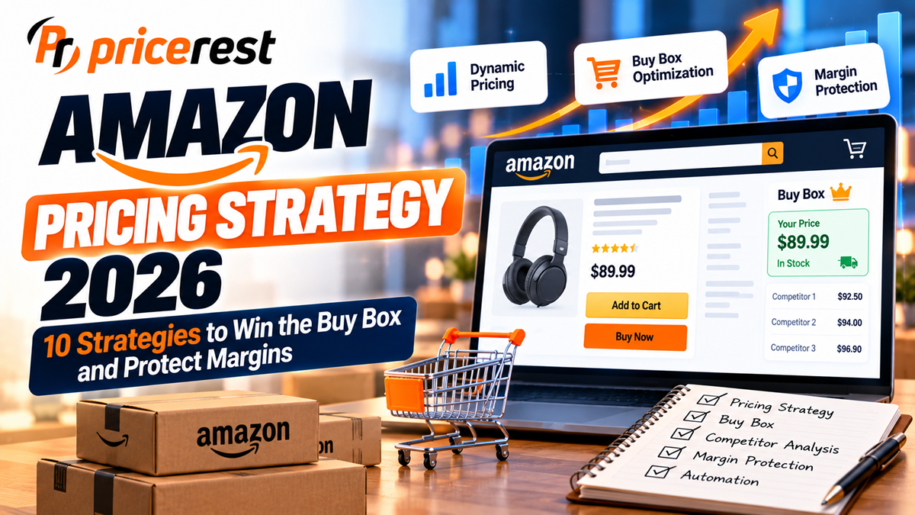
The best Amazon pricing strategy in 2026 is a rule-based approach that competes for the Buy Box on total landed price while protecting a minimum margin. Price against the offers that can actually win the featured offer, reprice automatically within a floor and a ceiling, use short promotions instead of permanent cuts, keep prices consistent with your other channels to stay clear of the Fair Pricing Policy, and monitor every Amazon marketplace you sell on separately.
Sources: Chen, Mislove and Wilson, WWW 2016; see our price monitoring statistics.
Basics
How pricing works on Amazon
On Amazon, many sellers can offer the same product on one product page, identified by its ASIN. Amazon picks one offer as the featured offer, the one behind the Add to Cart button, also called the Buy Box. Price, including shipping, is a major factor in that choice, together with delivery speed and seller performance, so Amazon pricing is mostly about competing for the featured offer without giving away margin.
Four things make Amazon pricing different from pricing on your own store:
- Shared listings. You compete with every other seller of the same ASIN, sometimes including Amazon itself, on the same page.
- Fast price changes. Research on Amazon Marketplace found more than 500 sellers using algorithmic pricing; only 13% of best-selling products kept a static Buy Box price over six weeks, while half had more than 14 changes.
- Fees. Amazon charges a referral fee on each sale, a percentage that depends on the category, and fulfillment fees if you use FBA. Your price floor has to cover both.
- Pricing rules. Under the Amazon Marketplace Fair Pricing Policy, Amazon can remove the featured offer from an offer it considers significantly higher than recent prices on or off Amazon.
Learn the terms used in this guide in our price monitoring glossary.
Strategies
10 Amazon pricing strategies for 2026
1. Compete for the Buy Box on landed price
Compare your total price including shipping with the offers that can win the featured offer, not with every offer on the page. A cheap offer with slow delivery or weak seller metrics may not compete with you at all.
2. Rule-based repricing with a floor and a ceiling
Set clear rules, for example staying slightly below the current featured offer, and always define a minimum price that protects margin and a maximum price that stays within the Fair Pricing Policy. Amazon offers its own Automate Pricing tool in Seller Central, which requires a minimum price for every rule; third-party repricers add more complex rules.
3. Algorithmic or AI repricing
Algorithmic repricers react to competitor moves, sales velocity and stock levels automatically. They suit large catalogs and busy listings where prices change many times a day, but they need the same guardrails as simple rules.
4. Value-based pricing for your own brand
If you are the only seller of a product, there is no Buy Box battle. Price on the value of the product and the price of comparable alternatives, and use reviews, images and A+ content to justify a premium.
5. Short promotions instead of permanent cuts
Use Amazon promotions such as coupons, Lightning Deals and Prime Exclusive Discounts for events like Prime Day, Black Friday and Cyber Monday, then return to your regular price. Online promotions are short: in a 2026 PriceRest study, 56% of price cuts were reversed within 14 days.
6. Bundles and multipacks
A bundle or multipack can create its own listing, where you are not competing head to head with every seller of the single item. It also raises the order value.
7. Psychological pricing
Charm prices such as 19.99 instead of 20.00 and clear price steps between sizes still influence shoppers on Amazon. Combine them with your repricing rules instead of letting a repricer produce odd prices such as 20.03.
8. Fulfillment-aware pricing
Delivery speed matters for the featured offer, so an FBA offer can often win at a slightly higher price than a slower merchant-fulfilled offer. Price FBA and merchant-fulfilled offers separately and include fulfillment fees in your floor.
9. Marketplace-by-marketplace pricing
Each Amazon marketplace has its own competitors, currency, fees and tax display, so one global price rarely works. Prices on European marketplaces are shown including VAT, while prices on Amazon.com are shown before sales tax. Set and monitor prices per marketplace.
10. MAP and price control for brands
Amazon does not enforce a brand MAP policy for it. Brands that sell through resellers need to monitor advertised prices on their listings, detect sellers below MAP and identify unauthorized sellers, then act on their reseller agreements. Amazon Brand Registry helps protect listings, while price monitoring provides the evidence. See Amazon MAP violation software.
How to set a minimum price on Amazon
Your Amazon floor price must cover product cost, Amazon fees and the profit you need. A simple formula is: minimum price equals product cost plus fulfillment fee plus target profit, divided by one minus the referral fee rate. Every repricing rule should use this floor.
Minimum price = (Cost + Fulfillment fee + Target profit) divided by (1 minus Referral fee rate)
Illustrative example: a product costs 12, the fulfillment fee is 5, you want at least 3 profit per unit and the referral fee is 15%. The minimum price is 20 divided by 0.85, which is 23.53. Below that price, every sale earns less than your target. Check your actual fees in Seller Central, since they vary by category, size and marketplace. To work out margins and markups, use our free margin and markup calculator.
Common Amazon pricing mistakes
- No minimum price. Two repricers undercutting each other without floors can drive a price toward zero within hours.
- Matching out-of-stock or slow offers. An offer that cannot ship soon is not your real competition.
- Ignoring landed price. Comparing item prices without shipping gives the wrong picture.
- Raising prices too far. A price far above your recent prices or your prices elsewhere can trigger the Fair Pricing Policy and cost you the featured offer.
- Permanent cuts for temporary competition. Many competitor discounts end within days; match them with rules that expire, not with a new base price.
- One price for every marketplace. Currency, VAT and competition differ by marketplace.
Monitoring
How to monitor Amazon prices
Monitor the featured offer price and seller, every other offer on your listings with its landed price and fulfillment method, stock status, and your price on other channels. Because Buy Box prices on busy listings change many times a week, check them several times a day rather than once a day or once a week.
| What to track | Why it matters |
|---|---|
| Featured offer price and seller | The price you actually compete with |
| All offers with shipping and fulfillment method | Shows which offers can realistically win the Buy Box |
| Stock and availability | A seller without stock cannot take your sales |
| Your prices on other channels | Keeps you consistent with the Fair Pricing Policy |
| Sellers below MAP and unauthorized sellers | Protects brand pricing across resellers |
| Ratings and reviews | Explain why a higher price can still win |
From monitoring Amazon in 20 marketplaces. The issues we see most often when sellers monitor Amazon themselves:
- tracking only the lowest price on the page instead of the featured offer;
- missing shipping costs, so landed prices are wrong;
- prices that change by delivery location, which need to be checked from the right country;
- offers from unauthorized sellers appearing and disappearing between manual checks.
PriceRest monitors Buy Box prices, sellers, stock and reviews on Amazon and flags sellers that advertise below MAP. See the Amazon price tracker, unauthorized seller detection and Amazon review monitoring.
Pricing across 20 Amazon marketplaces
Sellers expanding beyond one country face different competition, currency and tax display in each marketplace. PriceRest monitors these 20 Amazon marketplaces:
| Region | Amazon marketplaces | Price display |
|---|---|---|
| North America | Amazon.com, Amazon.ca, Amazon.com.mx | US and Canada before sales tax; Mexico including VAT |
| South America | Amazon.com.br | Including local taxes |
| Europe | Amazon.co.uk, Amazon.de, Amazon.fr, Amazon.it, Amazon.es, Amazon.nl, Amazon.se, Amazon.pl, Amazon.com.tr | Prices including VAT |
| Middle East and Africa | Amazon.ae, Amazon.sa, Amazon.eg | Including VAT |
| Asia-Pacific | Amazon.co.jp, Amazon.in, Amazon.sg, Amazon.com.au | Including local consumption tax or GST |
Read more about global price monitoring and why location matters for price collection.
FAQ
Frequently asked questions
What is the best pricing strategy for Amazon?
For most sellers, the best Amazon pricing strategy is rule-based repricing that competes for the featured offer on total landed price while never going below a minimum price that covers cost, fees and target profit. Brand owners who are the only seller of a product should price on value instead.
How does Amazon decide who wins the Buy Box?
Amazon chooses the featured offer, also called the Buy Box, from the eligible offers on a product page. Total price including shipping is a major factor, together with delivery speed, availability and seller performance. Amazon does not publish the exact formula.
How often should you reprice on Amazon?
On competitive listings, several times a day. Research on Amazon Marketplace found that only 13% of best-selling products kept the same Buy Box price over six weeks, while half had more than 14 changes. Automated repricing with a price floor is the practical way to keep up.
Does Amazon allow automated repricing?
Yes. Amazon offers its own Automate Pricing tool in Seller Central for Professional sellers, with rules such as matching the featured offer or a competitive price, and it requires a minimum price for each rule. Many sellers also use third-party repricing software.
What is the Amazon Fair Pricing Policy?
The Amazon Marketplace Fair Pricing Policy lets Amazon act against prices that harm customer trust. For example, Amazon can remove the featured offer from an offer that is significantly higher than recent prices on or off Amazon, so very high maximum prices in repricing rules are risky.
Does Amazon enforce MAP pricing?
No. Amazon does not enforce the minimum advertised price policy of a brand. Brands monitor their listings for sellers advertising below MAP, identify unauthorized sellers and enforce their own reseller agreements, using price monitoring software as evidence.
Should prices be the same on every Amazon marketplace?
Usually not. Each Amazon marketplace has its own competitors, currency, fees and tax display, with European marketplaces showing prices including VAT. Set and monitor prices per marketplace, and review them when exchange rates move.
Monitor Amazon prices in 20 marketplaces
Track Buy Box prices, sellers, stock and MAP violations automatically. 14-day free trial, no credit card required.
Start Free TrialRequest a personalized demo of PriceRest
We look forward to showing you how our platform allows you to optimize the pricing, execution, and measurement initiatives that matter most to your brand and products.
It is Free!
What can I expect?
- A brief conversation to assess what PriceRest can do to help your pricing strategy
- Live product demo with insight into how to get the most benefit from PriceRest
- Discuss your prices KPIs to determine the best path forward for your business
- No commitment required