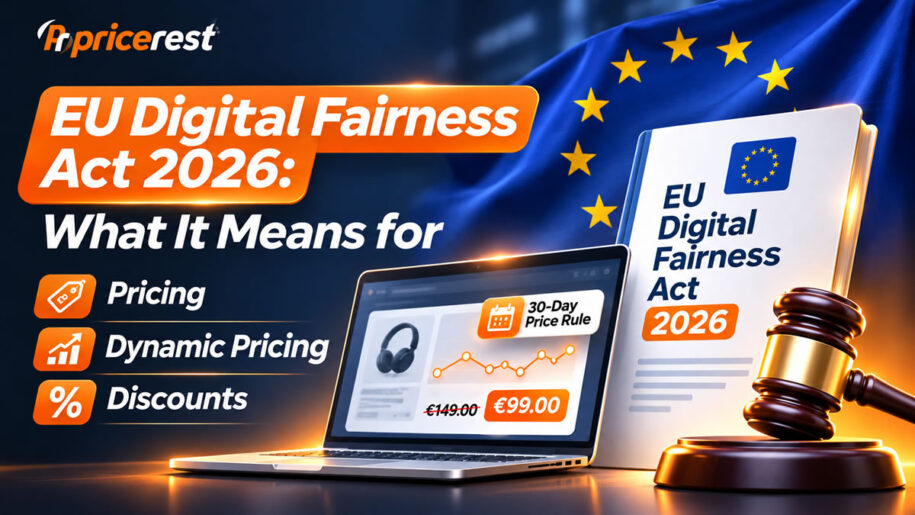
The EU Digital Fairness Act (DFA) is a proposed regulation, published by the European Commission on November 11, 2026, that updates EU consumer law for online shopping. For pricing it would ban crossed-out and percentage “compare at” prices unless the reference is a current price charged by a clearly identified competitor, ban drip pricing and fake scarcity, require the duration of limited-time offers, restrict harmful personalised pricing and add transparency rules for dynamic pricing of event tickets. It does not ban dynamic pricing in general. The proposal still needs the approval of the European Parliament and the Council, and it would apply 12 months after it enters into force.
Sources: European Commission press release and questions and answers, the DFA proposal and its annexes, COM(2026) 1100, November 11, 2026. This is a proposal and may change.
Overview
What is the Digital Fairness Act?
The Digital Fairness Act is a proposed EU regulation that would replace the Unfair Commercial Practices Directive with a directly applicable regulation and add new rules for online practices such as dark patterns, hidden fees, misleading price comparisons, personalisation, influencer marketing and subscriptions. It applies to all businesses selling to consumers, not only to large platforms.
- Published: November 11, 2026, as part of a consumer package with a revised Consumer Protection Cooperation (CPC) Regulation and a simplification directive.
- Legal form: a regulation, so the same rules would apply directly in every member state instead of 27 national versions.
- Scope: all business-to-consumer commercial practices, online and offline, with a focus on online interfaces.
- Status: a Commission proposal. It is not law yet and will be negotiated by the European Parliament and the Council.
Pricing rules in the DFA at a glance
| Topic | What the proposal says | Where |
|---|---|---|
| Price comparisons | Crossed-out prices, percentage or money savings based on a reference price are banned unless the reference is a current price charged by a clearly identified competitor | Annex I, point 11 |
| Drip pricing | The first price shown must include all foreseeable fees, taxes and charges the consumer will unavoidably pay | Annex I, point 12 |
| Limited-time offers | False “limited time” claims are banned, and true ones must state the duration of the offer | Annex I, points 13 and 14 |
| Scarcity and popularity | False availability or popularity claims, and persistent scarcity messages through checkout, are banned | Annex I, points 53 and 54 |
| Price prominence | The price may not be shown less prominently than other key information | Annex I, point 60 |
| Personalised pricing | No personalised prices based on profiling that are likely to harm minors or vulnerable consumers | Article 13 |
| Dynamic ticket prices | Show how many tickets are available at the advertised price and the maximum possible price | Article 18 |
| Virtual queues | Show the price at entry, real-time changes and the maximum price | Article 19 |
| Virtual currencies | Prices in in-app currencies must be shown in real money | Article 14 |
| Subscriptions | Reminder and active consent before a free trial turns paid, easy online cancellation | Articles 20 to 23 |
| Automated systems | Consumers can set the key parameters of AI systems that contract for them | Article 26 |
Does the DFA ban dynamic pricing?
No. The DFA proposal does not ban dynamic pricing. Retailers can still change prices based on demand, stock or competitor prices. The proposal adds transparency rules where dynamic pricing is most controversial, event tickets and virtual queues, and it restricts personalised prices that are likely to harm minors or vulnerable consumers.
For event tickets whose price can rise because of the trader’s actions or algorithmic pricing, the trader would have to show clearly how many tickets in the category are available at the advertised price and the maximum price a consumer may have to pay. In virtual queues, consumers would see the price when they join the queue, real-time price changes and the maximum price.
For most online retailers, dynamic pricing stays legal, but the way prices are presented becomes stricter: full price up front, honest urgency and comparisons that can be verified. For the wider legal picture, see what dynamic pricing is and whether it is legal.
Price claims
The big change: crossed-out and “compare at” prices
Under point 11 of the DFA blacklist, showing a saving as a percentage or amount, crossing out a reference price or using similar techniques would be unfair in all circumstances unless the reference price is a current price charged for the product by a clearly identified competitor on the market.
The explanatory recital adds that comparisons with estimated or recommended prices, such as a manufacturer’s recommended retail price, should not use these techniques, while comparing a second-hand or refurbished product with the price of the same new product remains possible. Price reductions on your own prices stay governed by the existing EU 30-day lowest price rule.
| Price claim | Today in the EU | Under the DFA proposal |
|---|---|---|
| Discount on your own price | Show the lowest price of the last 30 days | Unchanged: the 30-day rule still applies |
| “RRP €129, now €99 (–23%)” | Allowed if not misleading | Crossed-out or percentage format banned against recommended prices |
| “€99, 15% below Competitor X” | Allowed if not misleading | Allowed only with a current price of a clearly identified competitor |
| “Compare at €150” without a source | Risky under general rules | Banned |
| Refurbished vs new price | Allowed if not misleading | Possible, according to the recital |
The practical consequence is simple: if you want to show a saving against a competitor, you need the competitor’s current price for the same product, the competitor’s name and evidence of when you checked it. That is exactly what competitor price tracking records.
Personalised pricing
Article 13 of the proposal would ban personalised prices based on profiling when they are reasonably likely to harm the consumer and the trader knows with reasonable certainty that the consumer is a minor or vulnerable. Personalisation that benefits consumers, such as student or senior discounts, stays allowed.
The recital also says pricing based on lawful, relevant, objective and transparent factors, such as evidence-based insurance risk or extra costs for the trader, is not prevented. Separately, the DFA would extend the existing platform bans on personalised advertising to minors or based on sensitive data to all traders.
Fake scarcity, urgency and limited-time offers
- False scarcity and popularity. Claims such as “Only 1 left” or “5 other customers are looking at this” would be banned when false, and so would persistent scarcity messages throughout checkout.
- Limited-time offers. Falsely saying an offer is available only for a very limited time would be banned, and genuine limited-time offers would have to state how long they last.
- Pressure and shaming. Confirmshaming (“No thanks, I don’t like good deals”) and pre-ticked add-ons would be on the blacklist.
Countdown timers and “ends tonight” banners therefore need to be true and to show the real end of the offer.
Drip pricing and the total price
The first price shown to the consumer would have to include all foreseeable fees, taxes and charges that the consumer cannot avoid. Adding mandatory booking, service or handling fees at checkout, known as drip pricing, would be banned in all circumstances. The UK already enforces a similar rule under the Digital Markets, Competition and Consumers Act 2024.
AI shopping agents and automated systems
The DFA is one of the first EU laws to address AI shopping agents directly. Traders that offer consumers automated systems for contracting would have to let consumers set the key parameters, for example a spending limit, and to disclose when the system is paid for proposing a contract, such as a sponsored suggestion. Contracts fully automated on both sides would get simpler information requirements.
For retailers, this matters because agents compare prices across stores. Accurate, consistent and competitive prices become even more important when software makes the first comparison.
Enforcement
Fines and enforcement
Under the revised CPC Regulation proposed alongside the DFA, the Commission could investigate large-scale cases directly and fine companies up to 6% of worldwide annual turnover. National authorities would still enforce most cases, and member states would have to set maximum fines for widespread infringements of at least 4% of annual turnover.
- When the Commission steps in: breaches likely to affect consumers in at least two thirds of member states, representing at least two thirds of the EU population, by companies that are not SMEs.
- Non-EU companies: would have to appoint a legal representative in the EU.
- Faster cooperation: deadlines for key steps in cross-border cases between national authorities.
Timeline: what happens next
- November 11, 2026: the Commission publishes the proposal.
- Negotiation: the European Parliament and the Council adopt their positions and negotiate a final text. This usually takes one to two years, and the content can change.
- Entry into force: 20 days after publication in the Official Journal.
- Application: 12 months after entry into force, according to the proposal.
Until then, current EU rules apply, including the 30-day lowest price rule for discounts and the Unfair Commercial Practices Directive.
Action
What retailers should do now
- List every price claim format you use: crossed-out prices, “compare at”, RRP comparisons, “save X%”.
- Replace RRP-based crossed-out prices over time with your own 30-day prior price or with verified competitor prices.
- Build an evidence trail for competitor comparisons: competitor name, product, price, date and link.
- Show the total price first, including all mandatory fees.
- Audit urgency messages, timers and stock warnings for accuracy, and add the end date to limited-time offers.
- Review personalised pricing and make sure it cannot target minors or vulnerable consumers to their harm.
- Check subscription flows: trial reminders, active consent and easy cancellation.
- Follow the negotiations, because the final text can still change.
PriceRest
How PriceRest helps
PriceRest records current and historical competitor prices with the seller, date and product link, which is the evidence a “compare at” claim against a named competitor would need under the DFA, and the price history you need for the 30-day rule today.
- Current competitor prices. Daily and instant price checks across more than 2,500 online stores in 64 countries, 20 Amazon marketplaces and Google Shopping, plus login-protected prices.
- Exact product matching. Comparisons must be for the same product, so PriceRest matches listings with barcodes, MPN, titles and AI image recognition. See our product matching engine.
- Price history and exports. Daily prices and stock with dates, exportable to Excel as evidence.
- Dynamic pricing within limits. Dynamic pricing rules with minimum and maximum prices.
General information, not legal advice. The Digital Fairness Act is a proposal and may change before adoption.
FAQ
Frequently asked questions
What is the EU Digital Fairness Act?
The Digital Fairness Act is a proposed EU regulation published by the European Commission on November 11, 2026. It would update EU consumer law for online shopping with new rules on dark patterns, hidden fees, price comparisons, personalisation, influencer marketing and subscriptions.
Is the Digital Fairness Act already law?
No. It is a Commission proposal that the European Parliament and the Council still have to negotiate and adopt. According to the proposal, it would apply 12 months after it enters into force, and the text may change during the negotiations.
Does the Digital Fairness Act ban dynamic pricing?
No. Dynamic pricing remains allowed. The proposal adds transparency rules for event tickets whose price can rise and for virtual queues, and it bans personalised prices based on profiling that are likely to harm minors or vulnerable consumers.
Will crossed-out prices be banned under the DFA?
Crossed-out prices and percentage savings based on a reference price would be banned unless the reference is a current price charged by a clearly identified competitor. Discounts on your own prior price remain allowed under the EU 30-day lowest price rule.
Can I still compare with the recommended retail price?
Under the proposal, savings shown as a percentage, an amount or a crossed-out price could not be based on a recommended or estimated price. Recommended prices could still be mentioned in a fair and transparent way, but not as a crossed-out reference price.
Does the DFA ban personalised pricing?
Not in general. It bans personalised prices based on profiling that are likely to harm a consumer when the trader knows with reasonable certainty that the consumer is a minor or vulnerable. Discounts for groups such as students or seniors stay allowed.
What does the DFA say about drip pricing?
The first price shown must include all foreseeable fees, taxes and charges that the consumer will unavoidably pay. Adding mandatory fees later in checkout would be banned in all circumstances.
What are the fines under the Digital Fairness Act?
Under the proposed CPC revision, the Commission could fine companies up to 6% of worldwide annual turnover in large-scale cases affecting at least two thirds of member states. For widespread infringements, member states would have to set maximum fines of at least 4% of annual turnover.
When will the Digital Fairness Act apply?
It would apply 12 months after entry into force. Before that, the European Parliament and the Council must agree on a final text, which usually takes one to two years, so retailers have time to prepare.
How should retailers prepare for the DFA?
Review every price claim, move away from crossed-out recommended prices, keep evidence for competitor price comparisons, show total prices up front, make urgency messages true and add end dates to limited-time offers.
Back every price claim with real competitor data
Current and historical competitor prices with seller, date and link across 2,500+ online stores, Google Shopping and 20 Amazon marketplaces. 14-day free trial, no credit card required.
Start Free Trial