
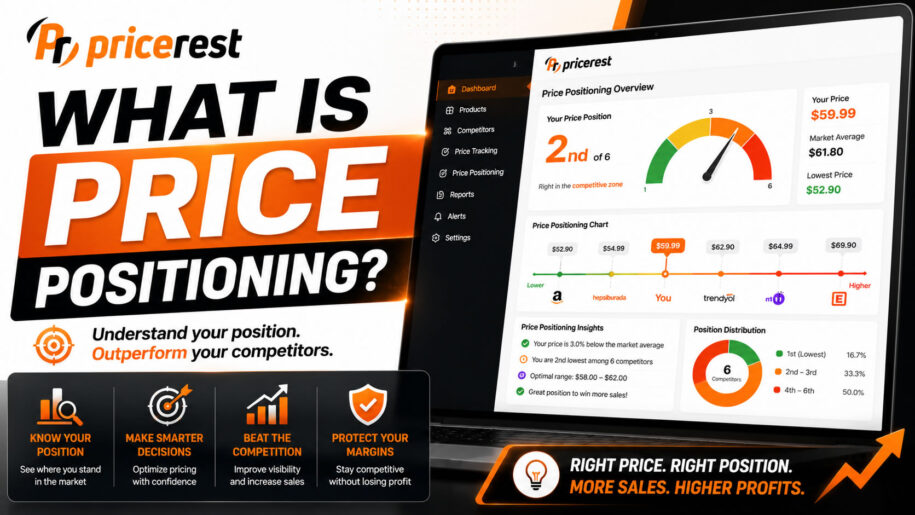
Price positioning refers to how a product or service is perceived in relation to its price in the market. Imagine you’re shopping for headphones. You see one pair priced at $20 and another at $200. Even without knowing the details, you might assume the $200 headphones are higher quality or offer more features. That’s price positioning—how consumers perceive value based on price alone.

Price positioning refers to whether consumers perceive a brand’s product prices as expensive, neutral, or cheap, which is associated with the quality of the products and services offered. In e-commerce, price positioning is crucial as it impacts customers’ buying decisions and brand perception. That is why, each brand owner who is seeking for success in e-commerce should have an understanding of the concept “Price Positioning”.
Competitors’ actions and changes in supply and demand can affect this perception of potential and actual customers regarding price positioning. To alter price positioning, a suitable pricing strategy must be chosen, which can change customers’ perceptions of the brand or a particular product. There are various business strategies that can be used for price positioning in e-commerce. Here are a few examples:
Price Positioning Strategies
- Penetration Pricing: This strategy involves setting a low price for products in order to attract new customers and increase market share. The aim is to establish brand loyalty and then gradually increase the prices.
- Price Skimming: This strategy involves setting a high price for a new product, with the aim of generating maximum revenue from early adopters and then gradually reducing the price as the product matures.
- Value-Based Pricing: This strategy involves setting a price based on the perceived value of the product or service to the customer, rather than the cost of production. This considers factors such as quality, features, and benefits.
- Competitive Pricing: This strategy involves setting a price based on the prices of competitors. The aim is to offer similar products at a similar price to competitors to remain competitive in the market.
- Dynamic Pricing: This strategy involves changing the price of a product based on real-time market demand, supply, and other factors such as time of day, seasonality, and location. This allows businesses to adjust their prices in response to changing market conditions.
It is important to note that changing the price positioning can also attract a different target market. To optimize decision-making for business growth, a deep understanding of the brand’s price positioning is necessary. By effectively managing their price positioning strategy, businesses can attract and retain customers, differentiate themselves from competitors, and increase sales and revenue. Consistent pricing across different e-market areas and channels can help to establish a strong brand identity and improve customer trust and loyalty. Additionally, monitoring competitors’ prices and adjusting pricing strategies accordingly can help businesses stay competitive and capture more market share. Therefore, price positioning is an important factor that can impact a business’s success in different e-market areas.
Importance Of Price Monitoring Tools
Price intelligence tools can provide valuable insights into competitors’ pricing strategies, market trends, and consumer behavior, which can help business owners to optimize their price positioning. Tools like Pricerest can monitor competitors’ prices, analyze pricing trends, and provide recommendations on the best pricing strategies based on the data. By leveraging price intelligence tools, business owners can make data-driven pricing decisions that help them stay competitive in the market, improve their price positioning, and ultimately drive business growth.

Price monitoring is the ultimate key to maintaining price positioning because it helps to ensure that the prices of a business’s products or services remain in line with their intended price positioning. By regularly monitoring the prices of competitors and adjusting prices as needed, businesses can maintain their position in the market and ensure that customers perceive their prices as reasonable and competitive. Without regular price monitoring, a business may be left with prices that are too high or too low, damaging their price positioning and potentially driving customers to competitors with more competitive prices. Price monitoring tools can help automate the process of monitoring prices across multiple channels and provide insights into how competitors are pricing their products. This information can then be used to adjust prices as needed and maintain the intended price positioning.
Join Pricerest today for balancing prices for better price positioning.
If you also want to monitor your retailers or sellers on e-commerce, join PriceRest today. And see What PriceRest can do for you.

What is Price Positioning? Video
Request a personalized demo of PriceRest
We look forward to showing you how our platform allows you to optimize the pricing, execution, and measurement initiatives that matter most to your brand and products.
It is Free!
What can I expect?
- A brief conversation to assess what PriceRest can do to help your pricing strategy
- Live product demo with insight into how to get the most benefit from PriceRest
- Discuss your prices KPIs to determine the best path forward for your business
- No commitment required