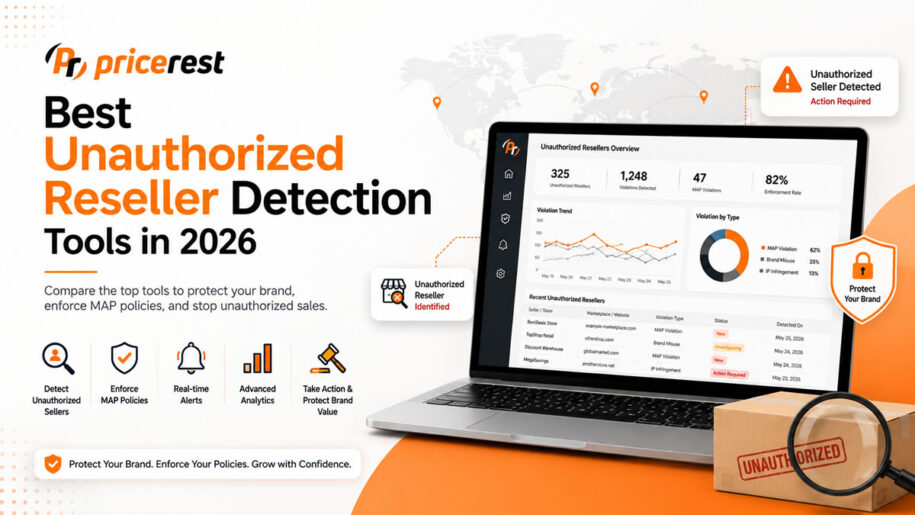
The best unauthorized reseller detection tool depends on what you need after a seller is found. To see who sells your products and at what price, choose a monitoring tool such as PriceRest, Price2Spy, Wiser or Minderest. To automate notices to sellers, look at TrackStreet. To remove listings at scale, look at Red Points, MarqVision, Corsearch, BrandShield or Gray Falkon. No tool can make it illegal to resell genuine goods. In the US, the first sale doctrine generally allows that resale, so your legal options depend on material differences, contracts and how the seller presents your brand.
About this comparison: PriceRest wrote this page and PriceRest is one of the tools listed, so read it with that in mind. Details of other tools come from their own websites, checked on October 31, 2026. They are the vendors’ statements, not results of our own tests. The legal sections are general information, not legal advice.
The 10 tools at a glance
This table sorts each tool by its main job. The order is not a score: PriceRest comes first because this is our page, and the others are grouped by type.
| Tool | Main job | What it says about unauthorized sellers | What happens after detection |
|---|---|---|---|
| PriceRest | Price and seller monitoring | Finds sellers through Google Search, Google Shopping and site search, then flags those outside your network | Alerts and dated history; your team acts |
| TrackStreet | MAP and reseller enforcement | Uncovers sellers listing products without approval and links related accounts | Automated notices with escalation levels |
| Red Points | Brand protection and removal | Scans marketplaces, websites and social media every hour | Rule-based enforcement and removal requests |
| MarqVision | Brand protection and gray market control | Matches listings to your SKUs and checks prices hourly | Listing removal, with offline tracing through MarqLaw |
| Corsearch | Trademark and brand protection | Controls gray markets, domains and unauthorized sellers | Channel policy enforcement and investigations |
| BrandShield | Brand protection and fraud | Detects counterfeit listings, unauthorized sellers and marketplace abuse | Expert-led takedowns |
| Gray Falkon | Marketplace seller removal | Targets illegitimate sellers and value chain leaks | Seller removal is its focus; ask how each case is handled |
| Wiser | MAP monitoring and enforcement | Surfaces unfamiliar sellers on marketplaces | Evidence and one enforcement history per seller |
| Price2Spy | Price and MAP monitoring | Can capture seller names and addresses from Amazon offers | Alerts and optional screenshots; your team acts |
| Minderest | Price and market monitoring | Monitors marketplace sellers and can spot unauthorized ones | Monitoring data; your team acts |
The basics
What is unauthorized reseller detection?
Unauthorized reseller detection is the process of finding every seller that offers your products online and comparing them with the list of sellers you have approved. Anyone who is not on that list is a possible unauthorized seller, to be checked before you act.
The word unauthorized describes the seller’s relationship with you. It does not tell you whether the product is fake or the price is too low. These cases need different responses, so keep them apart:
| Case | What it means | Usual first response |
|---|---|---|
| Unauthorized seller | Sells your products without being part of your approved network; the goods may be genuine | Verify the product, trace the source of the stock |
| Counterfeit seller | Sells fake goods using your brand | Trademark report to the platform; legal action |
| Gray market seller | Sells genuine goods made for another country or channel | Compare warranty, labels and packaging for differences |
| MAP violator | Advertises below your minimum advertised price; may be authorized | Apply your MAP policy, where such a policy is lawful |
| Authorized seller out of bounds | An approved partner sells in a territory or channel its contract excludes | Use the contract |
Unknown sellers usually get stock from a few places: distributors passing goods on, products intended for another region, retail arbitrage and liquidation stock. Our guide to unauthorized retailer problems covers these sources in more detail.
How detection tools work
Manual checks work for a few products. A brand with 1,000 products and 30 possible sellers already has 30,000 listings to check, and new sellers keep appearing. Most tools automate the same five steps:
- Discover listings. The tool searches marketplaces, Google Shopping, search engines and store websites for your products.
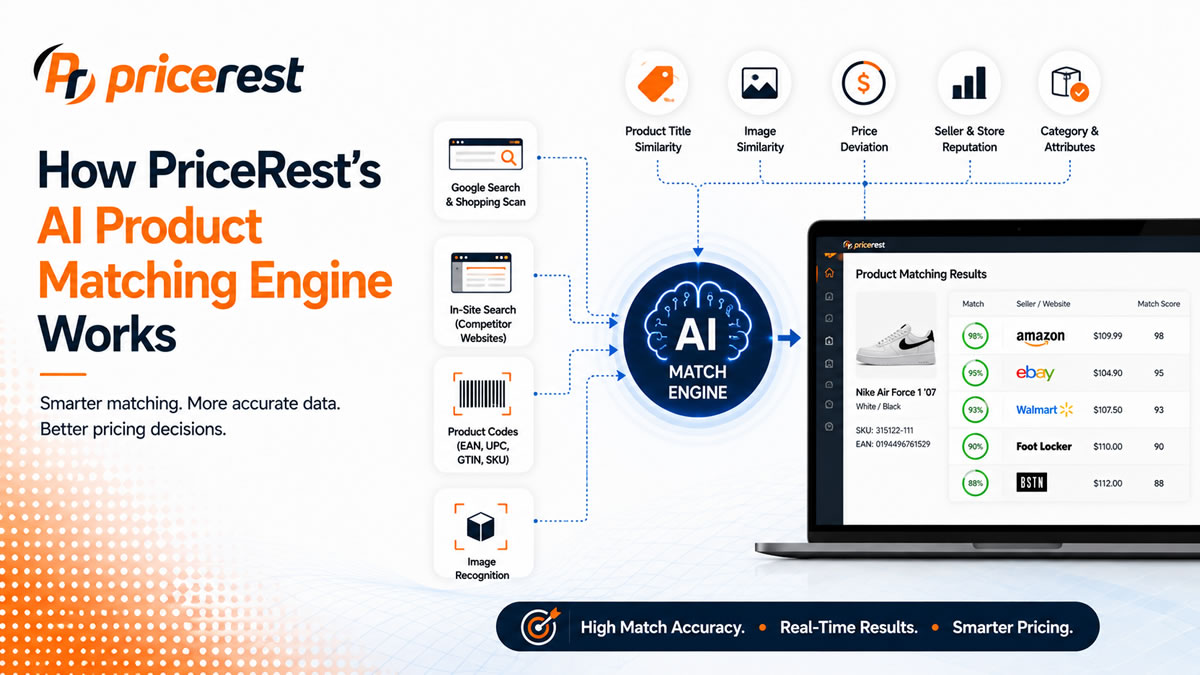
- Match products. It decides whether each listing is really your product, using barcodes, MPNs, titles or images. Product matching quality decides how many false alerts you get.
- Identify the seller. It records the store or marketplace seller behind each listing. Better tools link accounts that belong to the same operator.
- Compare with your list. Sellers missing from your approved list are flagged for review.
- Alert and record. Your team receives an alert, along with dated evidence such as price, stock and a screenshot where available.
Finding sellers vs removing them
Comparison pages often list these tools as if they all do the same job. They fall into three groups, and this choice matters more than any single feature.
| Type | Strength | Weak spot | Tools |
|---|---|---|---|
| Monitoring | Shows sellers together with price and stock data, which also helps pricing teams | Your team or lawyers must handle enforcement | PriceRest, Price2Spy, Minderest, Wiser |
| Reseller enforcement | Sends notices and tracks repeat offenders | Notices tied to price need legal review outside the US | TrackStreet, Wiser |
| Brand protection and removal | Removes counterfeits and infringing listings across many channels | Less pricing data; genuine goods can be harder to remove | Red Points, MarqVision, Corsearch, BrandShield, Gray Falkon |
Many brands start with monitoring because it shows the size of the problem. If the findings are mostly counterfeits, a removal service makes sense. If they are mostly genuine goods from leaking distributors, the fix usually sits in your contracts and supply chain.
The tools
The 10 unauthorized reseller detection tools
1. PriceRest
Best for: brands and manufacturers that want seller and price data in one tool.
PriceRest finds where your products are listed through Google Search, Google Shopping and site search, matches them with product codes and AI image recognition, and flags sellers outside your network. Coverage includes Amazon on 20 marketplaces, Google Shopping and more than 2,500 online stores in 64 countries. It also handles MAP monitoring and price and stock history.
Limits: PriceRest is a monitoring tool, not a takedown service. It does not file removals for you or cover social media and domain abuse. If counterfeits on many channels are your main problem, add or choose a brand protection service.
2. TrackStreet
Best for: brands with a large reseller network that want automated notices.
TrackStreet says it can uncover sellers listing products without approval, link accounts across names, emails and domains, and detect violations across more than 185,000 websites and marketplaces. It sends policy notices using templates and escalation levels, and it can flag merchants who pass a violation threshold for a do-not-sell list.
Check: automated price notices and do-not-sell lists can create legal risk outside the US. Have counsel review the workflow for each market.
3. Red Points
Best for: brands that want counterfeit and unauthorized seller removal handled at scale.
Red Points says it scans marketplaces, websites and social media every hour, uses image recognition and lets you set rules that start enforcement automatically. It also offers seller risk scores and a litigation-based revenue recovery program.
Check: Red Points’ own guide says resale of genuine goods is generally legal, so ask how it handles sellers of genuine stock, as separate from counterfeits.
4. MarqVision
Best for: brands dealing with both counterfeits and gray market stock.
MarqVision says it detects and removes counterfeit listings across more than 1,500 platforms. Its Gray Market Control matches listings to SKUs and checks prices hourly, and it also covers impersonation, fake stores and offline enforcement.
Check: the 94%+ matching figure on its site is the vendor’s own. Test it with your catalog, especially products with many variants.
5. Corsearch
Best for: larger brands that want trademark work and brand protection from one provider.
Corsearch combines trademark screening and watching with brand protection. Under its Distribution Control offering it says it can enforce channel policies and disrupt gray market sales, and its investigations service aims to uncover the people behind threats.
Check: it is a broad platform. If you only need to see sellers and prices, it may be more than you need.
6. BrandShield
Best for: brands that face marketplace abuse along with phishing and fake websites.
BrandShield says it can detect and remove counterfeit listings, unauthorized sellers and marketplace abuse. It also covers phishing, lookalike domains and copycat websites, with expert-led enforcement.
Check: much of its offer goes beyond seller monitoring. Ask how much price and seller history you get if your main concern is your reseller network.
7. Gray Falkon
Best for: brands focused on removing sellers from major marketplaces.
Gray Falkon says its AI and automation combat illegitimate sellers and identify leaks in the value chain. Its site shows eBay and TikTok among supported platforms, and customer quotes mention Amazon and Walmart.
Check: the removal results on its site are customer quotes. Ask for the channels covered and the method used for genuine goods.
8. Wiser
Best for: brands that want MAP enforcement along with wider retail data.
Wiser says its MAP Intelligence product surfaces unfamiliar sellers on marketplaces, captures evidence for follow-up and merges a seller’s storefront names into one record, so violations count toward one history.
Check: its seller features sit inside a MAP product. Confirm how sellers are flagged if you do not use a MAP policy.
9. Price2Spy
Best for: teams that mainly need price and MAP tracking, with seller data as an extra.
Price2Spy offers MAP monitoring, alerts and marketplace monitoring. Its Amazon guide says you can capture seller names and addresses, and screenshots are an add-on. See our PriceRest vs Price2Spy comparison.
Check: its homepage does not describe how new sellers are discovered, so test this on products where you already know of an unknown seller.
10. Minderest
Best for: brands that also want market data across many countries.
Minderest offers MAP and MSRP monitoring and a Marketplace Sellers Benchmark that monitors sellers of your products, tracks their prices, promotions and stockouts, and can spot unauthorized sellers.
Check: its homepage does not explain how sellers are discovered. Ask about this in the demo.
Why some familiar tools are not listed
An earlier version of this page included tools whose own websites do not present them as seller detection products. We removed them after checking their sites on October 31, 2026. They may suit other needs:
- BrandVerity describes itself as a paid search and web compliance service. Its focus is unauthorized ads and affiliate abuse.
- Competera describes itself as pricing AI for enterprise retail.
- Omnia Retail describes itself as dynamic pricing and price monitoring software. Its homepage does not mention unauthorized sellers.
- Dealavo mentions MAP compliance on its homepage, but not seller discovery or unauthorized sellers.
For tools built around price rules instead, see the best MAP monitoring software.
What to look for in a tool
| Feature | Question to ask the vendor |
|---|---|
| Seller discovery | How do you find sellers I have never told you about? |
| Product matching | How do you match products without barcodes, bundles and variants? |
| Seller identity | Can you connect several storefronts to one operator? |
| Channel coverage | Do you cover my countries, marketplaces and local stores? |
| Authorized list | Can I upload approved sellers by country and channel? |
| Evidence | Do I get dates, prices, seller names and screenshots I can export? |
| Alerts | Can I separate new sellers from price changes and known issues? |
| Enforcement | What do you do for genuine goods, and who approves each action? |
| Integration | Is there an API or Excel export for my own reports? |
Law and enforcement
What the law lets you do
Finding sellers is generally not the legal problem. The risk begins with what you do next. Selling genuine goods without your approval is often lawful, so check the rules in each market before you send a demand.
United States
The first sale doctrine generally lets someone resell genuine goods after a lawful first sale, even if the brand objects. US courts have recognized limits, including:
- Material differences. The goods differ in a way that matters to buyers. In Beltronics v. Midwest Inventory (10th Cir. 2009), the case involved altered serial numbers and voided warranties.
- Quality control. Under Warner-Lambert v. Northside (2d Cir. 1996), a brand must show real quality control procedures that it follows, and that the sales in question reduce the value of its mark.
- False affiliation. A reseller may not imply it is an authorized dealer. Maui Jim v. SmartBuy Guru (N.D. Ill. 2020) is one example.
- Poor repackaging. Repackaged goods generally need a notice and a disclaimer.
These limits need facts. In Maui Jim, for example, slower shipping was not treated as a material difference. A warranty that genuinely does not transfer is a stronger argument, but ask your lawyer how it applies to your products.
European Union
Under Article 15 of the EU Trade Mark Regulation, you generally cannot stop resale of goods first sold in the European Economic Area by you or with your consent, unless you have a legitimate reason, such as goods that were changed or impaired. Goods first sold outside the EEA are different: the Silhouette ruling (C-355/96) confirmed that member states cannot apply worldwide exhaustion. For luxury goods, Copad v Dior (C-59/08) shows that a selective distribution breach can matter when it harms the brand’s prestige.
United Kingdom
UK government guidance says goods placed on the EEA market are generally treated as exhausted in the UK, so they can usually be imported without the rights holder’s permission. Going the other way, exporters of goods from the UK to the EEA may need the rights holder’s consent.
Keep price and authorization separate. In the EU and the UK, using monitoring data to push resellers toward a minimum price can be resale price maintenance. Do not use a seller’s low price as the reason for a warning or for cutting supply without legal advice. See Is MAP pricing legal?
Amazon: what Brand Registry can and cannot do
Amazon describes Report a Violation as a tool for suspected IP infringement, store policy violations and regulatory compliance concerns. Being unauthorized is not listed as a category on that page, and Amazon agencies say resale of genuine goods alone generally gives you nothing to enforce. A report needs a concrete violation.
| Amazon program | What it does | What it does not do |
|---|---|---|
| Brand Registry | A free program with brand protection tools and Report a Violation | Does not give you control over who resells genuine goods |
| Project Zero | Lets eligible brands remove counterfeit listings themselves | Not for genuine goods; requires a 90% report acceptance rate in the last 6 months |
| Transparency | Puts unique codes on each unit and blocks listings without valid codes in supported stores | Requires serialization of your products, so it is not a quick fix |
For practical steps, see how to enforce MAP pricing on Amazon. An Amazon price tracker also helps you see which offers are active and who is behind them.
What to do after you find a seller
- Verify the match. Confirm that the listing shows your product and that the seller is really outside your list. Your list may simply be out of date.
- Save the evidence. Record the date, URL, seller name, price, stock status and a screenshot.
- Make a test purchase. For sellers you plan to escalate, Red Points suggests buying anonymously and keeping the order, packaging and lot or serial numbers.
- Trace the stock. Serial numbers or lot codes can show which distributor sold the unit. Check audit rights and sub-distributor terms in your contracts.
- Decide: remove or convert. Counterfeits are for removal. A seller of genuine goods with good service may become a partner.
- Choose the legal route with counsel. The options include a contract notice, a platform report, a cease and desist letter or a lawsuit.
- Keep monitoring. Sellers can return under new names, so keep the history and watch for repeat patterns.
Buying
How to choose and test a tool
| Your situation | Start with |
|---|---|
| You do not know who sells your products | A monitoring tool with seller discovery |
| You also need pricing and MAP data | PriceRest, Price2Spy, Minderest or Wiser |
| You have a US MAP policy and many resellers | TrackStreet or Wiser, and also compare how to monitor MAP violations |
| Counterfeits appear on many channels | Red Points, MarqVision, Corsearch or BrandShield |
| You also face phishing and fake websites | BrandShield, MarqVision or Red Points |
| You sell in many countries | A tool that covers local stores, such as global price monitoring |
Vendor claims are hard to compare, so run the same test on each shortlisted tool:
- Pick 20 products, including some without barcodes and some with variants.
- Note the sellers you already know, including one or two unknown sellers you found by hand.
- Upload only part of your authorized list and see whether the tool flags the rest.
- Count missed sellers, wrong product matches and duplicate alerts after two weeks.
- Ask for the evidence on one seller and check whether a lawyer could use it.
- Get a quote for your full catalog. Prices usually depend on the number of products and channels.
PriceRest
How PriceRest helps
PriceRest shows brands, manufacturers and distributors who sells their products online, at what price and with what stock. It discovers listings, matches them to your catalog, flags sellers outside your network, alerts your team and keeps a dated history by product and seller.
- Coverage. Amazon on 20 marketplaces, Google Shopping, other marketplaces and more than 2,500 online stores in 64 countries.
- Discovery and matching. Google Search, Google Shopping and site search discovery, with product-code and AI image matching.
- Brand protection. Unauthorized seller detection, MAP violation alerts, seller history and stock monitoring.
- Reporting. Reports by product, seller and date, Excel export and API integrations.
Plans start at $49 per month for 100 products, with a 14-day free trial and no credit card required. The competitor suggestion and matching tool carries an extra charge, so ask for a quote that covers your full catalog.
FAQ
Frequently asked questions
What is an unauthorized reseller?
An unauthorized reseller is a business or person selling your products without being part of your approved distribution network. The goods may be genuine, gray market or counterfeit, so being unauthorized does not by itself show that the product is fake or that the sale is illegal.
What is the best unauthorized reseller detection software?
It depends on what you need after detection. PriceRest, Price2Spy, Wiser and Minderest combine seller visibility with price data. TrackStreet focuses on automated notices. Red Points, MarqVision, Corsearch, BrandShield and Gray Falkon focus on removal and brand protection. Test your shortlist on the same products before you decide.
How do I find unauthorized sellers of my products?
Start with a list of approved sellers. Then search for your products by name and code on Google, Google Shopping and marketplaces, and record every seller that is not on your list. This works for a small catalog. For larger catalogs, detection software can repeat the search automatically and alert you to new sellers.
Is it illegal to sell a product without authorization?
Often it is not. In the US, the first sale doctrine generally allows resale of genuine goods. In the EU, rights are generally exhausted once goods are first sold in the EEA by the brand or with its consent. Exceptions exist, including materially different goods, false claims of being an authorized dealer and contract breaches. Ask a lawyer about your case.
Can Amazon remove unauthorized sellers?
Amazon can act on reports of IP infringement, store policy violations and regulatory concerns, but being unauthorized alone is generally not enough when the goods are genuine. Brand Registry, Project Zero and Transparency help most with counterfeits, trademark misuse and serialized products. A report needs a concrete violation that you can support with evidence.
What is the difference between an unauthorized seller and a counterfeit seller?
An unauthorized seller lacks your approval but may sell genuine goods. A counterfeit seller sells fake goods under your brand. Counterfeits are generally a clear trademark problem and can be reported for removal, while unauthorized sales of genuine goods usually need a different approach based on the facts, contracts and local law.
What is a gray market product?
A gray market product is a genuine product sold outside the channel or country the brand intended. It may differ in warranty, labels, language or formulation. In the US, such differences can matter under the material differences rule. In the EU, goods first sold outside the EEA are not covered by exhaustion.
What is the difference between MAP monitoring and unauthorized seller detection?
MAP monitoring checks whether advertised prices fall below your minimum advertised price. Unauthorized seller detection checks who is selling your products and whether they are approved. An approved seller can break a MAP policy, and an unapproved seller can advertise above MAP, so many brands track both.
Will detection software remove unauthorized sellers?
Not always. Monitoring tools find sellers and provide evidence, and your team decides what to do. Enforcement tools send notices, and brand protection services file removal requests. Even so, none of them can make lawful resale of genuine goods illegal, so stopping leaks in your supply chain is often part of the solution.
How much does unauthorized seller detection software cost?
Costs usually depend on the number of products, sellers and channels, and on whether enforcement services are included. Many vendors give quotes on request. PriceRest plans start at 49 US dollars per month for 100 products, and its competitor suggestion and matching tool carries an extra charge.
See who sells your products online
Seller discovery, unauthorized seller detection, MAP alerts and dated history across Amazon, Google Shopping and 2,500+ online stores. 14-day free trial, no credit card required.
Start Free Trial