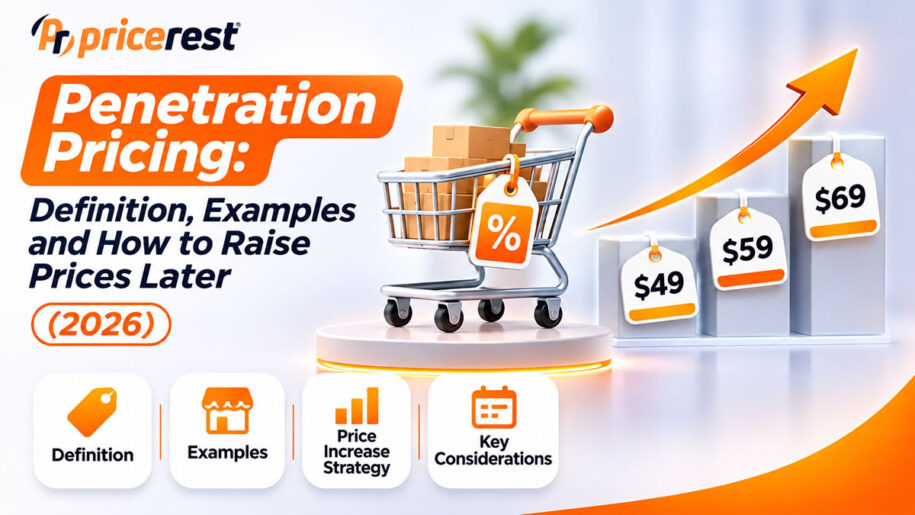
Penetration pricing means launching a product at a deliberately low price to win customers and market share fast, then raising the price once the product has reviews, repeat buyers and a place in the market. It works when buyers are price sensitive, the market is crowded and you can afford a lower margin for a planned period. It fails when the low price looks like a sign of low quality, when competitors simply match it, or when the price never goes back up.
Three rules keep it under control: price below the market’s usual level but above your own unit cost, decide the exit dates before launch, and monitor how competitors react every day. Penetration pricing is legal; it only becomes predatory pricing when a dominant company prices below cost to push rivals out.
Penetration pricing calculator
Source: PriceRest 2026 price change study, 522,878 daily prices from 261 online stores and marketplaces in 24 countries. The calculator uses the worked example from this guide; replace the numbers with your own.
The basics
What is penetration pricing?
Penetration pricing is a launch strategy: a new product, brand or seller enters the market at a price clearly below what competitors charge, so that price sensitive buyers try it. Once the product has enough sales, reviews and repeat customers, the price is raised step by step towards a normal level.
The strategy is also called price penetration or a penetration price strategy. The idea is simple. In a crowded online market, shoppers compare prices first, and a new name with no reviews has little else to offer. A lower price gives them a reason to take the risk. The margin you give up is an investment in market share, reviews and customer data, and like any investment it needs a budget and an end date.
Penetration pricing is not the same as being the cheapest forever. A business that wants to stay the cheapest uses a low price or price positioning strategy, and it needs a lower cost base to survive. Penetration pricing is temporary by design.
How penetration pricing works
A penetration launch runs in four phases: study the market price band, enter below it, hold the low price for a planned period while sales and reviews build up, and then raise the price in steps to the level you planned from the start.
| Phase | What you do | What you watch |
|---|---|---|
| 1. Research | Collect competitor prices for comparable products and find the lowest, median and typical promotional price. | The price band and how often competitors discount. |
| 2. Entry | Launch below the band, but above your unit cost. | Conversion rate, sales rank, first reviews. |
| 3. Hold | Keep the launch price for the planned period, usually several weeks to a few months. | Competitor reactions, stock, review count and rating. |
| 4. Step up | Raise the price in two to four smaller steps to the regular price. | Conversion after each step and whether competitors follow. |
Penetration pricing vs price skimming
Penetration pricing starts low and moves up to win volume. Price skimming starts high and moves down to collect the most from early buyers who want the product first. Penetration fits crowded markets with price sensitive buyers; skimming fits new or premium products with little direct competition.
| Penetration pricing | Price skimming | |
|---|---|---|
| Starting price | Below the market | Above the market |
| Direction over time | Up | Down |
| Main goal | Market share, reviews, repeat buyers | Margin from early adopters |
| Best for | Crowded categories, similar products, new sellers | Innovative, premium or hard to copy products |
| Buyers | Price sensitive | Less price sensitive, want it first |
| Main risk | Price war, cheap image, low price becomes permanent | Competitors enter below you, slow early sales |
How price sensitive your buyers are can be measured. See price elasticity of demand for the formula and a free calculator.
Penetration pricing vs predatory pricing, loss leaders and launch discounts
These four are often confused. Penetration pricing is low but above cost and temporary. A loss leader is priced below cost to sell other products. A launch discount is a short promotion. Predatory pricing is pricing below cost by a dominant firm to drive rivals out, and it is illegal.
| Strategy | Price vs cost | Duration | Purpose | Legal status |
|---|---|---|---|---|
| Penetration pricing | Above cost, below the market | Weeks to months | Win share for a new product or seller | Legal |
| Launch discount | Above cost | Days to a few weeks | Create a buying moment at launch | Legal, but price reduction rules apply |
| Loss leader | Below cost | Ongoing or seasonal | Bring traffic for other products | Legal in most cases; some countries limit selling below cost |
| Predatory pricing | Below cost | Until rivals leave | Exclude competitors, then raise prices | Illegal for dominant firms |
For the legal tests behind predatory pricing, see legal limits below and what is predatory pricing?.
Should you use it?
Advantages and disadvantages
The upside is speed: more trial purchases, faster reviews and better marketplace ranking. The downside is cost and risk: lower margins, competitors who match you, buyers who see the price as a quality signal and customers who leave when the price goes up.
| Advantages | Disadvantages |
|---|---|
| Gives price sensitive buyers a reason to try an unknown brand | Lower margin on every unit sold during the launch |
| Builds reviews and ratings faster, which helps conversion later | Competitors can match the price and start a price war |
| Can improve sales rank on marketplaces, where rank follows sales | A very low price can look like a cheap or fake product |
| Wins shelf space and attention from retailers | Bargain hunters may leave when the price rises |
| Produces real demand data for forecasting and stock planning | Customers anchor on the launch price, so raising it feels like a price increase |
| Can discourage new entrants while you build scale | Retailers may keep selling at the launch price after you raise yours |
When penetration pricing works and when it fails
Penetration pricing works when buyers compare prices, products are easy to compare, you have the cash to carry lower margins and the price can rise later without losing most buyers. It fails when the category is driven by trust or quality, competitors can match you cheaply or you have no plan to raise the price.
It tends to work when:
- Buyers are price sensitive and compare offers side by side, as on marketplaces and Google Shopping.
- Your product is comparable to known products, so the lower price is easy to see.
- Repeat purchases, subscriptions or accessories let you earn the margin back later.
- Your unit cost falls as volume grows, so the regular price becomes more profitable over time.
- You can fund the lower margin for the planned period without running out of stock or cash.
It tends to fail when:
- Buyers judge quality by price, as in premium, safety or health products.
- Large competitors can match your price for longer than you can hold it.
- The market already discounts heavily, so your launch price disappears among competitors’ promotions.
- Your retailers or marketplace sellers keep the low price after you try to raise it.
The last point matters more online than many sellers expect. In our 2026 price change study, 43% of products were discounted at least once in 90 days, with a median discount of 20%. A launch price only 5% below the regular market price is easily lost among those promotions. To stand out, it usually has to be compared with the prices competitors actually charge, promotions included, not only with their list prices.
How to do it
How to set a penetration price in 6 steps
Map the market price band, calculate your price floor, choose an entry price below the band but above your cost, write the exit plan before launch, monitor competitor reactions daily and raise the price in planned steps.
- Map the market price band. Collect current prices for 10 to 30 comparable products from the stores and marketplaces where you will sell. Note the lowest price, the median and how often each competitor runs promotions. Four weeks of price history gives a much better picture than one day.
- Calculate your price floor. Add up everything a sale costs you: product cost, shipping, marketplace and payment fees, returns and advertising per unit. The penetration price must stay above this floor, or every sale loses money.
- Choose the entry price. Place the price below the market median and close to or below the prices competitors use in their promotions. Use the calculator to see how many more units you need to earn the same gross profit.
- Write the exit plan. Decide in advance how long the launch price lasts, which results trigger the first increase (for example a review count, rating or sales rank) and the steps up to the regular price.
- Launch and monitor daily. Track competitor prices, stock and new sellers every day. If a large competitor matches your price, decide quickly whether to hold, shorten the launch or compete on something other than price.
- Raise the price in steps. Move to the regular price in two to four steps, a few weeks apart. Check conversion after each step before taking the next one.
Worked example: launching at 179 to reach 209
A new brand launches a cordless vacuum at 179 against competitors selling between 199 and 249. Each sale costs 120, so the margin falls from 89 to 59 per unit. The brand needs about 51% more units to earn the same gross profit, and it plans to reach 209 in three steps over four months.
| Item | Value |
|---|---|
| Competitor price band for similar models | 199 to 249, median 219 |
| Unit cost including fees, shipping and returns | 120 |
| Planned regular price | 209 (margin 89 per unit) |
| Penetration price | 179 (margin 59 per unit), 18% below the market median |
| Expected sales at the regular price | 300 units per month |
| Units needed at 179 for the same gross profit | 453 per month, about 51% more |
| Gross profit invested if volume does not grow | 9,000 per month |
The exit plan, written before launch:
| Period | Price | Condition to move on |
|---|---|---|
| Weeks 1 to 8 | 179 | At least 50 reviews with an average rating of 4.3 or more |
| Weeks 9 to 12 | 189 | Conversion rate no more than 15% below the launch level |
| Weeks 13 to 16 | 199 | Same check, and no competitor priced below 189 for more than a week |
| Week 17 onwards | 209 | Regular price; promotions follow the normal calendar |
If a competitor drops to 179 in week 3, the brand does not follow it further down. It checks whether the competitor is clearing stock, which usually ends within days, or repositioning for good. In our study, 56% of price cuts were reversed within 14 days, so many competitor reactions are short.
How to raise prices after the launch
Raise the price in small, planned steps, tie each step to a result such as reviews or sales rank, add value where you can and avoid fake reference prices. Before you run your first promotion after the launch, check which earlier price you are allowed to show as the before price.
- Use steps, not one jump. Three increases of 5% are easier for buyers to accept than one of 15%, and each step tells you how sensitive demand is.
- Time the steps with value. Raise the price when reviews have built up, when you add a bundle or accessory, or when you launch a new colour or version.
- Keep loyal customers. Subscriptions, loyalty discounts or a launch price for existing customers can soften the increase where your business model allows it.
- Do not invent a former price. Present the launch price as a launch price. Do not show a crossed out regular price you have never really charged.
- Plan promotions around the 30-day rule. In the EU, a price reduction must show the lowest price of at least the previous 30 days. If you raise the price from 179 to 209 and run a sale two weeks later, the before price you must show can still be 179, so a sale at 189 is not a reduction.
- Check your resellers. If retailers and marketplace sellers stock your product, check that they follow the increase. Some will keep selling at the launch price as long as their stock lasts.
Legal limits in the US, EU and UK
Low prices above cost are normal competition and legal. The risks start when a dominant company prices below cost to push rivals out, when a brand fixes the prices its retailers charge, or when a seller advertises a misleading former price. This section is general information, not legal advice.
| Topic | United States | EU and UK |
|---|---|---|
| Predatory pricing | The Supreme Court’s Brooke Group decision (1993) requires prices below an appropriate measure of cost and a dangerous probability, or reasonable prospect, of recouping the losses later. | Abuse of dominance under Article 102 TFEU, and Chapter II of the UK Competition Act 1998. In AKZO (1991), the EU Court of Justice held that a dominant firm’s prices below average variable cost aimed at eliminating a competitor are abusive. |
| Former price claims | The FTC Guides Against Deceptive Pricing treat a former price as genuine only if it was openly offered for a reasonably substantial period. | Under Article 6a of the Price Indication Directive, a price reduction must show the lowest price of at least the previous 30 days. Member States may allow a shorter period for products on the market for less than 30 days. |
| Retail prices set by the brand | Brands can use unilateral MAP policies to limit advertised prices. | Fixing or imposing minimum resale prices is generally treated as resale price maintenance. Brands can recommend prices but not force retailers to follow them. |
For a small or new seller, predatory pricing is rarely a real risk, because it requires dominance and below-cost prices. The practical risks are fake reference prices and, for brands selling through retailers, trying to control their resale prices. See is MAP pricing legal? for the brand side.
What to monitor during a penetration launch
Track the market price band, each competitor’s reaction to your launch price, competitor stock, the sellers on your own listings and your own price history. Daily checks are enough for most launches; marketplace Buy Box prices may need checks every few minutes.
| What to track | Why it matters | How often |
|---|---|---|
| Price band of comparable products | Tells you whether your launch price is still below the market | Daily |
| Competitor price changes after your launch | Shows who is matching you and for how long | Daily, with alerts |
| Competitor stock | A competitor out of stock is a chance to step up earlier | Daily |
| Buy Box price and sellers on your listing | On marketplaces, other sellers can undercut your launch price on your own listing | Every few minutes to hourly |
| Your resellers’ prices | Shows whether retailers follow your price steps | Daily |
| Your own price history | Proves the lowest price of the last 30 days for EU price reductions | Kept automatically |
To decide which changes need a response, see competitor price alerts. For the wider choice of strategy, see pricing strategy with price monitoring.
PriceRest for penetration pricing
PriceRest monitors competitor prices, stock and sellers across 2,500+ online stores and marketplaces in 64 countries. It keeps price history, sends alerts when competitors react and can set prices automatically within your floor and ceiling.
- Market price band: product matching across stores, so you see the lowest, median and highest price for comparable products.
- Competitor reactions: daily checks on every plan, instant checks and notifications on Professional and Premium.
- Marketplaces: Buy Box mode checks Amazon, Trendyol and Hepsiburada every 5 minutes through their official APIs.
- Price history: every price is stored, so you can check the lowest price of the last 30 days before announcing a sale.
- Resellers: MAP monitoring and unauthorized seller detection are included in every plan. PriceRest can also log in to collect member, dealer and B2B prices.
- Dynamic pricing: rules that hold the launch price, follow the market within limits and never go below your floor. See what is dynamic pricing?.
Plans start at $49 per month for 100 products and 10 sites, with $189 and $389 plans for 1,000 and 5,000 products. All plans include a 14-day free trial with no credit card required.
Frequently asked questions
What is penetration pricing?
Penetration pricing is a launch strategy where a new product or seller enters the market at a price clearly below competitors to win customers and market share quickly. The price is raised step by step once the product has sales, reviews and repeat buyers.
What is an example of penetration pricing?
A new brand launches a vacuum cleaner at 179 while similar models sell for 199 to 249. After eight weeks and fifty reviews it raises the price to 189, then 199, and reaches its regular price of 209 after about four months.
What is the difference between penetration pricing and price skimming?
Penetration pricing starts below the market and rises to win volume. Price skimming starts above the market and falls over time to earn more from early buyers. Penetration suits crowded markets with price sensitive buyers, skimming suits new or premium products.
Is penetration pricing legal?
Yes. Low prices that stay above cost are normal competition. It becomes illegal predatory pricing only when a dominant company prices below cost to push competitors out. Sellers must also avoid misleading former prices in their promotions.
How long should penetration pricing last?
Most online launches hold the low price for several weeks to a few months. Tie the end to results such as review count, rating or sales rank, and decide the dates before launch so the low price does not become permanent.
How low should a penetration price be?
Low enough to stand out against the prices competitors actually charge, including their promotions, and always above your full unit cost. In online markets where discounts of around twenty percent are common, a cut of five percent is rarely noticed.
What are the advantages of penetration pricing?
It gives buyers a reason to try an unknown brand, builds reviews faster, can improve marketplace ranking, wins retailer attention and produces real demand data for planning stock and the regular price.
What are the disadvantages of penetration pricing?
Margins are lower during the launch, competitors may match the price, a very low price can look like a cheap or fake product, bargain hunters may leave when the price rises and retailers may keep selling at the launch price.
How do you raise prices after penetration pricing?
Raise the price in two to four small steps a few weeks apart, tie each step to a result, add value such as bundles or new versions and check conversion after each step. Do not show a former price you never really charged.
How does price monitoring help with penetration pricing?
Price monitoring shows the market price band before launch, alerts you when competitors react, tracks competitor stock and the sellers on your listings and keeps the price history you need for later promotions.
Launching a product at a penetration price?
See the market price band before you launch, get alerts when competitors react and track every step of your price plan across 2,500+ stores in 64 countries. 14-day free trial, no credit card required.
Start Free TrialGet your free competitor price report
Leave your email and website. Our team prepares a free report showing how your competitors’ prices compare with yours.