
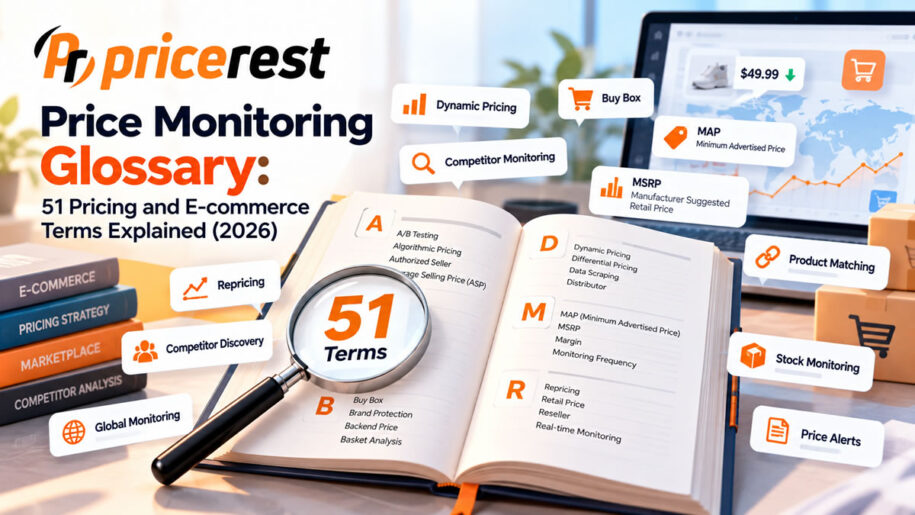
This glossary defines 51 terms used in price monitoring, competitor price tracking, dynamic pricing, MAP monitoring and e-commerce pricing, from ASIN and Buy Box to price index and product matching. Each definition is written to stand on its own and links to a deeper guide where one exists. Every term has its own link, so you can share or cite a single definition.
A
Algorithmic pricing
Algorithmic pricing is setting prices with software that follows rules or models instead of manual decisions. Research on Amazon Marketplace identified more than 500 sellers using algorithmic pricing in a study of 1,641 best-selling products.
ASIN
An ASIN (Amazon Standard Identification Number) is the 10-character code Amazon assigns to each product in its catalog. Sellers offering the same product share one ASIN, which makes it the key identifier for monitoring Amazon prices and sellers.
B
Brand protection
Brand protection is the monitoring and enforcement of how a brand is sold online, including advertised prices, authorized sellers, product listings and counterfeit offers. Price monitoring supports it by detecting MAP violations and unauthorized sellers.
Buy Box
The Buy Box is the area on an Amazon product page with the Add to Cart button. When several sellers offer the same product, Amazon decides whose offer appears there, so winning the Buy Box is central to selling on Amazon and to monitoring Amazon prices.
C
Competitive pricing
Competitive pricing is setting prices mainly in relation to competitor prices, for example matching the market, staying slightly below it or keeping a premium. It depends on accurate, up-to-date competitor price data.
Competitor discovery
Competitor discovery is finding which online stores and marketplace sellers offer the same products as you, including competitors you did not know about. It is usually done by searching Google Shopping, Google Search, marketplaces and store search pages.
Competitor price monitoring
Competitor price monitoring is price monitoring focused on the direct competitors of a retailer. It shows where your prices stand against each competitor, when they change prices and when they start promotions or run out of stock.
Cost-plus pricing
Cost-plus pricing is setting a price by adding a fixed markup to the cost of a product. It is simple but ignores competitor prices, so many retailers combine it with price monitoring to check that the result is competitive.
Crawler
A crawler is a program that visits web pages automatically and reads data from them. In price monitoring, a crawler loads each competitor product page and extracts the price, list price, stock status and other details. Each website usually needs its own crawler setup.
Crossed-out price
A crossed-out price is the higher reference price shown with a strikethrough next to the current selling price to signal a discount. In the EU, the Omnibus Directive requires an announced price reduction to refer to the lowest price applied in at least the previous 30 days.
Currency normalization
Currency normalization is converting prices collected in different currencies into one currency for comparison while keeping the original price. Keeping the original matters, because otherwise exchange rate movements look like price changes.
D
Discount depth
Discount depth is the percentage difference between a crossed-out price and the current selling price. In a 2026 PriceRest study, the median discount at stores showing a crossed-out price was 20%.
Dynamic pricing
Dynamic pricing is changing prices frequently in response to market conditions such as competitor prices, demand, stock levels or time. In e-commerce it is usually automated with rules or algorithms that use price monitoring data.
E
EAN
An EAN (European Article Number) is a 13-digit product barcode, also called EAN-13, used mainly outside North America. It is part of the GTIN system managed by GS1 and is one of the most reliable codes for matching the same product across stores.
G
Geo-pricing
Geo-pricing, or location-based pricing, is charging different prices depending on where the customer is, by country, region or delivery ZIP code. It is why international price monitoring needs to collect each market price from that market.
Google Shopping
Google Shopping is the product search service of Google, where retailers list products through Google Merchant Center. Because it shows many sellers for the same product, it is widely used for competitor discovery and price comparison.
GTIN
A GTIN (Global Trade Item Number) is the global family of product identifiers managed by GS1, including UPC (GTIN-12), EAN (GTIN-13), GTIN-8 and GTIN-14. A GTIN identifies the same product across retailers, which makes it valuable for product matching.
H
Headless browser
A headless browser is a web browser without a visible window, controlled by software. Price monitoring tools use it to load pages that build prices or variants with JavaScript, which a simple page download cannot read.
K
Key value items (KVI)
Key value items are the products whose prices customers know best and use to judge whether a store is cheap or expensive. Retailers usually monitor KVIs most closely and price them most competitively.
L
List price
A list price is the standard price of a product before discounts, often set by the manufacturer or in the catalog of the retailer. On product pages it often appears as the crossed-out price when a product is on sale.
Loss leader
A loss leader is a product sold at or below cost to attract customers who then buy other, more profitable items. Monitoring helps spot competitor loss leaders so you do not chase a price that is not meant to make a profit.
M
MAP (minimum advertised price)
MAP, or minimum advertised price, is the lowest price at which a manufacturer allows retailers to advertise a product. It limits the advertised price rather than the final selling price. In the EU, imposing minimum resale prices is generally prohibited.
MAP policy
A MAP policy is the document in which a manufacturer sets its minimum advertised prices and explains what happens when retailers advertise below them. In the United States, many brands use unilateral MAP policies.
MAP violation
A MAP violation happens when a retailer or marketplace seller advertises a product below the minimum advertised price set in the MAP policy of the brand. MAP monitoring software detects violations and records the seller, price and time as evidence.
Margin floor
A margin floor is the minimum margin or price that an automated pricing rule will never go below. It protects profit when repricing reacts to competitor price cuts.
Marketplace monitoring
Marketplace monitoring is tracking prices, sellers and stock on online marketplaces such as Amazon, eBay or Allegro. Because many sellers share one listing, it usually needs seller-level data and frequent checks.
MPN
An MPN (manufacturer part number) is the code a manufacturer assigns to identify a product model. Combined with the brand name, it helps match products when stores do not show a barcode.
MSRP
MSRP, or manufacturer suggested retail price, is the price a manufacturer recommends retailers charge. It is a recommendation rather than a requirement, and brands monitor how far retailers deviate from it.
O
Out of stock
Out of stock means a product cannot currently be bought from a seller. Price monitoring tracks stock together with price, because an out-of-stock competitor should not set your price. In a 2026 PriceRest study, 20% of products went out of stock at least once in 90 days.
P
Price elasticity
Price elasticity of demand measures how much sales change when the price changes: the percentage change in quantity divided by the percentage change in price. Products with high elasticity lose more sales when their price rises.
Price history
Price history is the record of a product price over time at one or more sellers. It separates temporary promotions from permanent price changes and shows how competitors behave around events such as sales seasons.
Price index
A price index compares your price with the market: your price divided by the average competitor price, multiplied by 100. A value of 100 means you are at market level, above 100 more expensive and below 100 cheaper.
Price intelligence
Price intelligence is the practice of collecting and analysing market price data, such as competitor prices, promotions and stock, to make better pricing decisions. Price monitoring is its data collection part.
Price matching
Price matching is a policy of lowering your price to match a lower competitor price, either automatically or when a customer asks. It requires reliable competitor price data to apply fairly.
Price monitoring
Price monitoring is the regular tracking of the prices that competitors, resellers and marketplaces charge for the same products as you. It shows where your prices stand, when competitors change prices or start promotions, and when products go out of stock.
Price monitoring software
Price monitoring software automates price monitoring. It matches your products to the same products on competitor websites and marketplaces, collects their prices, discounts and stock status on a schedule, and provides price history, reports and alerts.
Price optimization
Price optimization is using data and models to set the prices that best meet a business goal such as profit, revenue or sales volume. It typically combines competitor prices, costs and price elasticity.
Price positioning
Price positioning is where your prices sit relative to the market, for example premium, at parity or discount. Price monitoring shows whether your actual prices match the positioning you intend.
Price tracking
Price tracking is usually used as another name for price monitoring. It is sometimes used more narrowly for following the price history of a single product.
Price war
A price war is a cycle in which competitors repeatedly cut prices to undercut each other, eroding margins for everyone. Automated repricing without a margin floor can start or accelerate one.
Product matching
Product matching is linking your product to the same product on each competitor website, using product codes, titles, images and attributes. It is the step that decides whether price comparisons are correct, since a wrong size, bundle or variant gives a misleading result.
Promotional pricing
Promotional pricing is a temporary price reduction used to drive sales, often shown with a crossed-out price. In a 2026 PriceRest study, 56% of price cuts were reversed within 14 days, which shows how short most online promotions are.
Proxy
A proxy is an intermediary server that sends requests on your behalf, so a website sees the proxy IP address instead of yours. In price monitoring, proxies located in the target country let you collect the local price a shopper there sees.
R
Recommended retail price (RRP)
A recommended retail price, or RRP, is the price a manufacturer suggests for a product, and the term commonly used in the UK and Europe for MSRP. In the EU, brands can recommend prices but generally cannot impose minimum resale prices.
Repricing
Repricing is automatically adjusting your own prices in response to competitor prices, usually with rules such as staying a set percentage below a competitor. It is common among marketplace sellers competing for the Buy Box.
Rule-based pricing
Rule-based pricing is setting prices with explicit rules, for example matching the lowest in-stock competitor but never going below a margin floor. It is the most common and most transparent form of dynamic pricing.
S
SKU
A SKU (stock keeping unit) is the internal code a retailer uses to identify a product in its own inventory. SKUs differ from store to store, so they are less useful than GTINs or MPNs for matching products across competitors.
U
Unauthorized seller
An unauthorized seller is a retailer or marketplace seller that offers the products of a brand without its approval, often from gray-market supply. Unauthorized sellers frequently ignore MAP policies, so brands monitor them as part of brand protection.
UPC
A UPC (Universal Product Code) is a 12-digit product barcode used mainly in the United States and Canada. It is part of the GTIN system, where it is known as GTIN-12.
V
Variant tracking
Variant tracking is monitoring a separate price for each product variant, such as size, color or capacity. Without it, a tool may record the default variant shown on the page instead of the one you sell.
W
Web scraping
Web scraping is extracting data from web pages automatically. Price monitoring uses web scraping to collect publicly displayed prices, list prices and stock from competitor product pages.
Last reviewed October 2026 by the PriceRest team. Statistics cited in definitions come from the PriceRest 2026 price change study and the sources listed on our price monitoring statistics page.
Put these terms to work
Monitor competitor prices, discounts, stock and MAP violations in 64 countries. 14-day free trial, no credit card required.
Start Free TrialRequest a personalized demo of PriceRest
We look forward to showing you how our platform allows you to optimize the pricing, execution, and measurement initiatives that matter most to your brand and products.
It is Free!
What can I expect?
- A brief conversation to assess what PriceRest can do to help your pricing strategy
- Live product demo with insight into how to get the most benefit from PriceRest
- Discuss your prices KPIs to determine the best path forward for your business
- No commitment required