
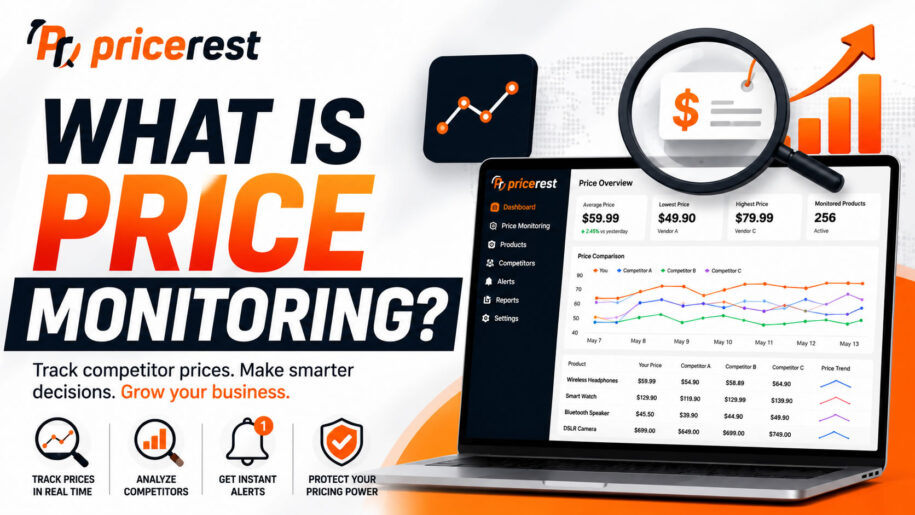
Price monitoring is the process of tracking the prices that competitors, resellers and marketplaces show for the same products as you, so you know where your prices stand and can react when the market changes. Today it is done with price monitoring software, which automatically finds your products on competitor websites, collects their prices, discounts and stock status every day, and alerts you to changes.
Source: PriceRest 2026 study of 522,878 daily prices from 261 online stores and marketplaces in 24 countries.
Basics
What is price monitoring?
Price monitoring is the regular tracking of the prices that other sellers charge for the same products you sell or make. It shows how your prices compare with the market, when competitors raise or cut prices, which resellers sell below agreed prices, and when products go on promotion or out of stock.
The term is used in two main ways. For retailers, price monitoring means watching competitors so they can price competitively without giving away margin. For brands and manufacturers, it means watching the retailers and marketplace sellers that sell their products, to protect pricing policies such as a minimum advertised price (MAP). In both cases the goal is the same: replace guesses about the market with up-to-date facts.
Price monitoring is also called competitor price monitoring, competitive price monitoring or price tracking. When the collected prices are analysed to support pricing decisions, the broader discipline is usually called price intelligence.
What is price monitoring software?
Price monitoring software is a tool that automates price monitoring. It finds your products on competitor and reseller websites, collects their prices, discounts and stock status on a schedule, usually daily, and turns the results into dashboards, price history, reports and alerts.
Most price monitoring software also includes some of the following:
- Product matching that links your product to the same product on each competitor site.
- Marketplace monitoring for Amazon, eBay and local marketplaces, often with seller-level data.
- Alerts when a competitor changes price, starts a promotion or runs out of stock.
- MAP monitoring that flags resellers advertising below a minimum price.
- Dynamic pricing that updates your own prices automatically based on rules.
- Integrations with e-commerce platforms such as Shopify, WooCommerce and Magento.
PriceRest price monitoring software combines these features and has ready-made coverage for more than 2,500 online stores in 64 countries.
How does price monitoring work?
Price monitoring works in five steps: you define which products to monitor, the software matches them to the same products on competitor websites, crawlers collect prices and stock from those pages on a schedule, the data is cleaned so prices are comparable, and the results are shown as reports and alerts that lead to pricing decisions.
- Define your products. Upload a product list, connect your store or enter your website URL. Product codes such as GTIN, EAN, MPN and SKU make the next step much more accurate.
- Match products. The software finds the same product on each competitor website, using product codes, Google Shopping, site search, product titles and image matching. Wrong matches, such as a different size or a bundle, are the biggest source of wrong conclusions, so good tools score each match and let you review uncertain ones.
- Collect prices. Crawlers visit each matched product page and read the selling price, the crossed-out list price, stock status and, on marketplaces, the sellers. Most businesses collect once a day; fast-moving categories collect several times a day.
- Clean and normalise. Prices are compared in the right currency, with or without VAT consistently, for the right product variant, and failed checks are flagged instead of silently showing an old price.
- Analyse and act. Dashboards, price history and a price index show your position. Alerts trigger on changes that matter, and the results feed pricing decisions, repricing rules or MAP enforcement.
From running crawlers for thousands of online stores. The hard part of price monitoring is not downloading a page; it is reading the right price. The most common traps are a crossed-out list price read as the current price, member or app-only prices shown next to the public price, the default variant recorded instead of the one you sell, and out-of-stock products that still display a price.
What data does price monitoring collect?
| Data point | Why it matters |
|---|---|
| Selling price | The price a customer pays today, the core of every comparison |
| Crossed-out list price | Shows that a product is on promotion and how deep the discount is |
| Stock status | An out-of-stock competitor is not taking your sales, so it should not set your price |
| Price history | Separates temporary promotions from permanent price changes |
| Seller and Buy Box | On marketplaces, shows who is selling and who wins the sale |
| Product variants | Sizes, colours and capacities often have different prices |
| Shipping | Free or paid delivery changes what the customer really pays |
| Ratings and reviews | Help explain why a more expensive competitor still sells well |
Types of price monitoring
Competitor price monitoring
Retailers and online stores track the prices of direct competitors to stay competitive, spot promotions early and avoid being undercut on their best sellers. See competitor price tracking.
MAP and reseller price monitoring
Brands and manufacturers track the retailers and marketplace sellers that sell their products, to find sellers advertising below the minimum advertised price and unauthorized sellers. See MAP monitoring software.
Marketplace price monitoring
Sellers on Amazon and other marketplaces track the Buy Box price and the other sellers on each listing, where prices often change several times a day. See the Amazon price tracker.
Supplier price monitoring
Businesses also track the prices and stock of their suppliers and distributors, to protect their margin when purchase costs change.
Price monitoring vs related terms
| Term | Meaning |
|---|---|
| Price monitoring | Regularly tracking the prices other sellers charge for the same products |
| Price tracking | Usually used as a synonym for price monitoring, sometimes for following the price history of one product |
| Competitor price monitoring | Price monitoring focused on direct competitors of a retailer |
| Price intelligence | The wider practice of analysing market price data to make pricing decisions |
| Dynamic pricing | Automatically changing your own prices based on rules and market data, also called repricing |
| MAP monitoring | Checking whether resellers advertise below the minimum advertised price set by a brand |
| Product matching | Linking your product to the same product on each competitor website |
| Price index | Your price divided by the average competitor price, multiplied by 100 |
Value
Why price monitoring matters
Online prices change too often to follow by intuition. In a 2026 PriceRest study of 261 online stores and marketplaces in 24 countries:
- 46% of products changed price at least once within 30 days, and products that changed did so about every 6 days.
- One in three price changes was smaller than 5%, the kind of move a manual check easily misses.
- 56% of price cuts were reversed within 14 days, so many competitor discounts are temporary.
- 20% of products went out of stock at least once in 90 days.
Price monitoring turns this constant movement into decisions. It helps businesses:
- Protect margin by raising prices where they are cheaper than the market without needing to be.
- Stay competitive on the products customers compare most.
- Avoid overreacting to short promotions and out-of-stock competitors.
- Enforce pricing policies such as MAP across resellers and marketplaces.
- Save time that teams would otherwise spend checking websites by hand.
Manual vs automated price monitoring
| Manual (spreadsheets) | Automated (software) | |
|---|---|---|
| How often | Weekly or less, when someone has time | Daily or several times a day |
| Coverage | A few products and competitors | Thousands of products across many websites and marketplaces |
| Small changes | Easy to miss | Captured and alerted |
| History | Rarely kept | Full price history for every product |
| Stock and promotions | Often ignored | Tracked together with price |
| Cost | Staff time | A subscription, from about $30 to $500 a month for most businesses |
Manual checks can work for a handful of products. Once you track more than a few dozen products or competitors, the time cost and the missed changes make software the cheaper option. For a detailed buying guide, read 15 questions buyers ask before choosing a price monitoring tool.
A price monitoring example
Imagine an online store selling a coffee machine for $249. Its price monitoring software shows four competitors for the same model:
| Seller | Price | Stock | Note |
|---|---|---|---|
| Your store | $249 | In stock | |
| Competitor A | $239 | In stock | Lowest in-stock price |
| Competitor B | $229 | Out of stock | Cheapest, but cannot sell today |
| Competitor C | $259 | In stock | |
| Competitor D | $244 | In stock | Promotion, crossed-out price $279 |
Counting only in-stock competitors, the average competitor price is $247.33 and the store’s price index is 100.7, which means it is priced almost exactly at market level. If the out-of-stock competitor were wrongly included, the index would be 102.6 and the store might cut its price for no reason. Competitor D’s discount is a promotion, and promotions often end within two weeks, so the better move is to set an alert rather than match it permanently. This is what price monitoring adds: not just prices, but the context to read them correctly.
Illustrative example. Read more about the price index formula.
Next steps
How to start price monitoring
- Pick your products. Start with best sellers and the products customers compare most.
- Pick your competitors. Three to ten websites and marketplaces where your customers actually shop.
- Add product codes. GTIN, EAN or MPN codes make matching faster and more accurate.
- Set alerts. For example, when a competitor drops below your price or a reseller goes below MAP.
- Review weekly, act daily. Use alerts for daily decisions and price history for weekly strategy.
PriceRest covers more than 2,500 online stores in 64 countries and 20 Amazon marketplaces. Read how PriceRest monitors prices worldwide.
FAQ
Frequently asked questions
What is price monitoring?
Price monitoring is the regular tracking of the prices that competitors, resellers and marketplaces charge for the same products as you. It shows where your prices stand, when competitors change prices or start promotions, and when products go out of stock, so you can make pricing decisions based on current market data.
What is price monitoring software?
Price monitoring software automates price monitoring. It matches your products to the same products on competitor websites and marketplaces, collects their prices, discounts and stock status every day, and provides price history, reports and alerts. Many tools also include MAP monitoring and dynamic pricing.
What is the difference between price monitoring and price tracking?
In practice the two terms mean the same thing and are used interchangeably. Price tracking is sometimes used more narrowly for following the price history of a single product, while price monitoring usually describes ongoing tracking of many products across many competitors.
What is the difference between price monitoring and dynamic pricing?
Price monitoring collects and analyses competitor prices. Dynamic pricing uses that data to change your own prices automatically based on rules, such as staying a set percentage below a competitor while never going below a minimum margin. Price monitoring is the input and dynamic pricing is one way to act on it.
How often should prices be monitored?
Daily for most businesses. A 2026 PriceRest study found that products which change price do so about every 6 days and that 56% of price cuts are reversed within 14 days, so weekly checks miss many changes. Fast-moving marketplaces and categories such as beauty can justify several checks a day.
What is MAP monitoring?
MAP monitoring is a type of price monitoring used by brands and manufacturers. It checks whether retailers and marketplace sellers advertise products below the minimum advertised price set by the brand, and flags those sellers so the brand can enforce its pricing policy.
Is price monitoring legal?
Monitoring prices that are publicly displayed on websites is a common and widely accepted business practice. Responsible tools collect only public product data, avoid personal data and keep request rates low. Rules differ by country, so check with legal counsel for your situation.
How much does price monitoring software cost?
Most self-serve price monitoring tools cost roughly $30 to $500 per month, depending on the number of products, competitor websites and check frequency. PriceRest plans start at $49 per month for 100 products, with a 14-day free trial and no credit card required.
Start monitoring competitor prices today
See your first competitor prices in minutes. 14-day free trial, no credit card required.
Start Free TrialRequest a personalized demo of PriceRest
We look forward to showing you how our platform allows you to optimize the pricing, execution, and measurement initiatives that matter most to your brand and products.
It is Free!
What can I expect?
- A brief conversation to assess what PriceRest can do to help your pricing strategy
- Live product demo with insight into how to get the most benefit from PriceRest
- Discuss your prices KPIs to determine the best path forward for your business
- No commitment required